


How much does 50,000 euros invested earn per month in France?

Updated on 21 July 2026
In France, 50,000 euros invested earns between 108 and 375 euros a month depending on the vehicle: around 2.6% a year in a life insurance euro fund, 4% to 6% in rental property, 7% to 9% on average in equities or ETFs, with a risk of capital loss. This guide breaks the returns down by type of investment. Common investment options include savings accounts, bonds, equities and investment funds.

- France's regulated savings accounts (Livret A, LDDS) are capped at €22,950 and €12,000, too low to hold 50,000 euros in full.
- Diversifying across equities, property and euro funds spreads the risk and adjusts the return/risk trade-off to your profile.
- Taxation and inflation cut the real return you get: any simulation of gains must factor them in.
- A wealth simulator lets you test several scenarios before investing 50,000 euros over the horizon you choose.
How much does 50,000 euros invested earn per month in France?
A 50,000 euros investment earns, as an order of magnitude, between 1,300 and 4,500 euros a year depending on the vehicle chosen: regulated savings accounts and euro funds for safety, equities, ETFs or rental property for higher return potential, with a risk of capital loss depending on the vehicle. The return also depends on how long the money stays invested, on prevailing rates and on market conditions.
Savings accounts: Savings accounts are secure bank accounts that generally pay low interest rates, with deposits guaranteed by the FGDR up to €100,000. For example, the Livret A pays a regulated rate of 1.5% since 1 February 2026, rising to 1.7% on 1 August 2026. If you put 22,950 euros (the Livret A ceiling) into it, annual interest comes to around €344 at the current rate.
Equities and the stock market: Equities and the stock market offer higher return potential, with greater risk. Depending on how markets move, a diversified equity portfolio can deliver an average annual return of 5% to 7% (average historical return of equity markets). On that basis, a 50,000 euros investment would generate between 2,500 and 3,500 euros of income a year.
Property: Property investment is another option for 50,000 euros. By buying a home to let, you can generate monthly rental income. The return will depend on the location, the type of property and occupancy rates. Rental investment can deliver an annual return of 3% to 6%. That range is consistent with the average gross rental yield recorded in France.
Life insurance investments: Taking out alife insurance policy is another way to invest 50,000 euros. Euro funds offer better capital protection, with an average return of 2.6% in 2025 according to France Assureurs, while unit-linked funds give access to equities, bonds or property with higher return potential (4.7% net on average in 2025) and a risk of capital loss. Finary Life offers a life insurance policy available from 300 euros, combining a euro fund and unit-linked funds.
To estimate the net return on your savings after tax, you can use the life insurance simulator from Finary.

The exact return on 50,000 euros invested is hard to know in advance, because it depends on several factors that vary over time: the type of investment, the risks attached, the applicable taxation and inflation.
Return variability in investments carrying a risk of capital loss
It is hard to predict precisely how much 50,000 euros invested each month will earn, because of return variability. Investments carrying a risk of capital loss, such as the stock market or property assets, are exposed to market volatility , which makes their profitability uncertain. Their past performance is therefore not necessarily an indicator of their future performance.
The risks attached to the different types of investment
Every type of investment carries specific risks . For example, limited-risk investments such as regulated savings accounts generally offer a lower rate of return than other investments, but they are safer. Conversely, speculation on financial markets can produce large gains, but also significant losses.
How compounding works and the principles behind it
Then there is compounding , another factor to take into account when assessing returns. The interest generated by an investment is reinvested, which lets you benefit from compound interest. The return obtained also depends on how often the interest is reinvested.
Tax consequences by type of investment and account
In France, taxation varies with the type of investment and account. Some vehicles, such as life insurance, enjoy favourable tax treatment, while others, such as equities, are subject to tax on capital gains and dividends. Weighing the tax impact of each investment is therefore essential to estimate its return.
Factoring the effect of inflation into financial analysis
Finally,inflation also influences the real return on an investment. An apparent profit can be reduced by the erosion of purchasing power that inflation causes. Assessing the profitability of an investment therefore means factoring inflation into the analysis.
Goals
How much does 50,000 euros earn by type of investment?
The return on 50,000 euros varies widely with the vehicle chosen: from 2.6% a year on average in a life insurance euro fund to 7-10% a year on equities or equity ETFs held over the long term, the latter carrying a risk of capital loss.
How much can 50,000 euros earn on the stock market?
Investing 50,000 euros on the stock market can deliver an attractive return, allowing for market swings and the risks attached. Performance depends on the assets selected, such as equities, bonds or mutual funds. Returns vary with the investment strategy and how diversified the portfolio is.
50,000 euros in listed equities (estimated return 7%)
| Term (years) | Monthly gains (€) | Annual gains (€) | Total gains (€) |
|---|---|---|---|
| 5 | 335.45 | 4,012.75 | 20,063.75 |
| 10 | 402.50 | 4,828.75 | 48,287.50 |
| 15 | 489.30 | 5,867.25 | 88,008.75 |
| 20 | 598.93 | 7,187.10 | 143,742.00 |
| 25 | 738.95 | 8,864.35 | 221,608.75 |
| 30 | 917.08 | 11,024.94 | 330,748.20 |
50,000 euros in an S&P 500 ETF (estimated return 10%)
| Term (years) | Monthly gains (€) | Annual gains (€) | Total gains (€) |
|---|---|---|---|
| 5 | 507.50 | 6,105.10 | 30,525.50 |
| 10 | 664.05 | 7,968.70 | 79,687.10 |
| 15 | 882.55 | 10,590.85 | 158,612.75 |
| 20 | 1,193.25 | 14,319.00 | 286,380.00 |
| 25 | 1,639.10 | 19,669.20 | 491,730.30 |
| 30 | 2,284.65 | 27,415.80 | 822,474.00 |
50,000 euros in a World ETF (estimated return 8%)
| Term (years) | Monthly gains (€) | Annual gains (€) | Total gains (€) |
|---|---|---|---|
| 5 | 391.10 | 4,693.30 | 23,466.50 |
| 10 | 482.90 | 5,794.60 | 57,946.25 |
| 15 | 604.20 | 7,452.75 | 111,794.25 |
| 20 | 763.85 | 9,166.20 | 183,324.00 |
| 25 | 974.88 | 11,698.47 | 292,461.75 |
| 30 | 1,259.35 | 15,112.22 | 453,366.60 |
The rates shown in these tables (7%, 8%, 10%) are simulation assumptions based on the average historical returns of equity markets (MSCI World, +8.1% a year over 1990-2025); they are not a guarantee of future performance.
How much can 50,000 euros earn in property?
Property remains a popular option for a 50,000 euros investment. Profitability varies with the location, the type of property and rental demand. Rental yields also depend on the quality of the property, maintenance costs and property taxes.
50,000 euros in rental property (estimated return 4%)
| Term (years) | Monthly gains (€) | Annual gains (€) | Total gains (€) |
|---|---|---|---|
| 5 | 180.28 | 2,163.28 | 10,816.40 |
| 10 | 200.10 | 2,401.20 | 24,012.00 |
| 15 | 222.50 | 2,669.90 | 40,048.50 |
| 20 | 248.15 | 2,977.80 | 59,556.00 |
| 25 | 277.65 | 3,331.80 | 83,295.00 |
| 30 | 311.60 | 3,739.20 | 112,176.00 |
50,000 euros in SCPI, a French non-listed real-estate investment fund comparable to a REIT (estimated return 5%)
| Term (years) | Monthly gains (€) | Annual gains (€) | Total gains (€) |
|---|---|---|---|
| 5 | 230.25 | 2,763.00 | 13,815.00 |
| 10 | 262.03 | 3,144.38 | 31,443.75 |
| 15 | 299.70 | 3,596.38 | 53,971.75 |
| 20 | 344.73 | 4,136.75 | 82,735.00 |
| 25 | 398.88 | 4,786.50 | 119,662.50 |
| 30 | 461.40 | 5,536.75 | 166,102.50 |
How much can 50,000 euros earn in regulated savings accounts?
Savings accounts offer a lower-risk home for 50,000 euros. The ceilings on the various accounts have to be taken into account, though. In general, savers can put up to 22,950 euros into a Livret A or a Livret Bleu, while the ceiling on the Livret de développement durable et solidaire (LDDS) is 12,000 euros.
The return on savings accounts depends on prevailing interest rates. Since 1 February 2026, the Livret A and the LDDS have paid 1.5%, a rate that rises to 1.7% on 1 August 2026. You can also open a compte sur livret with an online bank, which may offer more attractive promotional rates.
How can you diversify your investments to maximise returns?
To maximise the returns on your 50,000 euros invested, diversification is essential. Diversifying means spreading your capital across different types of investment, such as equities, bonds, property and financial products. Here are a few tips for diversifying effectively:
- Spreading your capital: Spreading your capital across several asset classes matters, to reduce risk. You can, for example, invest part of your money in equities, another part in bonds, and the rest in property or investment funds.
- Investing across varied sectors: To maximise gains, choose companies from different sectors of activity. Investing across varied sectors reduces the risk of depending on a single company or a single sector.
- Reviewing your investments regularly: Assessing how your investments perform on a regular basis is crucial. It lets you adjust them according to their performance and identify further diversification opportunities.
- Investing gradually: Investing gradually, also known as "dollar-cost averaging", means investing a fixed sum at regular intervals (every month, for example). This method smooths out market swings and takes advantage of investment opportunities over time.
By diversifying, you can capture the best opportunities available on the market and reduce the risk tied to volatility. Keep in mind that past returns do not guarantee future performance, and that studying each investment carefully before committing is crucial.
Remember that maximising returns also means taking into account the fees and taxes attached to each investment. In France, investment income and disposals of securities are subject to income tax and social contributions that can reduce the net return. Take the time to learn about the tax obligations and costs attached to each type of investment in order to maximise your gains.
What are the risks and how do you manage them effectively?
When you invest 50,000 euros, various risks may be attached to that investment. Understanding these risks properly and putting the right management in place to control them is essential.
- Risk of capital loss : There is always a risk of losing part or all of your investment if the asset bought loses value. To minimise it, diversify your portfolio by selecting varied investments (equities, bonds, property, and so on).
- Liquidity risk : Not being able to sell an investment quickly without affecting its price can be a risk, especially for short-term investments. Good management means favouring assets with a developed secondary market, or assessing in advance what a sale would mean before you invest.
- Interest rate risk : Movements in interest rates can affect the profitability of an investment, bonds in particular. To mitigate this risk, opt for fixed or adjustable rate investments, or spread out the maturities.
- Currency risk : If the investment is made in a currency other than the euro, exchange rate swings can produce losses or gains. To manage this risk, you can choose euro-denominated investments or use hedging instruments such as forward contracts or currency options.
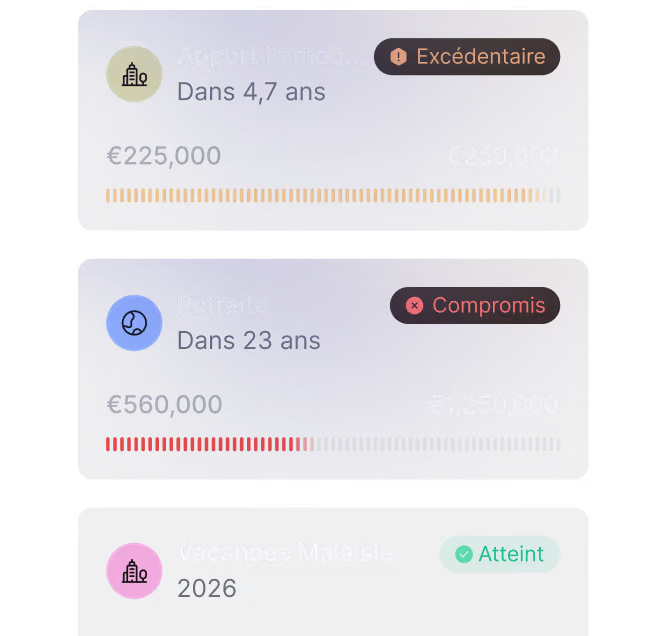
Plan your future and reach financial independence with Finary.
- 30-year simulation : our advanced algorithms run 5,000 scenarios to determine how your net worth evolves and the age at which you reach financial independence.
- Personalised goals : set your own wealth milestones.
- Tracking and suggestions : see how your investments bring you closer to your goals and get suggestions from Finary.

Frequently asked questions
How do you get an income of 500 euros a month from 50,000 euros?
To get an income of 500 euros a month from an initial 50,000 euros, you first have to work out the return needed. On a monthly basis, 500 euros represents 6,000 euros a year. Dividing 6,000 by 50,000 gives an annual return of 12%.
Note that achieving a return that high generally requires taking on more risk. The investments to consider include equities, investment funds or structured products. Consulting an authorised financial adviser is recommended, to discuss the best options for your profile and your risk tolerance.
How do you get an income of 1,000 euros a month from 50,000 euros?
To generate an income of 1,000 euros a month from a capital of 50,000 euros, the annual return required is 24%. That level of return is generally hard to reach without taking considerable risk.
Achieving a 24% annual return consistently is not realistic over the long term and implies a very high risk of losing all your capital. It is still crucial to assess how relevant such investments are to your financial situation and your risk appetite. A conversation with a wealth management expert can help you identify the strategies best suited to your profile.
Which investment should you choose to grow 50,000 euros risk-free?
Regulated savings accounts (Livret A, LDDS) are the only investments with no risk of capital loss, but their ceilings of €22,950 and €12,000 do not allow 50,000 euros to be placed in full. Life insurance euro funds offer more capacity, with an average return of 2.6% in 2025 according to France Assureurs.
How long does it take to double 50,000 euros through compound interest?
Under the rule of 72, divide 72 by the annual rate of return to estimate the doubling time. At 7% a year, 50,000 euros doubles in around 10 years; at 4% a year, it takes around 18 years, before tax and inflation.
Sources
Service-Public.fr, Livret A: rate, ceiling and how it works
Service-Public.fr, life insurance policies: how they work and how they are taxed
Impots.gouv.fr, investment income
Impots.gouv.fr, disposals of securities
Regulatory disclaimers: Marketing communication. Investing carries a risk of partial or total capital loss. Past performance is not a reliable indicator of future performance. This article is provided for information and educational purposes only; it does not constitute personalised investment advice, or tax advice.
Before investing, read the Key Information Document (KID) and, where relevant, consult an authorised adviser.
Finary SAS, an investment firm authorised by the ACPR (no. 19283), member of AMAFI. Insurance broker registered with ORIAS (no. 21001279), member of the CNCGP (association approved by the AMF). Crypto-Asset Service Provider (CASP, "PSCA" in French) authorised by the AMF under the MiCA regime, references no. A2026-026 and no. N2026-008.