


What pension for a €3,500 net salary in France?

Updated on 5 August 2026
With a €3,500 net monthly salary in France, the retirement pension works out in practice at around €2,450 net a month, a replacement rate of about 70%, in line with the projections of the Conseil d'orientation des retraites (COR), for a full career at the full rate. The theoretical calculation at a constant salary produces a higher ceiling (around €2,770 net), rarely reached because the average career salary is lower than the final salary. This guide details the calculation and the savings solutions available.

- The calculation rests on two pillars: the basic pension (about 50% of the average gross salary) and the Agirc-Arrco supplementary pension, calculated in points.
- The 2023 pension reform raises the legal retirement age to 64, but that timeline is suspended until 2028 for the 1964-1968 generations.
- An incomplete career, a career break, or physically demanding work can reduce the pension or allow an earlier retirement.
- Life insurance and the PER (France's retirement savings plan) can supplement retirement income, with favourable tax treatment after several years of holding.
- The final amount also depends on gender and career length: women receive, on average, a lower pension than men.
How to calculate the pension for a €3,500 net salary?
The calculation combines two elements: the basic pension, about 50% of the average gross salary, and the Agirc-Arrco supplementary pension, calculated from the points accumulated over the career.
Basic pension for a €3,500 net salary
In France, the net salary represents about 77% of the gross salary on average. So a €3,500 net salary corresponds approximately to a gross salary of €4,545. Let's use this figure as the basis for calculating the basic pension.
The number of quarters required for the full rate is currently 172 (172 quarters for generations born from 1965 onward, currently reduced to 170-172 depending on year of birth because the reform's timeline is suspended until 2028). The simplified theoretical calculation (€4,545 gross x 50%) would give €2,272.50 gross a month, but the basic pension under the régime général is capped at 50% of the French social security ceiling (PASS), or €2,002.50 gross a month maximum in 2026: above this salary level, only the supplementary pension keeps increasing (an indicative estimate).
Supplementary pension for a €3,500 net salary
The Agirc-Arrco supplementary pension is calculated in points, using the following formula: annual points = (gross annual salary up to the PASS x 6.20% + the share above the PASS x 17%) / 20.1877 (the 2026 point purchase price). With a gross salary of €4,545 a month, or about €54,545 gross a year, this is the first case in the series where the salary exceeds the annual French social security ceiling (PASS 2026: €48,060 gross): €48,060 gross falls into bracket 1 at 6.20% (€2,979.72 gross), and the remaining €6,485 gross falls into bracket 2 at 17% (€1,102.53 gross), for total contributions of €4,082.25 gross. This amount divided by 20.1877 gives about 202.21 points a year, or about 8,693 points accumulated over a full 43-year career (172 quarters). As of 1 November 2025, the Agirc-Arrco point value is frozen at €1.4386 (value maintained in 2026, with the next revaluation expected on 1 November 2026). The calculation is therefore 8,693 x 1.4386, or about €12,505.75 gross a year and so about €1,042.15 gross a month for the supplementary pension.

What factors affect the pension amount?
Three main factors come into play: the contribution period, the average salary earned over the career, and the regularity of the career path.
Contribution period
The contribution period is one of the key factors affecting the pension amount. Contributed quarters are recorded throughout your working life, and the more quarters counted, the higher the pension amount. The required insured period varies depending on year of birth, and it is essential to have a complete insured period for a full-rate pension.
Average salary
The average annual salary is another key factor in calculating the pension amount. The pension amount is generally based on the 25 best years of salary, and a high monthly salary will contribute to a larger pension. In the case of a €3,500 net salary, this will have a direct impact on the pension amount.
Professional career
The professional career also influences the pension amount. A career statement shows the quarters contributed and the salaries earned throughout your working life. It is essential to check and correct this statement if there are errors, to ensure an accurate and maximum pension.
Taking these factors into account, it is possible to estimate the retirement pension for a €3,500 net salary. That said, it is worth remembering that every individual situation is unique, and amounts can vary depending on the specifics of the career and the legislation.
What are the pension schemes in France?
France distinguishes between the régime général, which covers the majority of private-sector employees, and special schemes specific to certain professions (civil servants, rail workers, the self-employed).
Régime général (general scheme)
The régime général is the main pension scheme in France and covers the majority of salaried workers. It is managed by Social Security and consists of two parts: the basic pension insurance and the supplementary pension insurance.
The basic pension insurance is the base scheme, which pays the basic pension to all employees who have contributed at least one quarter. Contributions depend on the salary, and the replacement rate (the percentage of the salary replaced by the pension) is generally 50%.
In addition to the basic pension insurance, employees also contribute to supplementary schemes such as Agirc-Arrco, to secure a supplementary pension and improve their standard of living in retirement.
Special schemes
The special schemes cover workers who are not covered by the régime général, such as civil servants, rail workers, or the self-employed. These schemes offer specific retirement conditions for their members.
Special schemes include, among others:
- The civil servants' scheme, managed by the CNRACL (Caisse nationale de retraite des agents des collectivités locales - the pension fund for local-government staff)
- The self-employed workers' scheme, managed by the Sécurité Sociale des Indépendants (SSI), which replaced the RSI in 2018 and is now integrated into the régime général
- The specific schemes of state-owned enterprises, such as the RATP, the SNCF, or EDF.
Contributions and benefits vary by scheme, but in general, special schemes offer a higher replacement rate than the régime général, along with more favourable conditions for early or full-rate retirement.
Goals
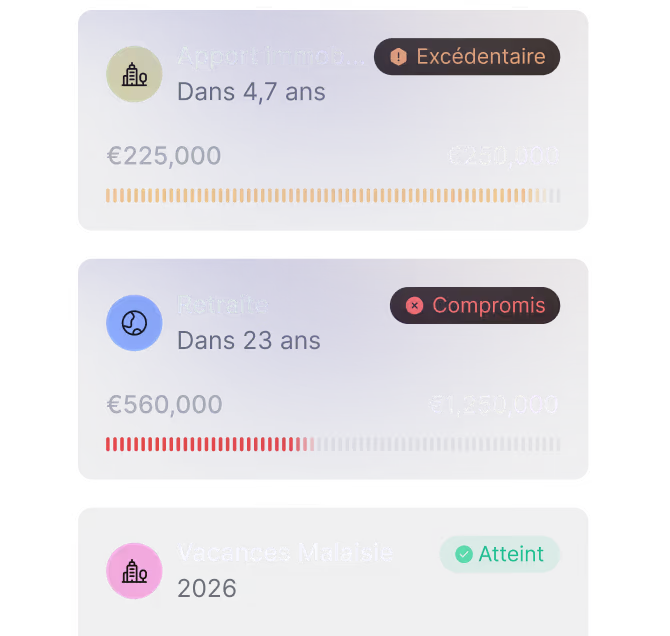
Pension simulator
Pension simulators provide an estimate of the retirement pension for an employee, taking into account their entire career and contributions. According to a Finary / Opinionway survey, 76% of French workers, or nearly 8 in 10, feel they are contributing to a system they will never benefit from, which makes a personalised estimate of their future pension all the more useful. Several tools are available online, and it is worth choosing the one that best suits your needs.
Here are a few worth trying:
If your situation is different, see our simulations for a net salary of €3,000, €4,000 or €5,000 net a month, or for a career on the minimum wage (SMIC).
Savings and other solutions to supplement retirement
Saving is a commonly used option for supplementing retirement income. Employees have several options for saving and supplementing their future pension.
Life insurance is a long-term savings vehicle that lets you diversify your investments within a specific tax framework. After 8 years of holding, gains are subject to favourable tax treatment (the flat tax (PFU) at 7.5% plus social levies at 17.2%, after an annual allowance of €4,600 / €9,200 for a couple) (source: service-public.gouv.fr, as of 20/07/2026).
The retirement savings plans (PER) are also worth considering. They let you build up savings specifically earmarked for retirement, with tax advantages. Contributions made to a PER are deductible from taxable income within certain limits. Note: the savings are locked in until retirement (except in cases of early release) and withdrawals are taxed.
An investment can, depending on the vehicles chosen, aim for long-term returns, in exchange for a risk of capital loss. Investment options include stocks, bonds, rental property, or stakes in unlisted companies. Each type of investment carries different risks and returns; diversification can help spread the risk, without eliminating it. A risk of capital loss exists.
The savings strategies should be adapted to each person's personal and professional situation. It is often advisable to diversify your savings across several types of savings and investment vehicles to spread the risk. Savers can also turn to a regulated Financial Investment Adviser (Conseiller en Investissements Financiers, or CIF) to design a personalised savings strategy tailored to their goals.
within your reach
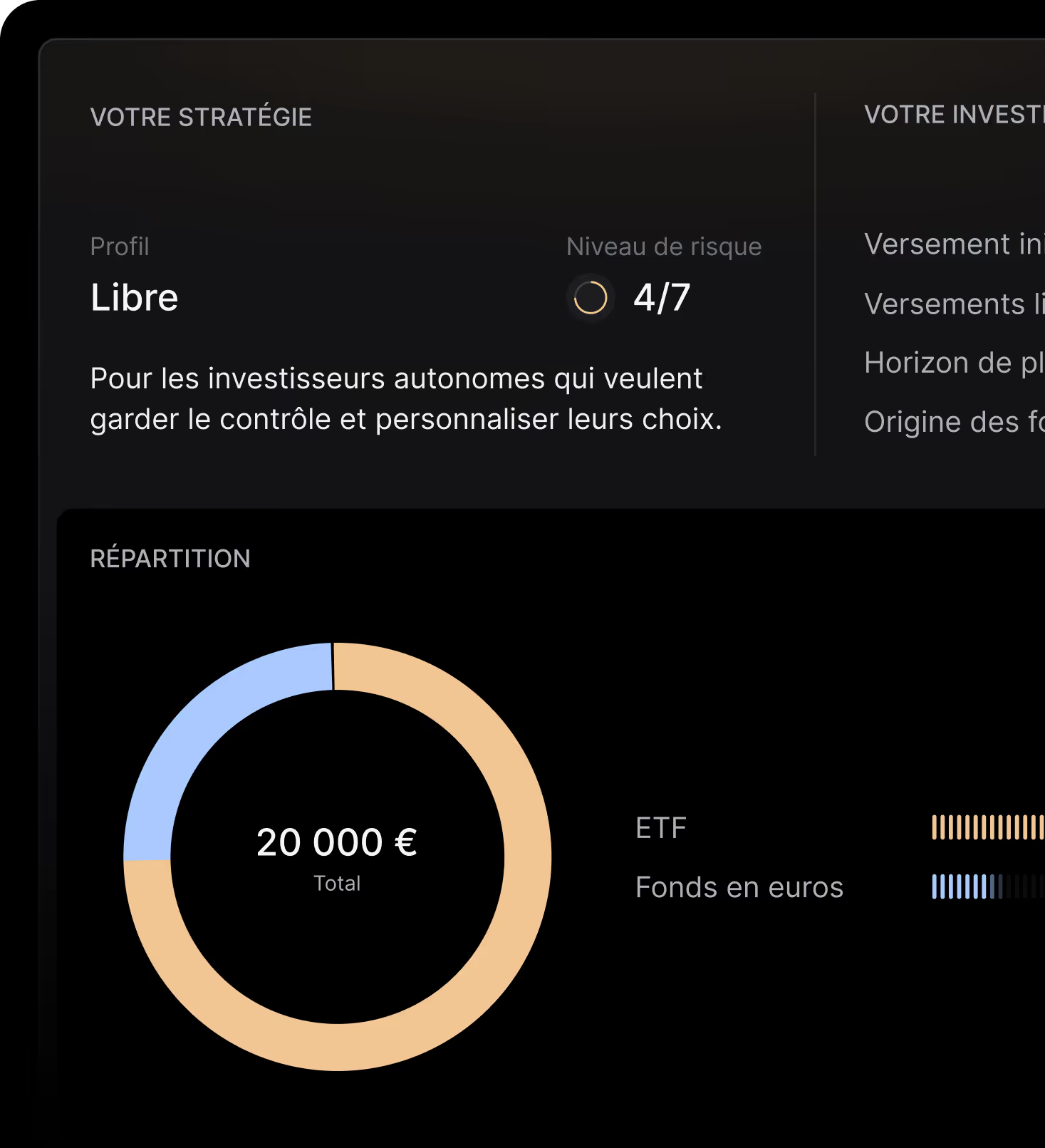
Non-contractual document for promotional purposes. Investment in unit-linked vehicles carries a risk of capital loss, since their value is subject to fluctuation, both upwards and downwards, depending in particular on developments in the financial markets. The insurer commits to the number of units held, not to their value, which it does not guarantee. The e-vie life insurance contract is an individual life insurance contract, denominated in euros and/or unit-linked funds, underwritten by Generali Vie, a company governed by the French Insurance Code. Finary SAS, 58 rue de Monceau 75380 Paris 8, ORIAS no. 21001279
Pension by age and gender
The retirement age and pension amount depend on several factors, such as year of birth, gender, the contribution period, and the legal retirement age. It is important to take these aspects into account to estimate the pension for a €3,500 net salary.
In France, the reform of 14 April 2023 provided for a gradual increase in the legal age from 62 to 64 and in the required contribution period to 172 quarters. The 2026 Social Security Financing Act, however, suspends this phase-in until 1 January 2028: the 1964 to 1968 generations retire at an age between 62 years and 9 months and 63 years and 9 months, with a contribution period reduced to 170-172 quarters depending on year of birth. However, the effective retirement age can vary depending on the contribution period and the specifics of certain occupations. In addition, early retirement is possible if certain conditions are met, such as incapacity to work or physically demanding work.
Gender also plays a role in the pension calculation, mainly because of pay differences and career breaks for family reasons, which are more frequent among women. Women generally have shorter careers, which often results in a lower pension than men's. That said, these differences tend to narrow with social change and progress toward gender equality in the labour market.
As for pension contributions, these are split between the basic pension and the supplementary pension. The basic pension amount is calculated from the average annual salary and the best years of salary, while the supplementary pension depends on the points accumulated over the career.
It is essential to plan your retirement carefully with these factors in mind, in order to better prepare for this period after your working life ends. Despite the uncertainties around how the French pension system will evolve, good preparation and anticipating future needs make it possible to approach this stage of life with better financial preparation.
Frequently asked questions
What is considered a comfortable pension amount?
There is no universal figure; it depends on the standard of living desired. A comfortable pension is generally considered to represent 65% to 85% of the final net salary, according to the projections of the Conseil d'orientation des retraites (COR, 2025 report), to cover everyday needs, leisure, and unforeseen expenses.
What is the pension amount for an average manager-level employee?
The amount depends on the retirement age, the contribution period, and the average salary earned during the career. As a guide, an average manager-level employee would receive a pension of between 50% and 70% of their final net salary, though an online simulator remains the most reliable way to get a personalised estimate.
From what age can you retire at the full rate in 2026?
The legal age is moving toward 64 under the 2023 reform, but its timeline is suspended until 1 January 2028 for the 1964 to 1968 generations, who retire between 62 years and 9 months and 63 years and 9 months depending on their year of birth (service-public.gouv.fr).
Does a €3,500 net salary correspond to a manager-level or non-manager profile?
A €3,500 net monthly salary can correspond to either status. This article's calculation uses a 77% net/gross ratio, an intermediate value applied across all our pension simulations, which gives a gross salary of €4,545 gross a month. A manager-level status, whose employee contributions are slightly higher, would result in a slightly higher gross salary for the same net amount.
Should you prioritise the PER or life insurance to prepare for retirement?
The PER lets you deduct contributions from taxable income but locks up the savings until retirement, whereas life insurance remains available at any time with favourable tax treatment after 8 years. The two can be combined depending on the saver's time horizon and tax objectives.
Sources
Service-public.fr, estimate your pension amount (official simulator)
Agirc-Arrco, calculate my pension (official simulator)
Agirc-Arrco, parameters and statistical data: supplementary pension point value
Service-public.gouv.fr, taxation of life insurance policy proceeds
Finary / Opinionway, survey on French workers' relationship to their pension (28 January 2026)
Regulatory disclaimers: Marketing communication. Investing carries a risk of partial or total capital loss. Past performance is not a reliable indicator of future performance. This article is provided for information and educational purposes only; it does not constitute personalised investment advice, a buy or sell recommendation, or tax advice. The capital guarantee on euro funds is provided by the insurer and depends on its financial strength. In a severe systemic crisis, the French "Sapin 2" law allows withdrawals to be temporarily restricted (liquidity), without affecting the guaranteed capital. Unit-linked funds are not guaranteed and carry a risk of capital loss. Before investing, read the Key Information Document (KID) and, where relevant, consult an authorised adviser. Finary SAS, an investment firm authorised by the ACPR (no. 19283), member of AMAFI. Insurance broker registered with ORIAS (no. 21001279), member of the CNCGP (association approved by the AMF). Crypto-Asset Service Provider (CASP) authorised by the AMF under the MiCA regime, references no. A2026-026 and no. N2026-008.