How to Secure Your Crypto: A Guide to Protecting Your Assets
Updated on 9 July 2026
Securing your cryptocurrencies comes down to three reflexes: keeping the bulk of your assets on an offline cold wallet, enabling strong two-factor authentication, and leaving on exchanges only the funds you need for trading. In 2025, crypto platform hacks exceeded $3.4 billion.

- A cold wallet (Ledger, Trezor) keeps private keys offline and remains the benchmark for long-term storage.
- Two-factor authentication via an app or a physical key is markedly safer than SMS, which is vulnerable to SIM swapping.
- Leaving the bulk of your crypto on a centralised exchange exposes you to hacking, bankruptcy, or frozen withdrawals.
- Recovery phrases should never be stored digitally, only on paper or metal, in several secure locations.
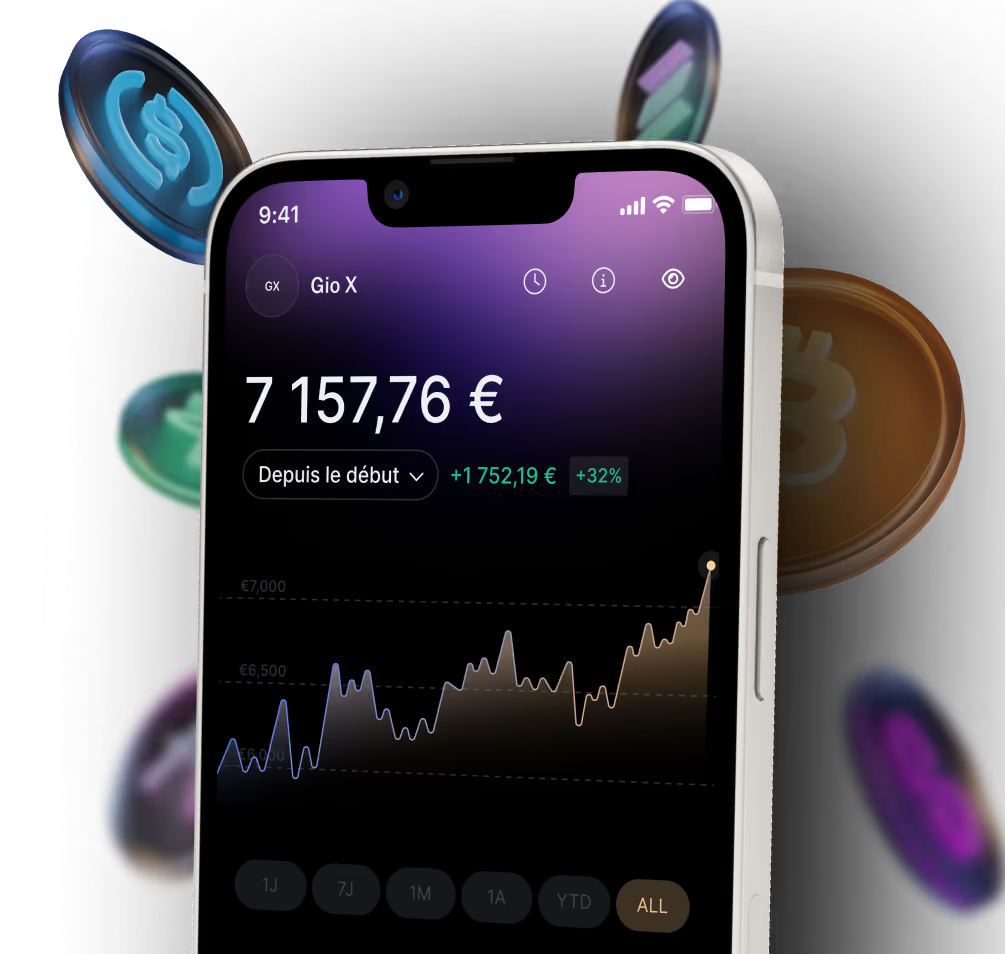
- Finary holds its users' crypto via Bitstamp, a CASP (Crypto-Asset Service Provider) authorised under MiCA, in their own name.
Why is cryptocurrency security so important?
Cryptocurrency security is essential because no central authority can reverse a fraudulent transaction or return stolen funds: the responsibility for security rests entirely on you. Unlike traditional banks, no central authority can recover your funds in the event of theft or loss.
The Bitfinex hack in August 2016 illustrates these stakes perfectly: the theft of nearly 120,000 bitcoins, worth around $72 million at the time, exposed major flaws in the security of cryptocurrency exchange platforms.
Common risks of holding cryptocurrency

The most common threats include:
- Phishing: Attempts to steal your login credentials and recovery phrases.
- Malware: Malicious software designed to steal your private keys.
- Scams: Social-media fraud and fake apps.
Hackers are becoming increasingly sophisticated. In 2024, for instance, the Lazarus Group used advanced social-engineering techniques to compromise the multi-signature wallet of the WazirX exchange, stealing $234.9 million, demonstrating its ability to manipulate complex systems.
Hot wallet vs. cold wallet: the difference
Hot wallets are connected to the internet, which offers speed and convenience for everyday transactions. Think of an app on your phone or computer. Their main advantage is ease of use, but this permanent connection makes them more vulnerable to cyberattacks.
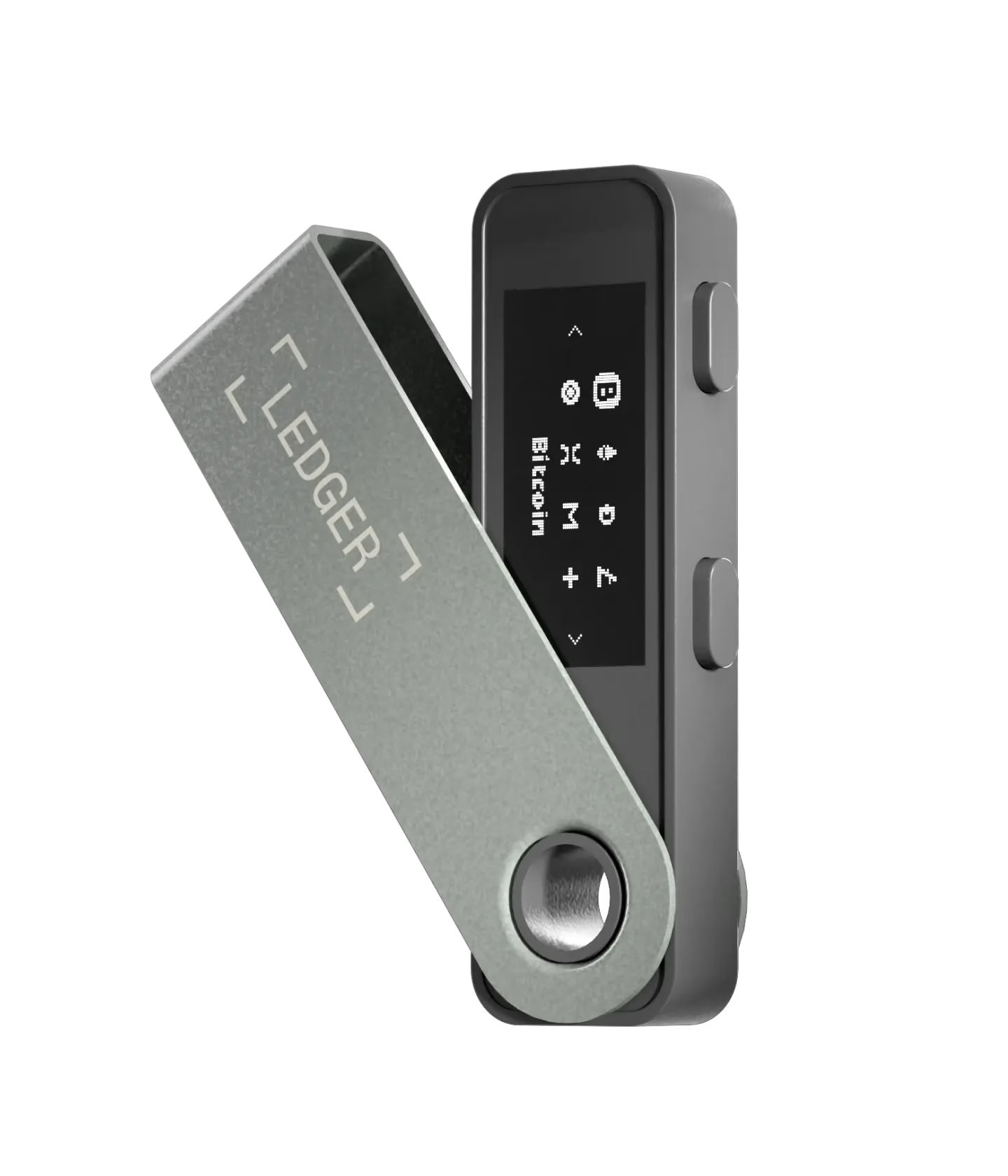
Cold wallets, by contrast, store your cryptocurrencies offline. These physical devices, similar to USB drives, offer stronger security. They suit long-term storage well, but they make everyday transactions less practical.
Common security mistakes beginners make
New investors often take unnecessary risks with their assets. For instance, many store all their cryptocurrencies on exchange platforms, which exposes them if the platform is hacked.
Another common mistake is writing recovery phrases down in unsecured digital files, such as text documents or screenshots. This leaves them vulnerable to hackers who target these types of files.
Finally, some people reuse the same password across several accounts, meaning a single data breach can compromise all of their assets.
How to choose the right wallet to secure your crypto?
The right wallet depends on how you use it: a cold wallet (Ledger, Trezor) for long-term storage, a hot wallet (MetaMask, Coinbase Wallet) for frequent transactions, always checking the manufacturer's reputation and the security features on offer.
What is a crypto wallet and how does it work?
A crypto wallet does not directly store your cryptocurrencies. Instead, it holds the private keys that prove you own them.
These keys are essential, as they let you access and manage your assets on the blockchain. Each wallet also generates a public key, which serves as an address for receiving funds.
The choice of wallet has a direct impact on the security of your crypto. A compromised wallet can lead to the total loss of your assets. The Atomic Wallet hack in 2023, with losses estimated at more than $100 million according to on-chain analyses, is a perfect illustration of this.
with full confidence
Investing carries risks, including the risk of capital loss. Crypto-assets are highly volatile: you may lose some or all of your investment. Past performance is not a reliable indicator of future performance. Finary is authorised as a Crypto-Asset Service Provider (CASP, "PSCA" in French) under the MiCA regime by the AMF.
Different types of wallets: hot, cold, mobile, desktop
Hot wallets are constantly connected to the internet. This connectivity offers great convenience, but it also increases vulnerability. Here are a few examples of hot wallets:
- Mobile wallets (MetaMask, Trust Wallet)
- Desktop wallets (Exodus, Electrum)
- Web wallets built into exchanges
Cold wallets, meanwhile, operate offline, which maximises security. Here are a few examples:
- Secure USB devices (Ledger, Trezor)
- Paper wallets
- "Air-gapped" wallets like SafePal
Even cold storage is not foolproof. The attack suffered by Bybit in February 2025, in which about $1.5 billion in Ethereum was stolen, is alarming proof of that.
Wallet comparison for securing your crypto
Here is an analysis of several options available in 2026:
| Type | Name | Price | Security | Best for |
|---|---|---|---|---|
| Cold | Ledger Nano S Plus | €79 | Very high | Long-term storage |
| Cold | SafePal S1 | €50 | High | Mixed use |
| Hot | Coinbase Wallet | Free | Medium | Frequent transactions |
| Hot | MetaMask | Free | Medium | DeFi, NFTs |
Criteria for choosing a secure wallet
The manufacturer's reputation is the first criterion to consider. Established brands like Ledger or Trezor are recognised for their reliability in security matters.
Here are the essential features to look for:
- Two-factor authentication support
- Data encryption
- Automatic backups
- Multi-currency compatibility
- Responsive customer support
New trends in wallet security
Biometrics is establishing itself as a security standard. Mobile wallets now include facial and fingerprint recognition to validate transactions.
Artificial intelligence is also revolutionising asset protection. Anomaly-detection systems spot suspicious behaviour and automatically block dubious transactions.
Some wallets, such as ZenGo, even use MPC (Multi-Party Computation) technology to eliminate the need for a recovery phrase.
What are the best practices for securing your cryptocurrencies?
Best practice means protecting your private keys and recovery phrases offline, using strong, unique passwords, and systematically enabling two-factor authentication on every platform.
Protecting your private keys and recovery phrases
Protecting your private keys and recovery phrases is crucial to the security of your cryptocurrencies. Losing a private key means permanently losing your funds.
Here are proven methods for securing this sensitive data:
- Keep your recovery phrases on paper or metal, and never in digital format.
- Split your recovery phrase into several parts and keep them in different secure locations.
- Never share this information, not even with customer support.
Using strong, unique passwords
Using weak passwords is a major vulnerability. In 2024, compromised private keys (stolen passwords, credentials or recovery phrases) accounted for more than 40% of total losses from cryptocurrency hacks. A strong password is therefore essential to protect your digital assets.
A password manager such as 1Password or Bitwarden can help you generate and store these complex passwords securely.
Enabling two-factor authentication (2FA)
Enabling two-factor authentication adds an extra layer of security. According to Microsoft, multi-factor authentication (MFA) makes an account more than 99.9% less likely to be compromised (2019 study). Two-factor authentication is therefore a powerful tool for protecting your account.
Here are the 2FA options, ranked by security:
- Physical security key
- Authenticator apps (Google Authenticator, Authy)
- SMS (avoid if possible, as it is vulnerable to SIM swapping)
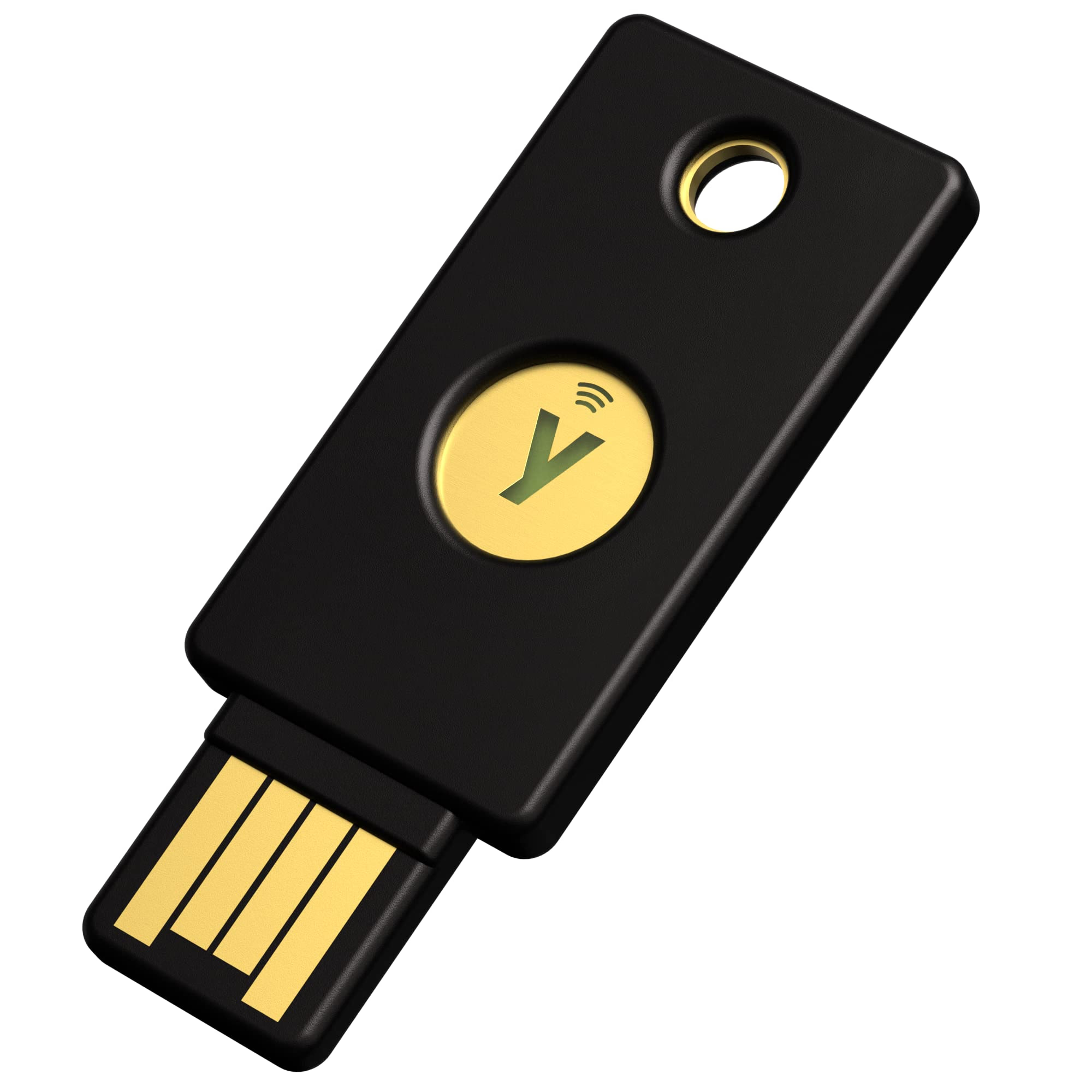
An added benefit of physical security keys: a key like YubiKey can secure not only your cryptocurrency platforms but also other online services (email, social media, cloud storage), offering universal, centralised protection across several sensitive accounts.
How to secure your crypto on exchange platforms?
Securing your crypto on an exchange means keeping only the funds you strictly need for trading there, choosing a reputable, regulated platform like Finary, and favouring a personal cold wallet for long-term storage.
The risks of leaving your crypto on an exchange
The recent Bybit hack in February 2025, in which 401,000 ETH (around $1.5 billion) was stolen, illustrates the dangers of keeping your cryptocurrencies on centralised exchange platforms. Despite their security measures, these platforms remain prime targets for hackers.
Here are the main risks to consider:
- Server hacks at the exchange.
- Platform bankruptcy, resulting in the loss of your funds (FTX being the most recent example)
- Withdrawal freezes during periods of high volatility, preventing you from accessing your assets.
- Loss of account access, whether due to a forgotten password or a compromised email address.
How to choose a secure exchange platform
Finary (a Crypto-Asset Service Provider (CASP, "PSCA" in French) authorised by the AMF under MiCA, ref. A2026-026 and N2026-008) offers custody of your crypto assets via its partner Bitstamp. Bitstamp is authorised as a CASP under MiCA by the Luxembourg CSSF and operates in France via the European passport, overseeing the custody of your digital assets.
Your crypto is held in your own name, not in Finary's name. So, in the event of Finary's bankruptcy, your cryptocurrencies remain your exclusive property and cannot be used to repay Finary's creditors.
Reputation and transparency are paramount. For example, Kraken keeps 95% of its users' funds in "cold wallets" (offline wallets) (verified in July 2026), and maintains constant monitoring of its servers, 24 hours a day, 7 days a week.
To go further in your choice, see our comparison guide to the best cryptocurrency platforms on the market. You'll find a ranking based on security, fees and features on offer. To get started, our complete guide to investing in crypto also covers the taxation and fees to expect.
Strategies to minimise risk on exchanges
A common practice is to keep on the exchange platform only the funds you need for trading. For example, if you hold €10,000 in cryptocurrencies, limit yourself to a maximum of €2,000 on the exchange.
Alternatives to centralised exchanges: decentralised exchanges
DEXs, such as Uniswap or dYdX, are an alternative to centralised platforms, with a different risk profile. These platforms operate without a central intermediary, which considerably reduces the risk of large-scale hacking.
The table below compares the main characteristics of centralised (CEX) and decentralised (DEX) exchanges:
| Aspect | Centralised Exchange (CEX) | Decentralised Exchange (DEX) |
|---|---|---|
| Custody of funds | Platform | User |
| Hacking risk | High | Low |
| Ease of use | Simple | More complex |
| Liquidity | High | Variable |
| KYC (identity verification) required | Yes | No |
DEXs do have their own challenges, though: a sometimes less intuitive interface, transaction ("gas") fees that can be high on Ethereum, and the need to properly manage your own private keys. Once your crypto is secure, see our guide to cryptocurrency taxation to anticipate how it's taxed.
finally regulated
Investing carries risks, including the risk of capital loss. Crypto-assets are highly volatile: you may lose some or all of your investment. Past performance is not a reliable indicator of future performance. Finary is authorised as a Crypto-Asset Service Provider (CASP, "PSCA" in French) under the MiCA regime by the AMF.
Security: an ongoing habit
A crypto wallet is never safer than the user protecting it. A cold wallet for long-term storage, strong two-factor authentication and vigilance against phishing are enough to rule out the vast majority of hacks.
The best protection remains the simplest: never expose a private key or recovery phrase, and only entrust an exchange with what you need for trading.
Frequently asked questions
What is the safest wallet for storing cryptocurrencies?
A cold wallet like a Ledger or a Trezor remains the safest solution: the private keys never leave the device and stay offline. For everyday use, a hot wallet like MetaMask is enough as long as the amounts stored remain limited.
What should you do if you lose your recovery phrase?
If the wallet is still accessible, you must immediately transfer the funds to a new wallet and generate a new recovery phrase. If access to the wallet is also lost, the funds tied to the old phrase become permanently inaccessible.
Can you recover your cryptocurrencies after a hack?
It's very rare: a transaction on the blockchain cannot be reversed. Some specialised teams sometimes manage to get part of the stolen funds frozen at exchanges, but the best protection remains prevention, before any hack happens.
Is SMS two-factor authentication enough?
No: SMS-based 2FA remains vulnerable to SIM swapping, a technique that lets an attacker take over the victim's phone number. An authenticator app (Google Authenticator, Authy) or a physical security key like a YubiKey is preferable.
How can you spot a phishing attempt targeting your cryptocurrencies?
An urgent message asking for a recovery phrase, a private key or a password is almost always phishing: no legitimate platform ever asks for this information. Always check the exact URL, too, before entering your credentials on a site.
Sources
Chainalysis, 2025 Crypto Theft Reaches $3.4 Billion
QuillAudits, analysis of the WazirX hack (Lazarus Group, 2024)
Elliptic, analysis of the Atomic Wallet hack (2023)
Chainalysis, analysis of the Bybit hack (February 2025)
CoinDesk, private key compromise and 2024 crypto losses
Microsoft, Your Pa$$word doesn't matter (Alex Weinert)
Kraken, A guide to protecting your crypto assets
AMF, PSCA whitelist (Finary SAS)
Regulatory disclaimers: Marketing communication. Investing carries a risk of partial or total capital loss. Past performance is not a reliable indicator of future performance. This article is for informational and educational purposes only; it does not constitute personalised investment advice, a buy or sell recommendation, or tax advice. Crypto-assets are highly volatile and carry a risk of total capital loss. They are not covered by any capital guarantee, nor by deposit guarantee or investor compensation schemes. Before investing, read the Key Information Document (KID) and, where relevant, consult an authorised adviser. Finary SAS, an investment firm authorised by the ACPR (no. 19283), member of AMAFI. Insurance broker registered with ORIAS (no. 21001279), member of the CNCGP (association approved by the AMF). Crypto-Asset Service Provider (CASP) authorised by the AMF under the MiCA regime, references no. A2026-026 and no. N2026-008.