What Are Altcoins? A Complete Guide for Beginners
Updated on 15 July 2026
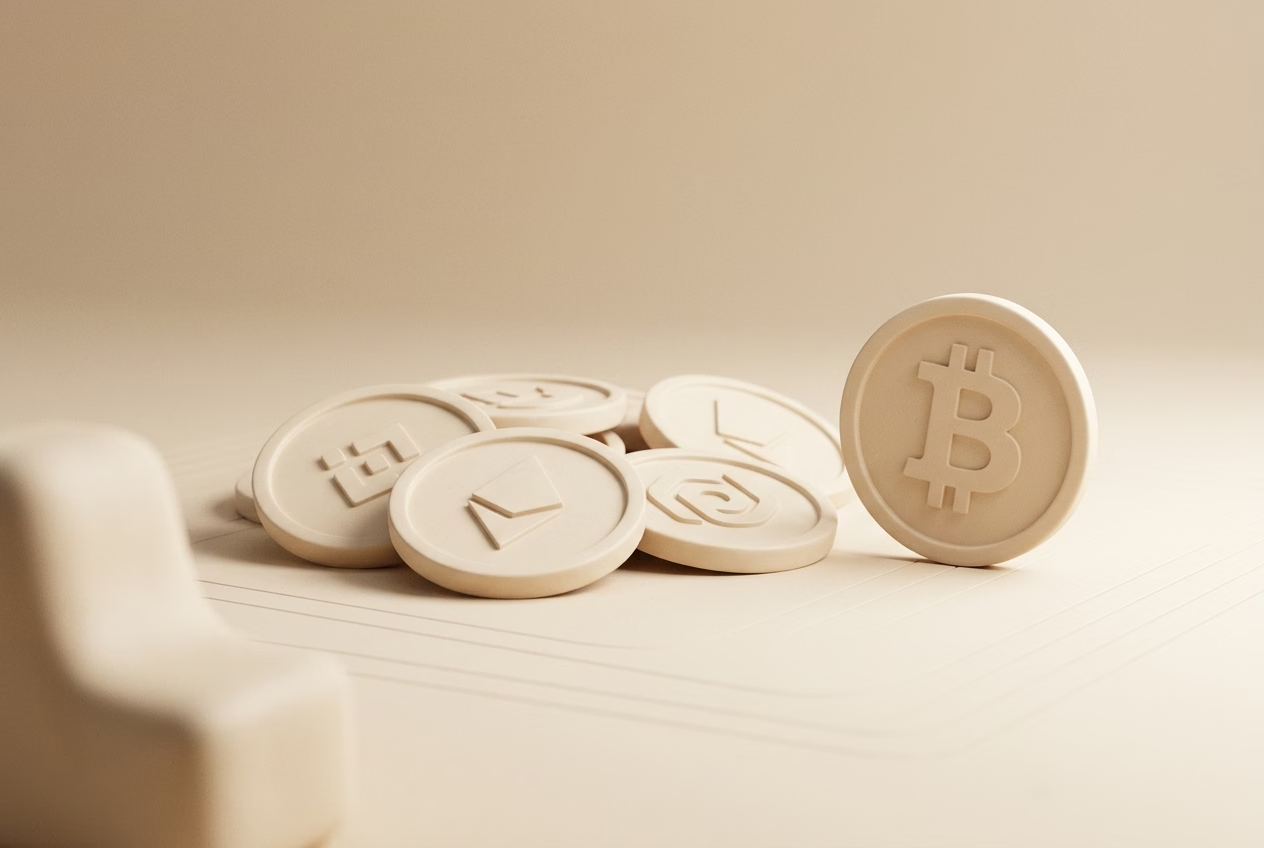
An altcoin is any cryptocurrency other than Bitcoin, designed to improve on or complement its features. This guide covers the main categories of altcoins, their uses, and the risks to know before investing.

- More than 17,000 active cryptocurrencies exist today, each addressing a distinct use case (payments, smart contracts, governance, storage).
- Altcoins fall into several categories: Bitcoin competitors, infrastructure blockchains, utility tokens, governance tokens and meme coins.
- Their volatility is generally higher than Bitcoin's, with a greater risk of capital loss for less mature projects.
- Evaluating an altcoin means combining fundamental analysis (team, technology, adoption) with technical analysis (historical price trends).
- Diversifying across several altcoins does not remove market risk, it only spreads it across several projects.
What are altcoins?
Altcoin definition
Altcoins, or "alternative coins", refer to all cryptocurrencies other than Bitcoin. They are created to improve on or complement Bitcoin's limitations. Altcoins stand out through their diversity in technology, protocol and purpose.
Some aim to offer faster, cheaper transactions, while others focus on anonymity or on building smart contracts.
History and origins of altcoins
Altcoins emerged shortly after Bitcoin launched in 2009. Litecoin (LTC), launched in 2011, was one of the first altcoins, introducing faster transactions and a higher maximum supply.
Over the years, thousands of altcoins have emerged. Each one brings specific innovations, from decentralized finance (DeFi) to non-fungible tokens (NFTs).
Why altcoins matter in the crypto ecosystem
Altcoins play a crucial role in diversifying cryptocurrency investments. They offer investors a wide range of options to explore different use cases and technologies.
Altcoins are also often behind major technological innovations. For example, smart contracts on Ethereum or Cardano's scalability solutions contribute to the evolution and maturation of the whole blockchain ecosystem.
More than 17,000 cryptocurrencies exist today according to aggregated industry data, each bringing unique features to improve on or complement Bitcoin's limitations.
What are the different types of altcoins?
Altcoins fall into six broad families: direct Bitcoin competitors, infrastructure blockchains, utility tokens, governance tokens and meme coins.
Bitcoin-competitor altcoins
Some altcoins are direct derivatives of Bitcoin, created through forks of the original network. Bitcoin Cash (BCH), for example, emerged in 2017 with an 8 MB block size for faster, cheaper transactions than Bitcoin. That limit has since been raised to 32 MB, with an automatic adjustment mechanism (ABLA) active since 2024.
Likewise, Litecoin (LTC), designed as the "silver" to Bitcoin's "gold", offers faster transactions and a maximum supply of 84 million tokens.
Infrastructure blockchain altcoins
Infrastructure blockchain altcoins aim to build robust platforms for decentralized applications (dApps) and smart contracts.
Ethereum (ETH), the leader in this space, enables the creation of smart contracts and dApps via its programmable blockchain. Its competitors include Solana, which processes up to 65,000 transactions per second, and Cardano, which focuses on security and scalability with its Proof of Stake protocol, Ouroboros.
Utility altcoins
Utility altcoins bring specific solutions to unique problems.
Chainlink, for example, is a decentralized oracle network that connects smart contracts to external data sources.
Filecoin, meanwhile, offers a decentralized alternative to traditional cloud storage services. It uses blockchain to create a marketplace for digital storage space.
Governance altcoins
Some altcoins play a key role in governing decentralized platforms. Uniswap (UNI), used on the Uniswap decentralized exchange, lets holders take part in decisions on the protocol's development and funding.
Likewise, Aave uses its AAVE token to govern its decentralized lending protocol, letting users vote on improvements to the system.
Meme coins
Meme coins, such as Dogecoin and Shiba Inu, gained popularity through viral campaigns and community engagement.
Originally created as a joke, Dogecoin saw explosive popularity despite lacking significant functionality. These coins carry high risks because of their extreme volatility and their sensitivity to social-media trends.
with full confidence
Investing carries risks, including the risk of capital loss. Crypto-assets are highly volatile: you could lose some or all of your investment. Past performance is not a reliable indicator of future performance. Finary is authorised by the AMF as a Crypto-Asset Service Provider (CASP, "PSCA" in French) under the MiCA regime.
Main altcoins and their characteristics
Ethereum (ETH)
Key features and uses
Ethereum is the leading blockchain platform for smart contracts and decentralized applications (dApps). Thanks to its Solidity programming language and the EVM (Ethereum Virtual Machine), it enables the automation of complex agreements and interoperability with different blockchains.
Position and growth in the crypto market
Ethereum has a robust infrastructure, even surpassing Tron for Tether (USDT) transactions. With Ethereum 2.0, scalability and efficiency are improving notably.
Cardano (ADA)

Overview and technical features
Cardano, developed by Charles Hoskinson, uses a scientific method to tackle the challenges of scalability and energy efficiency.
Its two-layer architecture separates payment operations from data processing, using Ouroboros to secure staking.
Recent performance and developments
Cardano has developed significantly with the Chang upgrade (2024), strengthening the network's decentralization. Layer-2 scaling solutions, such as Hydra, increase transaction throughput. ADA saw high volatility in 2024 (source: CoinMarketCap). Past performance is not a reliable indicator of future performance.
Polkadot (DOT)
Features and use cases
Polkadot stands out for its interoperability across different blockchains.
Using parachains to process transactions in parallel, it secures the transfer of data and assets between blockchains. DOT holders can stake to secure the network and take part in governance.
Adoption and market value
Polkadot stands out with an open governance system, where holders can vote on and fund projects. Its growing ecosystem and numerous partnerships are driving its adoption. Polkadot appeals to developers looking for scalable solutions.
Solana (SOL)
Strengths and areas of application
Solana is renowned for its ability to process thousands of transactions per second at minimal cost. Solana uses advanced validation mechanisms to ensure fast, secure transactions.
Technological progress and adoption
Solana is popular in DeFi and gaming, thanks to its scalability. Its innovations, such as proof of history and sharding, keep it competitive. Growing interest in Solana is also supported by innovative projects and partnerships.
Hedera (HBAR)
Key features
Hedera Hashgraph uses a technology alternative to blockchain, offering fast, efficient consensus without proof of work or proof of stake. Capable of handling more than 10,000 transactions per second, Hedera stands out for its decentralized governance.
Recent developments and adoption
Hedera shows notable adoption through strategic partnerships, including with Google, IBM and LG. Dubai's DIFC is integrating Hashgraph technology for digital-will solutions. The HBAR token is used for network fees, governance, asset tokenization and audit solutions.
To discover the most promising cryptocurrencies of 2026 and their future outlook, see our full guide to high-potential cryptocurrencies.
How to evaluate an altcoin
Evaluating an altcoin means weighing several criteria: past performance (with no guarantee on future results), the quality of the development team, and the strength of the user community.
The development team also plays a crucial role: an experienced, well-connected team is often a sign of success. The user community matters too, since strong, engaged support can propel a project forward.
Technical vs fundamental analysis
Technical analysis focuses on historical price trends and various indicators to predict future movements. It uses charts and models to identify buying or selling opportunities.
By contrast, fundamental analysis examines the altcoin's intrinsic value by looking at aspects such as the underlying technology, adoption, partnerships and use cases. Combining both approaches can offer a more complete picture.
Tools and resources for evaluating altcoins
Various tools and resources can help evaluate altcoins properly. Websites such as Finary and CoinMarketCap offer valuable data on altcoin market capitalization, trading volumes and price trends.
Platforms such as GitHub make it possible to track a project's development activity, revealing the team's momentum. Finally, forums and social networks such as Reddit, Twitter and Discord can provide useful signals.
Risks and opportunities
Risks associated with altcoins
Investing in altcoins carries several risks. Market volatility is a major factor: according to CoinMarketCap, altcoins accounted for about 41.6% of total cryptocurrency market capitalization as of 15 July 2026, a balance that can shift quickly within a few weeks.
What's more, not all projects succeed in the long run; some can fail due to poor management, limited adoption or technical issues. Finally, regulatory developments can have a significant impact on prices, introducing further uncertainty for investors.
Investment opportunities
Altcoins can present investment opportunities, but also a greater risk than Bitcoin, particularly for projects with innovative technology and solid use cases.
For example, altcoins linked to decentralized finance (DeFi) or to scalability solutions benefit from strong demand. Furthermore, new technologies, such as smart contracts and advanced consensus protocols, may be of interest to informed investors, with no guarantee of returns and a risk of capital loss.
at your own pace
Investing carries risks, including the risk of capital loss. Crypto-assets are highly volatile: you could lose some or all of your investment. Past performance is not a reliable indicator of future performance. Finary is authorised by the AMF as a Crypto-Asset Service Provider (CASP, "PSCA" in French) under the MiCA regime.
How to invest in altcoins?
Investing in altcoins starts with buying on a regulated exchange platform, then defining a diversification strategy and a gradual entry approach such as DCA.
How to buy altcoins
Several exchange platforms provide access to altcoins, including Finary (a Crypto-Asset Service Provider authorised by the AMF under the MiCA regime, no. A2026-026), Coinbase and Kraken. The buying process is simple: create an account on one of these platforms, verify your identity, deposit funds via bank transfer or credit card, and buy the altcoins of your choice.
Don't forget to transfer your altcoins to a secure wallet after buying them.
Investment strategies
Diversifying a portfolio across several altcoins can help spread risk, without eliminating it. Some investment approaches exist, such as DCA (Dollar-Cost Averaging), which consists of investing fixed amounts on a regular basis.
Staying regularly informed about market news can help you make informed choices. Risk of capital loss.
Altcoins expand the crypto ecosystem well beyond Bitcoin: new technologies, new uses, and a range of risks to weigh before every investment decision.
Diversification, fundamental analysis and risk management remain an informed investor's best allies, bearing in mind the high risk of capital loss inherent to altcoins.
Frequently asked questions
What is the difference between an altcoin and a token?
An altcoin refers to a cryptocurrency with its own blockchain, such as Ethereum or Solana. A token, by contrast, is issued on an existing blockchain (via standards such as ERC-20 on Ethereum) without having its own network. So not all altcoins are tokens, and vice versa.
Are altcoins riskier than Bitcoin?
Yes, most altcoins show higher volatility than Bitcoin, particularly recent or thinly traded projects. Some, such as meme coins, depend almost entirely on social trends rather than technical utility, which increases the risk of capital loss.
Should you favour large-cap altcoins?
Large-cap altcoins (Ethereum, Solana, Cardano) generally benefit from greater liquidity and technological maturity than smaller projects, which reduces some risks without eliminating them. Low-cap projects remain more volatile and more exposed to failure.
How do you store altcoins securely?
After buying, it is recommended to transfer altcoins to a personal wallet rather than leaving them on an exchange platform. This reduces exposure to the risk of hacking or platform failure.
Are meme coins real altcoins?
Yes, technically meme coins such as Dogecoin are altcoins since they are not Bitcoin. They differ, however, in their frequent lack of concrete technical utility, with their value resting mainly on community popularity and social-media trends.
Sources
CoinMarketCap, Global Charts (Bitcoin/altcoin dominance)
CoinMarketCap, Number of Cryptocurrencies Tracked
Chainspect, Solana Network Statistics
DIFC Courts, Digital Assets Will Launch
AMF, PSCA whitelist, Finary SAS
Regulatory disclaimers: Marketing communication. Investing carries a risk of partial or total capital loss. Past performance is not a reliable indicator of future performance. This article is provided for information and educational purposes only; it does not constitute personalised investment advice, a buy or sell recommendation, or tax advice. Crypto-assets are highly volatile and carry a risk of total capital loss; they are not covered by any capital guarantee or by deposit guarantee or investor compensation schemes. Before investing, read the Key Information Document (KID) and, where relevant, consult an authorised adviser. Finary SAS, an investment firm authorised by the ACPR (no. 19283), member of AMAFI. Insurance broker registered with ORIAS (no. 21001279), member of the CNCGP (association approved by the AMF). Crypto-Asset Service Provider (CASP) authorised by the AMF under the MiCA regime, references no. A2026-026 and no. N2026-008.