What Is a Crypto Airdrop? Everything You Need to Know

Updated on 15 July 2026
A crypto airdrop is a free distribution of tokens directly into the wallets of eligible users, usually to reward the adoption of a blockchain protocol. This guide explains the different types of airdrops, how to participate safely, and their tax treatment in France.

- An airdrop differs from an ICO or an IDO in that it's free: no investment is required to receive the tokens.
- About 88% of tokens distributed via airdrop lose value in the months following their launch, according to a Keyrock analysis of 62 airdrops in 2024.
- In France, tokens received are taxed as income at their value on receipt, and any capital gain on resale then falls under the flat tax (PFU) at 31.4%.
- Being wary of airdrops that ask for your recovery phrase or a fee to unlock the tokens remains the best protection against scams.
- Diversifying your interactions across several blockchains (Ethereum, Arbitrum, Polygon) increases your chances of being eligible for future airdrops.
How does a crypto airdrop work?
A crypto airdrop works in three steps: a blockchain project takes a snapshot of eligible addresses, applies its selection criteria, then automatically distributes the tokens or makes them available to be claimed.
What is a crypto airdrop and how does it work?
A crypto airdrop is a free distribution of tokens or cryptocurrencies directly into the digital wallet of eligible users.
This practice is akin to marketing in the blockchain world. Projects send their tokens to specific addresses, usually to reward certain behaviours or encourage adoption of their protocol.
Here are the key steps of the process:
- The project takes a snapshot, meaning an instant picture of the blockchain at a specific moment.
- This capture is used to identify eligible addresses according to predefined criteria.
- The tokens are then distributed automatically via smart contracts, or must be claimed manually by users.
The origins of crypto airdrops
The first major airdrop dates back to 2014 with Auroracoin in Iceland. This ambitious project aimed to create a national cryptocurrency by distributing tokens to every Icelandic citizen. Although the initiative did not last, it established the template for modern airdrops.
The rise of airdrops took place during the 2017-2018 ICO boom. Projects were then looking for alternatives to traditional fundraising as regulatory restrictions grew. This period saw the emergence of the first large-scale marketing airdrops.
Airdrops, ICOs and IDOs: what are the differences?
The table below highlights the main differences between airdrops, ICOs (Initial Coin Offerings) and IDOs (Initial DEX Offerings):
| Feature | Airdrop | ICO | IDO |
|---|---|---|---|
| Cost to the user | Free (excluding transaction fees) | Investment required | Investment required |
| Selection | Predefined criteria | Open to everyone | Whitelist often required |
| Distribution | Immediate | Gradual | Gradual |
| Main objective | Adoption and engagement | Fundraising | Decentralised fundraising |
In short, airdrops stand out through being free and aiming for adoption, while ICOs and IDOs aim to raise funds.
Why projects use airdrops
Airdrops serve several strategic goals for blockchain projects:
- Decentralising governance: By distributing their tokens widely, projects build a diverse base of holders who can take part in decisions.
- User acquisition: Airdrops make it possible to quickly attract a critical mass of users. For example, Uniswap gained more than 250,000 active users within days of its September 2020 airdrop.
- Viral marketing: The promise of free tokens generates significant buzz on social media. ENS's 2021 airdrop sparked massive enthusiasm on social media, with a spike in Twitter mentions in the days following the announcement.
- Testing the infrastructure: Waves of airdrop claims make it possible to test the robustness of smart contracts and user interfaces under real conditions.
Modern projects often build in retention mechanisms, such as gradual token vesting or staking bonuses, to turn recipients into engaged, long-term users.
with full confidence
Investing carries risks, including the risk of capital loss. Crypto-assets are highly volatile: you may lose some or all of your investment. Past performance is not a reliable indicator of future performance. Finary is authorised as a Crypto-Asset Service Provider (CASP, "PSCA" in French) under the MiCA regime by the AMF.
What are the different types of crypto airdrops?
There are five main categories of airdrops: those based on token holdings, those based on tasks, retroactive airdrops, those linked to blockchain forks and governance-oriented ones.
Holding-based airdrops
Holding-based airdrops reward people who already hold certain cryptocurrencies. The amount received generally depends on the number of tokens held at the moment of a "snapshot" of the blockchain.
For example, in 2018, Blockchain.com partnered with the Stellar Development Foundation to distribute 500 million XLM tokens (100 XLM per user, worth about $25 at the time) to its registered users, one of the largest crypto airdrops of that period.
To be eligible, users often need to hold a minimum number of tokens for a set period. For example, Uniswap required users to have carried out at least one transaction on its protocol before September 2020 to receive 400 UNI tokens.
Task-based airdrops
These airdrops ask participants to complete specific actions to be rewarded. Common tasks include :
- Following the project on social media
- Joining a Telegram or Discord group
- Testing an app's beta version
- Creating promotional content
Shardeum illustrates this approach perfectly. In 2024, its airdrop rewarded users who tested its network by running smart contracts on its EVM-compatible blockchain. These airdrops are a way to encourage active engagement with the project.
Retroactive airdrops
Retroactive airdrops target the earliest users of a protocol. dYdX distributed DYDX tokens to traders based on their historical trading volume.
The higher the volume, the bigger the reward. This strategy aims to build loyalty among the active users who contributed to the project's early success.
Airdrops linked to blockchain forks
When a blockchain forks, holders of the original cryptocurrency automatically receive tokens on the new chain. The Bitcoin Cash fork in 2017 thus created a 1:1 ratio: for every Bitcoin held, users received one Bitcoin Cash.
A fork in a blockchain is a split that creates two parallel versions. The old one continues on its path while the new one follows its own direction.
These airdrops occur during major changes to the protocol, such as :
- Major technical upgrades
- Community disagreements over the project's direction
- Major governance changes
These airdrops are often tied to major events in a blockchain's evolution.
Governance-oriented airdrops : what are the differences ?
Marketing airdrops mainly aim at promotion and fast adoption. Aidoge distributed 174 million tokens in 2023 to generate buzz on Twitter and Telegram.
Governance-oriented airdrops, such as Arbitrum's (ARB), give holders decision-making power over the protocol's evolution. The tokens allow holders to vote on :
- Technical parameter changes
- Allocation of the protocol's revenue
- Strategic partnerships
- Network upgrades
This approach favours long-term engagement over short-term speculation.
How do you participate in a crypto airdrop?
Participating in a crypto airdrop means spotting trustworthy projects through specialised platforms, meeting the eligibility criteria set by the project, then following the official instructions to claim the tokens.
Steps to find reliable airdrops
Finding legitimate airdrops requires a methodical, cautious approach. Specialised platforms such as AirdropAlert or Coinmarketcap offer verified calendars of upcoming distributions. Following the official Twitter accounts of major blockchain projects is also a reliable source of information.
To validate an airdrop's legitimacy, systematically check:
- The project's history and reputation on Github
- The presence of an identifiable, verifiable team
- The existence of detailed technical documentation (whitepaper)
- Community discussions on recognised forums such as Reddit or Discord
finally simple
Investing carries risks, including the risk of capital loss. Crypto-assets are highly volatile: you may lose some or all of your investment. Past performance is not a reliable indicator of future performance. Finary is authorised as a Crypto-Asset Service Provider (CASP) under the MiCA regime by the AMF.
Common eligibility criteria for airdrops
Blockchain projects often set minimum thresholds to take part in airdrops. For example, Uniswap required a minimum of one transaction before September 2020 for its landmark airdrop.
The most common eligibility criteria include:
- Holding a minimum amount of specific tokens
- Active participation in the protocol's governance
- Trading volume on the platform
- How long the wallet has been active on the relevant network
Diversifying your activity across different blockchains increases your chances of qualifying for future airdrops. Arbitrum, for example, rewarded users who carried out more than five transactions on its network.
Platforms and tools for tracking airdrops
Several tools make it easier to discover and track airdrops:
- Airdrops.io offers a verified calendar and rating system
- DappRadar lets you analyse emerging protocols
- CoinGecko offers a dedicated airdrops section with quality filters

The wallet extensions such as Metamask let you manage multiple addresses and monitor opportunities across different chains
Recent airdrop examples and how to take part
The LayerZero airdrop (February 2024) illustrates the participation process well:
- Create a compatible wallet (Metamask)
- Connect to the LayerZero protocol
- Carry out at least three cross-chain transactions
- Maintain a minimum balance for 30 days
- Check eligibility via the official interface
Advantages and risks of crypto airdrops
Advantages of airdrops for users and projects
Airdrops offer considerable benefits to participants. For users, it's a chance to obtain tokens for free, which may later gain value.
Uniswap's airdrop is a good example. The 400 tokens distributed were initially worth about $1,200 and reached an all-time high of about $17,000 (past performance, not representative of the future, high volatility).
For blockchain projects, airdrops are a powerful growth tool. More than 64,000 addresses qualified for dYdX's 2021 airdrop, one of the most generous in DeFi history.
This method of acquiring users is generally far cheaper than traditional marketing methods. Airdrops can therefore be an effective, cost-efficient way to attract new users and drive a project's growth.
Scam risks and how to avoid them
Unfortunately, the airdrop world also attracts plenty of scammers. Here are some common scams:
- Fake mirror sites that imitate legitimate projects
- Airdrops that ask for unusual participation fees
- Malicious tokens that compromise wallets
- "Dusting attack"-style scams
To protect yourself, it's crucial to verify the authenticity of your sources. Only trust a project's official channels, such as its verified Twitter account, official Discord server and main website. Avoid connecting your main wallet to airdrop sites. Instead, create a dedicated wallet with limited funds.
Volatility of tokens received via airdrops
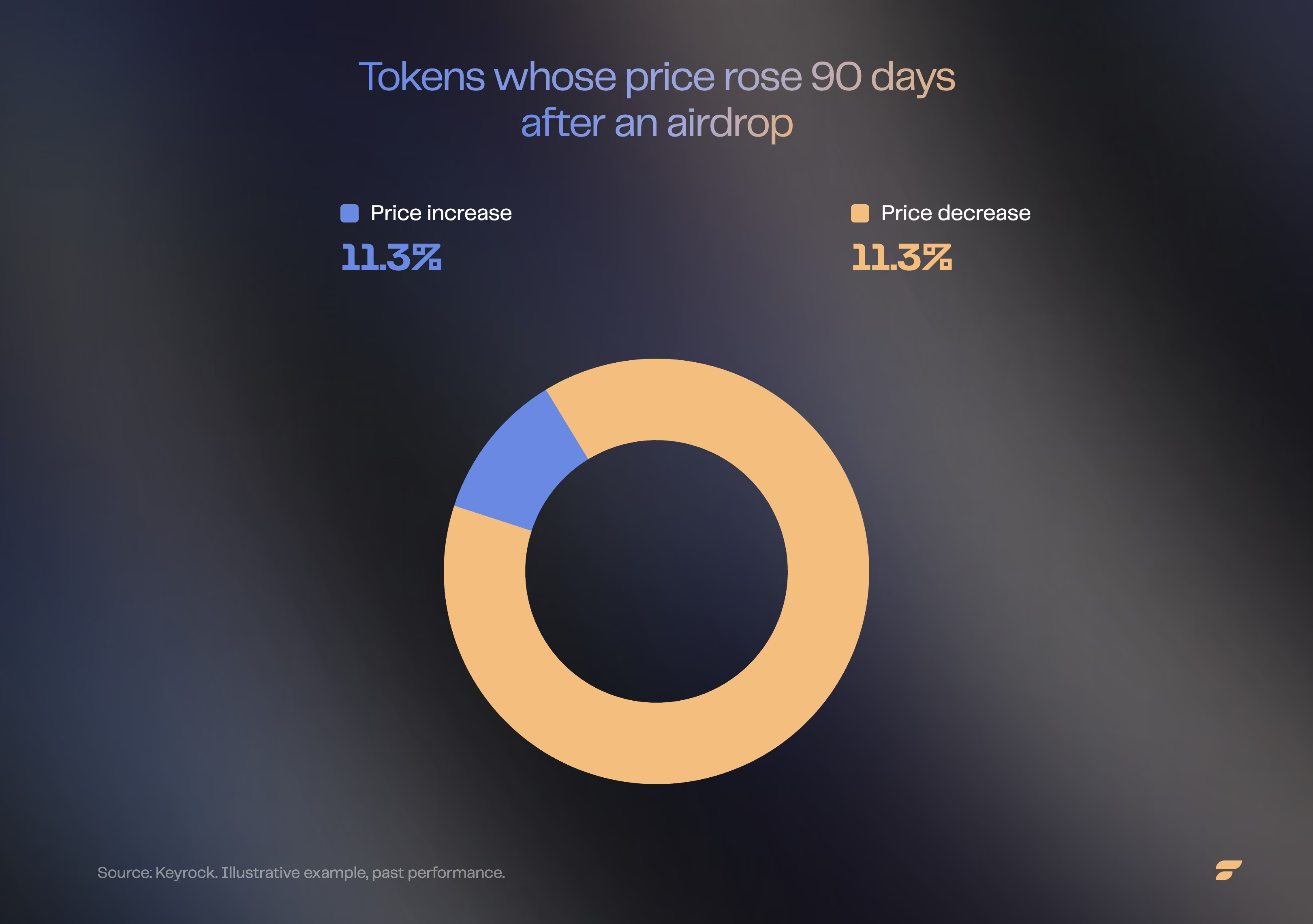
The analysis of 62 major airdrops in 2024 reveals:
- 88% of tokens lose value in the first months after launch
- Only 8 projects (4 on Ethereum and 4 on Solana) maintained positive returns after 90 days
- Most tokens see their highest volatility in the first 15 days after launch
To maximise your gains, a quick sale from day 1 can prove wise, since the vast majority of tokens see their value decline in the following months.
The BLUR token illustrates this volatility: after reaching about $5 on listing day (14 February 2023), it fell below $1 within hours, before stabilising around $0.65-1 in the following days.
finally regulated
Investing carries risks, including the risk of capital loss. Crypto-assets are highly volatile: you may lose some or all of your investment. Past performance is not a reliable indicator of future performance. Finary is authorised as a Crypto-Asset Service Provider (CASP) under the MiCA regime by the AMF.
Tax impact of airdrops and legal obligations
Tax rules on airdrops vary from country to country. In France, tokens received via an airdrop are considered taxable income. Their market value at the time you receive them is what counts.
For example, if you receive 100 tokens worth €10 each, you will need to declare €1,000 of income.
If you sell the tokens later, the 31.4% flat tax applies to the capital gain (source: impots.gouv.fr, 2026). So, if an airdrop initially valued at €1,000 is sold for €5,000, the taxable capital gain will be €4,000.
Strategies for maximising your gains from airdrops
How to spot the most promising airdrops
Identifying high-potential airdrops requires research and analysis. Here are some key indicators to watch:
- The project team: Projects backed by teams with a strong reputation in the crypto ecosystem tend to perform better. For example, the success of the Arbitrum (ARB) airdrop is partly due to its team's reputation for Ethereum optimisation.
- Partnerships: The quality of a project's partnerships is another important signal. When dYdX announced its airdrop, its partnerships with Paradigm and a16z contributed to its initial $2 billion valuation.
- Community engagement: Gauge community interest by watching activity on social media and specialised forums.
To go further, check out our full guide to the promising cryptocurrencies worth investing in during 2025.
How to increase your chances of being eligible for airdrops
To maximise your chances of being eligible for as many airdrops as possible, interact regularly with popular DeFi protocols.
Here are some concrete actions worth prioritising:
- Use different blockchains: Carry out transactions on Ethereum, Polygon, Arbitrum, and so on.
- Test new projects: Take part in network tests (testnets).
- Stay active: Keep an active wallet with regular transactions.
- Follow the news: Follow promising projects on their official social media.
Should you sell, hold or stake the tokens you receive?
Your post-airdrop management strategy will directly affect your returns. Here are three common approaches:
- Immediate sale: Selling right away can seem tempting, but you risk missing out on a potential rise.
- Long-term holding: Holding on to your tokens can pay off if the project grows in value.
- Staking: Staking can generate attractive passive income. Some ARB holders who staked their tokens are reported to have historically earned about 15% APY (past data, not guaranteed, variable), on top of the token's potential appreciation.
An example of a winning strategy
John, a retail trader, took a balanced approach during the dYdX airdrop:
- He sold 30% of his tokens to secure his initial investment.
- He staked 50% of his tokens to generate passive income.
- He held on to 20% of his tokens to benefit from a potential rise.
This example is purely illustrative and constitutes neither a recommendation nor a promise of gain. Past or hypothetical performance is not a reliable indicator of future performance.
How to avoid "sybil attacks" and prove your legitimacy
Projects use sophisticated techniques to detect manipulation attempts (sybil attacks). For example, several major airdrops, including ENS, excluded a share of the addresses identified as manipulation attempts (sybil attacks).
To boost your eligibility chances the legitimate way:
- Behave like a normal user: Use the blockchain organically and regularly.
- Explore different protocols: Diversify your interactions across different protocols.
- Be consistent: Keep a consistent transaction history.
- Avoid suspicious behaviour: Avoid repetitive or artificial transaction patterns.
Increasingly, projects reward genuine engagement rather than sheer transaction volume. For example, the Optimism airdrop favoured users who took part in governance over those who simply carried out transactions.
Frequently asked questions
Are airdrops always free?
Airdrops are not always entirely free. While the distribution of tokens is generally without charge, additional costs may apply. These costs can include:
- Gas fees to claim the tokens (particularly high on Ethereum).
- The cost of prior transactions needed to become eligible.
- Expenses related to NFTs or tokens required for qualification.
For example, the 2023 Arbitrum (ARB) airdrop was free, but users had to pay an average of $15 in gas fees to claim their tokens.
How can you avoid airdrop-related scams?
Airdrop scams are becoming more and more common. Here are the main warning signs to watch for to protect yourself:
- Never give out your recovery phrase or your private key.
- Be wary if you're asked to send crypto to "unlock" the airdrop.
- Watch out for pressure to act immediately, backed by fake countdown timers.
- Always verify information about the project.
The 2021 SQUID scam is a striking example: investors lost $3.38 million by falling for a fake airdrop based on the Netflix series. Always stay vigilant and do your own research before taking part in an airdrop.
What are the best tools for tracking airdrops?
Staying informed about legitimate airdrops can be a challenge. Fortunately, several reliable platforms exist:
- Airdrops.io: a comprehensive database with a rating system.
- CoinGecko: a section dedicated to verified airdrops.
- DeBank: personalised notifications based on your wallet's activity.
- Earnifi: a scanner that detects unclaimed airdrops.
These tools have helped many users discover major airdrops such as dYdX's, which required prompt action to be eligible. Using these platforms can help you avoid missing out on interesting opportunities.
Are airdrops subject to tax?
The tax treatment of airdrops varies from country to country. In France, the rules are clear:
- Tokens received are taxable at the time they are received.
- The declared value corresponds to the token's price on the day of the airdrop.
- Capital gains made on resale are also taxed.
- The tax rate follows the regime for capital gains on movable assets.
For example, a French user who received 400 UNI in the Uniswap airdrop had to declare about €1,200 of income, based on the tokens' initial price. It's important to find out about the tax treatment of airdrops in your own country.
What should you do if an airdrop requires high gas fees?
If an airdrop requires high gas fees, here are a few strategies to consider:
- Assess whether the tokens' potential value justifies the gas fees.
- Try to claim your tokens during periods of low network congestion.
- Use tools such as Etherscan's Gas Tracker to optimise your timing.
- If possible, use Layer 2 solutions to reduce fees.
The ENS airdrop illustrates this issue well: some users paid significant gas fees to claim tokens whose value then swung sharply. It's crucial to carefully weigh the costs and benefits before claiming an airdrop with high gas fees.
Crypto airdrops are more than simple digital gifts. They have become essential tools for community engagement and governance within the blockchain ecosystem. Understanding what an airdrop is lets you seize these opportunities safely, by telling legitimate projects apart from scam attempts.
Sources
impots.gouv.fr, How to declare capital gains or losses on disposals of digital assets
Keyrock, Airdrops in the Barren Desert (analysis of 62 airdrops)
Forbes, NFT Marketplace Wars Heat Up As Blur's Airdrop Drives It To The Top Spot
CoinDesk, Users Celebrate Massive DYDX Token Airdrop
Uniswap Governance, Learn: Requirements & How to Claim Your 400 UNI
Wikipedia, 2021 Squid Game Cryptocurrency Scam
The Daily Hodl, Blockchain Bitcoin Wallet Adds Support for Stellar (XLM)
Regulatory disclaimers: Marketing communication. Investing carries a risk of partial or total capital loss. Past performance is not a reliable indicator of future performance. This article is provided for information and educational purposes only; it does not constitute personalised investment advice, a buy or sell recommendation, or tax advice. Crypto-assets are highly volatile and carry a risk of total capital loss. They benefit from no capital guarantee, and from no deposit guarantee or investor compensation scheme. Before investing, read the Key Information Document (KID) and, where relevant, consult an authorised adviser. Finary SAS, an investment firm authorised by the ACPR (no. 19283), member of AMAFI. Insurance broker registered with ORIAS (no. 21001279), member of the CNCGP (association approved by the AMF). Crypto-Asset Service Provider (CASP) authorised by the AMF under the MiCA regime, references no. A2026-026 and no. N2026-008.