Cryptocurrency taxation in France: the guide (updated 2026)

Updated on 10 July 2026
Capital gains on the disposal of cryptocurrencies in France are taxed at a flat rate of 31.4% (the flat tax, PFU), unless total annual disposals stay below €305. This guide covers how the gain is calculated, how to file it (Cerfa 2086 and 3916) and the tax-audit risks in 2026.

- Gains made when converting cryptocurrencies into euros are taxable from the first euro of disposal, unless total disposals stay under €305.
- The overall tax rate is 31.4% (12.8% income tax plus 18.6% social levies), unless you opt for the progressive income tax scale.
- Crypto-to-crypto exchanges trigger no tax, unlike disposals into legal tender or the purchase of a good.
- Every account held on an exchange platform, French or foreign, must be declared each year on the Cerfa 3916 form.
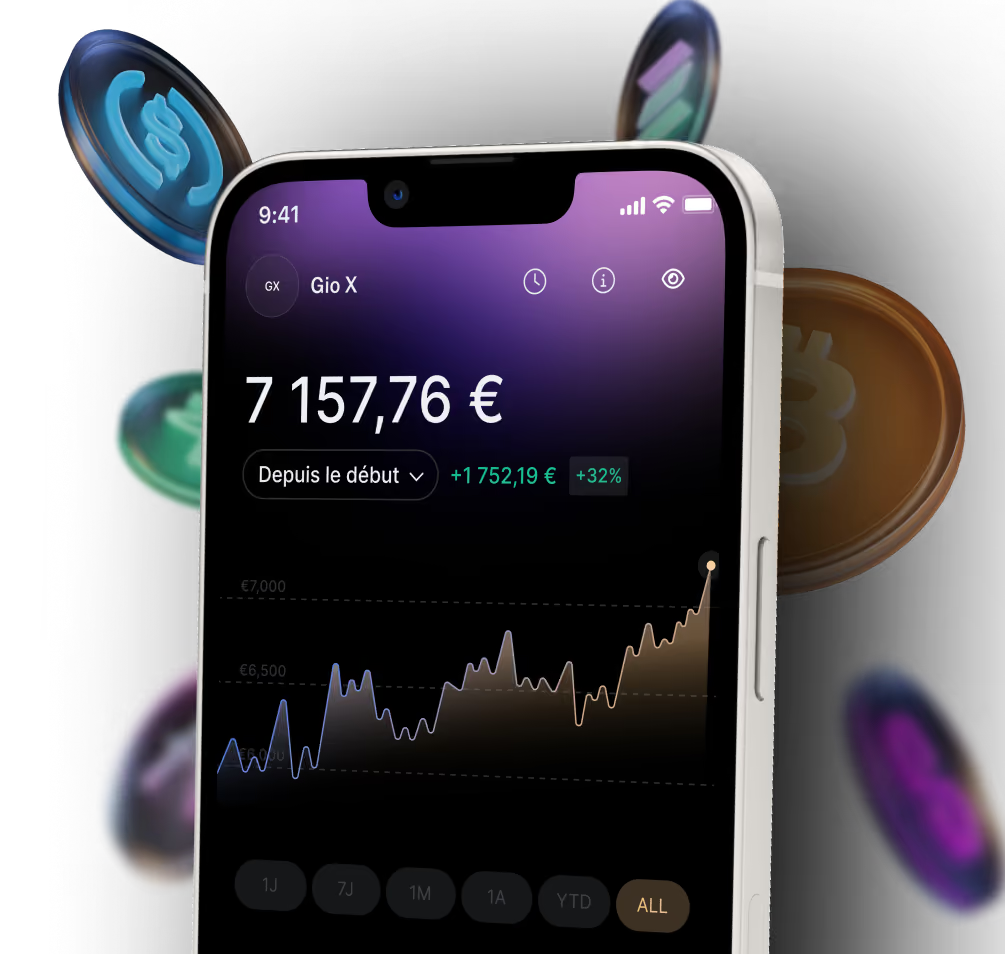
- Finary automatically calculates the taxable gain on your digital assets and centralises the tracking of your crypto portfolio.
Introduction to cryptocurrency taxation
Which transactions does the regime cover?
The tax regime for cryptocurrencies (French general tax code (CGI), art. 150 VH bis) applies only to transactions that meet the following three criteria:
They involve "digital assets" ; this legal category has two sub-categories, "tokens" and "virtual currencies", and today covers the vast majority of cryptocurrencies on the market.
The classification of some crypto-assets remains uncertain, in particular non-fungible tokens (NFTs), and above all artistic NFTs, such as those created by Justin Roiland, the creator of Rick and Morty.

Likewise stablecoins, tokens whose value is pegged to another asset such as a fiat currency (USD, EUR), could be classed instead as electronic money.
Some tokens, such as real-estate tokens, sit closer to the financial instruments category ("security tokens").
When a crypto-asset falls into a specific asset category, the digital-asset regime does not apply.
Stay alert: simply acquiring an asset that is not a digital asset can trigger a taxable event. In that case the tax deferral available on exchanges between cryptocurrencies (crypto-to-crypto) does not apply, whatever the transaction looks like.
They are "disposals for consideration" ; transfers free of charge are not taxable disposals.
You can therefore gift cryptocurrencies without reporting a taxable disposal. Bear in mind that gifts may still attract registration duties, which can reach 60% of the value of the gift when it is made to a third party.
Transactions other than disposals may fall under a different tax category: passive income (staking, lending and so on), payments received in digital assets, or derivatives trades.
So the belief that no tax is due as long as your wealth stays in cryptocurrencies is wrong. The tax owed depends mainly on which regime applies, staking income being a good example.
They are not carried out on a professional basis : income from selling cryptocurrencies leaves this regime only where buying and reselling digital assets amounts to a professional activity. Only disposals made in the course of managing your own private wealth are taxed under this regime.
The key features of the regime
The regime in force since 2019 has several important features to keep in mind:
First, exchanges between digital assets are not taxed. Only disposals of digital assets are taxable, a considerable advantage when managing your private wealth.
In practice, a taxable disposal means selling digital assets for legal tender, or buying a good or a service with digital assets.
So buying a car in BTC means calculating and reporting a gain or a loss. The same goes for a tax consultation with your adviser paid in ETH.
Frequent use of an exchange's payment card can therefore hold unpleasant surprises: tax to pay.
Some specific transactions can also trigger a taxable gain (e.g. contributions, buying derivatives, loans).
Second, the taxable gain is the sum of all gains and all losses realised by every member of the same tax household during the same year.
This makes calculating gains and losses far more complex when several members of the same tax household invest in crypto-assets.
Third, the law sets out a specific calculation method that requires the total portfolio value to be measured for every taxable transaction : the gross gain or loss equals the disposal price of the digital assets sold, minus the total acquisition price of the whole digital-asset portfolio multiplied by the ratio of the disposal price to the overall value of that portfolio.
The formula therefore requires the overall value of the digital-asset portfolio at each taxable disposal. That value is the euro value of every digital asset held by the members of the household just before the disposal.
Take a snapshot of your portfolio before every taxable disposal: it makes calculating the gain or loss far easier at filing time.
finally regulated
Investing carries risks, including the risk of capital loss. Crypto-assets are highly volatile: you may lose all or part of your investment. Past performance is not a reliable indicator of future performance. Finary is authorised as a crypto-asset service provider (CASP) under the MiCA regime by the AMF.
How do you calculate your gain or loss on digital assets?
As noted above, the method is fairly complex: for each taxable disposal, the gross gain or loss equals the disposal price of the digital assets sold, minus the total acquisition price of the whole digital-asset portfolio multiplied by the ratio of the disposal price to the overall value of that portfolio.
Calculating the gain therefore means mastering the following concepts.
- Disposal price of the digital assets sold. The disposal price is the actual price received or the value of the consideration obtained by the seller, including any balancing payment. It can be reduced by the costs the seller bears on the disposal (e.g. exchange platform fees).
- Total acquisition price of the digital-asset portfolio. The gross total acquisition price is the sum of the prices actually paid in legal tender for every digital-asset purchase, plus the value of each service and good handed over in exchange for digital assets or related rights before that same disposal.
So where cryptocurrencies are received in payment for a service (e.g. development work), their acquisition value on the date of receipt must be added to the portfolio's acquisition price when calculating the gain or loss.
At each disposal, that total acquisition price is reduced by a "fraction of initial capital" to arrive at the taxable gain or loss. This is the capital contained in the value or price of each earlier disposal of digital assets, whether free of charge or for consideration (exchanges excluded). These fractions of initial capital reduce the total acquisition price.
Example: in January 2025, Mathilde, resident in France, buys €1,000 of digital assets for the first time. In August 2025 her portfolio is worth €1,200. She then disposes of €450. The gain on that disposal is calculated as follows: 450 - (1,000 x 450 / 1200) = 450 - 375 = €75.
In December 2025 her portfolio is worth €1,300. She then decides to sell every digital asset she holds. To work out the gain on this new disposal, the total acquisition price must be reduced by the fraction of initial capital (€375) already deducted on the previous disposal: 1,300 - [(1,000 - 375) x 1,300 / 1,300] = 1,300 - 625 = €675 of gain.
- Overall value of the digital-asset portfolio. This is the euro value of every digital asset held by the members of the household just before the disposal, whether kept in a custodial or non-custodial wallet.
How the gain on digital assets is taxed
The net gain determined as set out above is taxed at a flat rate of 12.8%, to which social levies on investment income of 18.6% are added, giving an overall rate of 31.4% (the flat tax) since 1 January 2026.
Note that the flat tax applies to the sum of the gains and losses realised over the year, not to each taxable disposal.
Worked examples
If you dislike maths, brace yourself…
On 1 January 2025, Pierre buys 0.1 BTC for €9,000 (BTC is at €90,000) and 15 ETH for €48,000 (ETH is at €3,200).
On 1 June 2025, he buys 0.3 BTC for €27,600 (BTC is at €92,000).
On 1 September 2025, he swaps 0.05 BTC (BTC at €92,500) for 1.2 ETH (ETH at €3,750).
That swap is not taxable, since it exchanges two digital assets. After it, Pierre's portfolio holds 0.35 BTC and 16.2 ETH.
Still on 1 September 2025, Pierre sells 0.2 BTC for €18,500 (at a price of €92,500). At the time of the disposal his portfolio is worth €93,125 (0.35 BTC x €92,500 + 16.2 ETH x €3,750), against €84,600 invested in legal tender.
To calculate the taxable gain, subtract from the disposal price (€18,500) the total acquisition price of the whole digital-asset portfolio multiplied by the ratio of the disposal price to the overall value of that portfolio.
That is: disposal price - (net total acquisition price x (disposal price / overall portfolio value) ;
That is: €18,500 - (€84,600 x (€18,500 / €93,125)) = €18,500 - €16,806 = €1,694.
The taxable gain is therefore €1,694.
Because these transactions took place in 2025, the overall rate was still 30% (12.8% income tax and 17.2% social levies, before the rise to 18.6% that took effect on 1 January 2026, see above). The tax on this gain therefore came to €508.
Losses on digital assets
Unfortunately, and unlike other regimes, the overall annual loss can neither be offset against other types of income nor carried forward against digital-asset gains realised the following year.
In other words, a loss realised in one year is simply lost.
Several initiatives have tried to make the regime more flexible, but every amendment proposed to that end has been rejected.
Is there a specific exemption?
There is no specific exemption. Every disposal of digital assets for consideration must be reported.
However, where total disposals by the members of a single tax household do not exceed €305 during the tax year (threshold in force at 01/07/2026), the gains realised are exempt.
This is the only exemption available.
The test is the value of all disposals, not the size of the annual gain. A taxpayer who disposed of more than €1,000 of cryptocurrencies over the year but made a gain of €50 is taxable, whereas one who disposed of €300 of cryptocurrencies while making a gain of €200 is not.
What changed on 1 January 2023
Choosing how you are taxed
For disposals made from 1 January 2023, article 79 of the 2022 French finance act lets taxpayers choose between two methods: the 12.8% flat rate or the progressive income tax scale.
Whether that option is worthwhile depends mainly on the household's income: only households taxed at a low marginal rate stand to gain from the progressive scale.
with confidence
Investing carries risks, including the risk of capital loss. Crypto-assets are highly volatile: you may lose all or part of your investment. Past performance is not a reliable indicator of future performance. Finary is authorised as a crypto-asset service provider (CASP) under the MiCA regime by the AMF.
The professional investor status, revisited
Gains on the disposal of digital assets by individuals may fall under either:
- the digital-asset capital gains regime set out above, under article 150 VH bis of the CGI; or
- a business-profits regime, namely BIC (industrial and commercial profits) or BNC (non-commercial profits), depending on when the transactions took place.
Parliament stepped in on this second category, clarifying the criteria that separate gains from managing private wealth, taxed at the flat rate, from gains arising from a professional activity, taxed as business profits (BNC).
Before 1 January 2023 (commercial profits, BIC). Gains on digital assets realised by individuals could fall under the commercial profits regime (BIC) under article 34 of the CGI where they came from a commercial, industrial or craft profession. The test was habitual dealing, which raised fears that slightly too active taxpayers would be reclassified.
Since 1 January 2023 (non-commercial profits, BNC). Gains on cryptocurrency disposals may fall under the non-commercial profits regime (BNC) where they come from transactions "carried out in conditions similar to those of a person dealing in such transactions on a professional basis".
The Conseil d'Etat has already interpreted and applied this "conditions similar to those of a professional" test many times in the context of stock market trading.
It calls for a case-by-case assessment based on a body of evidence combining qualitative and quantitative criteria:
- Qualitative criteria : the means and tools used (a plain smartphone rarely raises an issue here), the information used, the diversity and sophistication of the transactions (using a trading bot, hedging, complex DeFi operations and so on), and the taxpayer's professional skills and training;
- Quantitative criteria : how often trades are made, trading volume relative to total wealth, average holding period, and so on.
These criteria are cumulative, and professional status should remain exceptional in practice.
As a rule, a large gain or actively managing your portfolio is not enough on its own to move disposal gains into the professional category.
Note, though, that in guidance published on 28 June 2023 in the Bulletin officiel des Finances publiques - Impôts, the tax authorities consider that disposal gains may fall under 3 different regimes rather than 2, even though Parliament set out to simplify the framework :
- BIC, where they arise from "a profession consisting in buying and reselling digital assets";
- the digital-asset capital gains regime (flat tax), where they are realised by individuals acting "in the course of managing their private wealth and not on a professional basis";
- BNC, "on a subsidiary basis", where they arise from transactions "carried out in conditions similar to those of a professional activity, without that activity being the taxpayer's own profession ".
This guidance creates the very uncertainty Parliament tried to remove with the BNC regime, and will certainly be a source of disputes with the tax authorities.
The Bulletin officiel des finances publiques states that, in assessing these "conditions similar to those of a professional activity", "holding, mastering and using specialised information and trading techniques, together with the organised pursuit of numerous and sophisticated digital-asset transactions" are decisive criteria (BOI-BNC-CHAMP-10-10-20-40 of 28/06/2023).
How do you report cryptocurrency disposals?
Taxable disposals are reported at the same time as your annual income tax return.
Once the gains are calculated, two filings are required:
- the return of taxable digital-asset disposals (Cerfa 2086); and
- where relevant, the return of digital-asset accounts held abroad (form 3916).
Filing crypto taxes online
As with your other income, gains and losses are declared online at www.impots.gouv.fr.
Here are the steps to find the right forms.
1. Tick the box “Gains de cession de valeurs mobilières, droits sociaux, gains assimilés, plus-values et gains divers…” (gains on securities and similar assets).

2. Select the annexes by clicking "Déclarations ANNEXES" (annex returns)

3. Select form 3916 and the Cerfa 2086

Reporting the gains realised (Cerfa 2042)
Once the gain is calculated, it goes on the matching form: the Cerfa 2042 C, used for supplementary income. Gains made in year N are declared the following year (N+1).
Here are the boxes to fill in:
- 3AN: for a gain. In the example above, you would enter €1,694
- 3BN: to be filled in for a loss
finally simple

Investing carries risks, including the risk of capital loss. Crypto-assets are highly volatile: you may lose all or part of your investment. Past performance is not a reliable indicator of future performance. Finary is authorised as a crypto-asset service provider (CASP) under the MiCA regime by the AMF.
Reporting digital-asset disposals (Cerfa 2086)
This form is used solely to report taxable cryptocurrency disposals. It is where the calculations set out above are entered.
The 2086 annex is available online in the annex section of your tax return.

Once the Cerfa 2086 is complete, boxes 3AN (gains) or 3BN (losses) on form 2042-C are filled in automatically in principle, but always check the amounts carried over.

Reporting digital-asset accounts held abroad
The exchanges offer little help on the thorny subject of cryptocurrency taxation, and none currently provides a dedicated tax calculation service. Holding an account on a foreign platform, however, triggers an extra obligation: reporting that account abroad.
If your account is with a French-registered crypto-asset service provider, there is nothing to report.
Good to know: cold wallets (such as Ledger or Trezor) are not covered by the reporting obligation.
Filling in form 3916 correctly
Most trading platforms are based abroad, so they count as foreign accounts. This time the form to fill in is the Cerfa 3916. Kraken, Bitstamp, Crypto.com: one form is needed for each of them. See our comparison of the best crypto platforms.

The form has a number of fields, which we review below:
- The account number or the email address used to open the account.
- The date the account was opened, and the closing date if it was closed during the year.
- Since the 2022 income return, the tax authorities let taxpayers simply enter the code of a pre-registered crypto-asset service provider, which makes identifying the institution easier. Pinning down the exact details of the platform where an account was opened used to be difficult.

- If the provider is not on that list, the details must be added manually.
Good to know: Revolut and N26 account holders already know the Cerfa 3916. These banks are also based abroad, so they must be declared just like crypto platforms.
Tax audits and cryptocurrencies: what are the risks?
As with any other income, failing to report cryptocurrency gains, or reporting them wrongly, exposes you to a tax audit: the tax authorities can review your position and adjust it.
Where gains go unreported, the main risk is a 40% penalty (where the authorities show the taxpayer could not have been unaware of the errors or omissions), and in the worst case 80% for undisclosed activity (the professional trader who does not declare their gains) or for fraudulent conduct.
For genuine mistakes, the taxpayer may simply face an adjustment and be asked to pay the difference between the tax due and the tax actually paid. Penalties of 10% of the reassessed tax may then apply. Late-payment interest, charged at 0.2% per month, can be halved where the return is corrected voluntarily under the French "right to make a mistake".
Failing to report accounts held abroad carries a fine of €750 per undeclared account, or €125 per omission or error, capped at €10,000 per return. Those €750 and €125 amounts rise to €1,500 and €250 respectively where the market value of the digital-asset accounts exceeds €50,000 at any point in the year covered by the obligation.
Frequently asked questions
Do you have to pay tax on cryptocurrencies?
Yes, if you sold cryptocurrency such as Bitcoin or Ethereum for euros and made a profit. The return is filed the year after the sale (N+1) and the rate is the flat tax, 31.4%. Losses must be declared, but nothing is due on them. Selling cryptocurrencies for other cryptocurrencies is not taxable.
Do you have to declare your cryptocurrency accounts?
Yes. Since 2019 you must declare every account (Coinbase, Kraken, Bitpanda and so on) holding crypto or digital assets, using the Cerfa 3916 form.
What is the tax rate on cryptocurrencies?
For the vast majority of investors, the flat tax of 31.4% applies to gains. This rate, the flat tax (PFU), applies only to the gain, that is the difference between the purchase price and the sale price.
Which crypto transactions are not immediately taxable?
Crypto-to-crypto transactions are not taxed, so no tax is due until you convert back into euros or dollars. You can also sell crypto for stablecoins such as USDT or USDC without triggering a taxable event (stablecoins do carry specific risks, including depegging).
How do exempt transactions work within the regime?
If, under this regime, you swap Bitcoin for Ethereum (ETH) or any other cryptocurrency, the transaction is exempt from tax even if you made a gain. The exemption also covers swaps carried out on cryptocurrency exchange platforms.
Sources
impots.gouv.fr, how to report gains or losses on digital-asset disposals
Légifrance, French general tax code, article 150 VH bis
Légifrance, article 79 of the 2022 finance act
bofip.impots.gouv.fr, BOI-BNC-CHAMP-10-10-20-40 of 28/06/2023
Yahoo Finance, BTC-EUR and ETH-EUR price history (data used in the worked example)
impots.gouv.fr, Cerfa 2086 form
impots.gouv.fr, Cerfa 3916 form
Regulatory disclaimers: Marketing communication. Investing carries a risk of partial or total capital loss. Past performance is not a reliable indicator of future performance. This article is provided for information and educational purposes only; it does not constitute personalised investment advice, a buy or sell recommendation, or tax advice. Crypto-assets are highly volatile and carry a risk of total capital loss. They benefit from no capital guarantee, and from no deposit guarantee or investor compensation scheme. Before investing, read the Key Information Document (KID) and, where relevant, consult an authorised adviser. Finary SAS, an investment firm authorised by the ACPR (no. 19283), member of AMAFI. Insurance broker registered with ORIAS (no. 21001279), member of the CNCGP (association approved by the AMF). Crypto-Asset Service Provider (CASP) authorised by the AMF under the MiCA regime, references no. A2026-026 and no. N2026-008.