


How to Invest in Classic Cars

Updated on 30 July 2026
Investing in a classic car means buying an old or rare vehicle in the hope of a capital gain, as a complement to a diversified financial portfolio. It is an illiquid, high-risk investment reserved for seasoned collectors with substantial capital.

- The classic car market keeps being driven by a deflationary supply: the best examples become rarer every year.
- Rarity, the vehicle's history and the authenticity of its parts (matching serial numbers) determine most of a model's value.
- Three buying channels coexist: private sellers, professionals and auction houses, each with very different levels of protection and risk.
- This investment pays neither dividend nor rent: performance depends solely on resale, which is never guaranteed or certain.
- Upkeep, storage and insurance for a classic car are recurring costs to plan for before any purchase.
Rarity Comes First
Classic cars are a matter of passion, but also of serious money. The global market is worth $20B, and 11K exceptional cars changed hands in 2019. Investment has largely overtaken passion. Americans are the biggest participants, holding more than 5M classic vehicles. Most large sales take place on the other side of the Atlantic. France ranks 4th worldwide with more than 1M registered vehicles, which is huge relative to its population.
The market is divided into 3 segments:
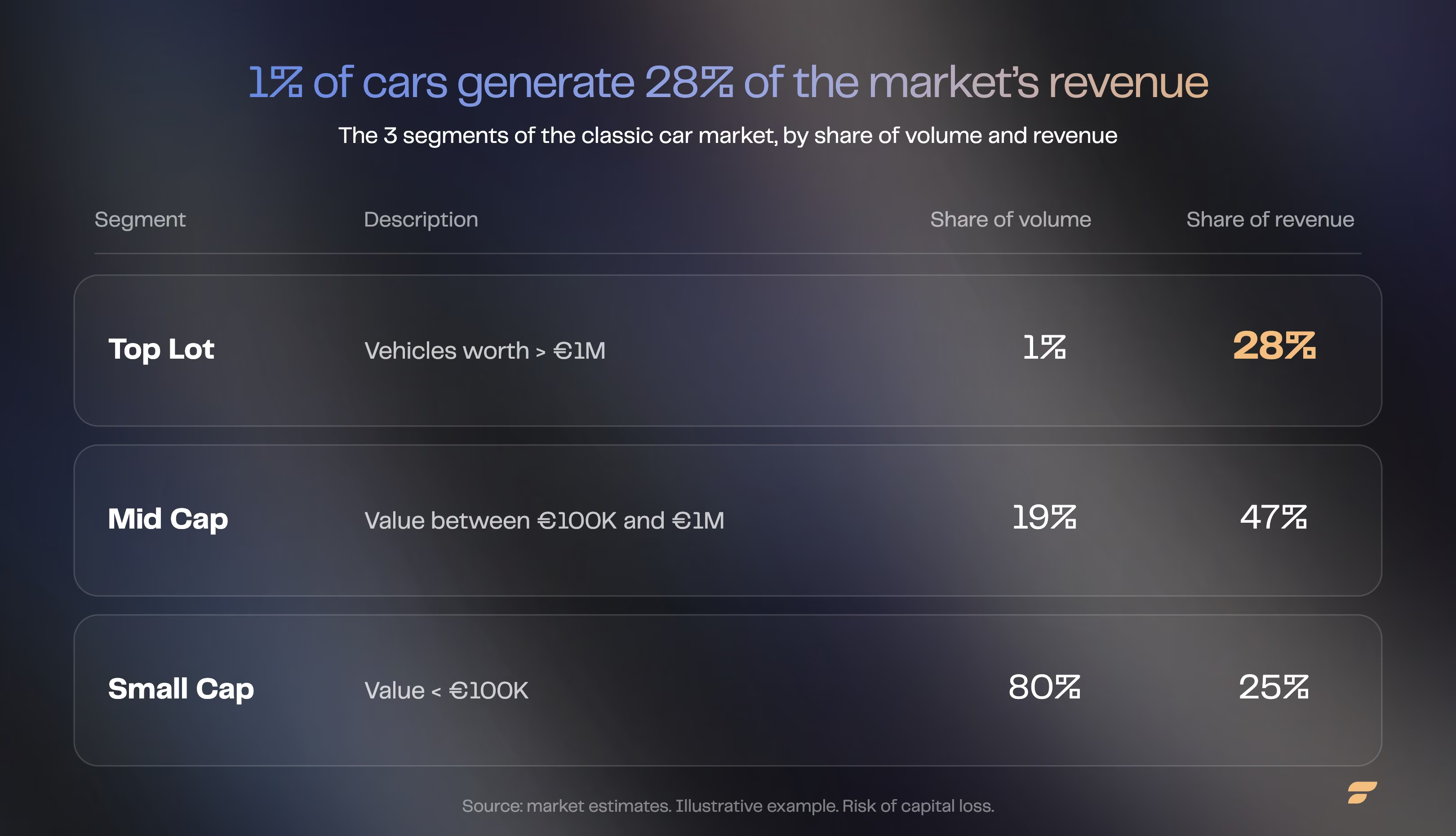
The Mid Cap segment is currently growing the fastest, mainly because of the relatively large number of vehicles available.
When it comes to model years, the post-classic era (1965-1974) is the most sought after. It matches exactly the era of Delon's Ferrari. In recent years, “instant classics” have also emerged: recent, rare vehicles that become extremely expensive. The original Tesla Roadster and the McLaren MP4 belong to this category. Finally, by brand, Ferrari generates the most volume ahead of Porsche, Aston Martin and Maserati, much like other passion asset classes such as investing in art. Think Alain Delon's Ferrari is expensive? A Ferrari 250 GTO sold for $48.4M in the United States in 2018, a world record at the time for a car at auction, since surpassed (another 250 GTO reached $51.7M in 2023, and the absolute record for any car is held by a Mercedes-Benz 300 SLR Uhlenhaut Coupé, sold for $143M in 2022). In February 2015, the auction house Artcurial, at its Rétromobile sale, sold a 1961 Ferrari 250 GT SWB California Spider that had belonged to actor Alain Delon between 1963 and 1965: it sold for €16.3 million (roughly $17.7 to $18.5 million at the time), after remaining with the same collector for 44 years.
The classic car market is unique for 2 reasons: the buyer base and the supply. The buyer base is made up of enthusiasts with substantial means. They invest for pleasure and for a potential capital gain. The supply is deflationary: vehicles become rarer and rarer, sometimes impossible to find. Even if prices can seem outlandish, these factors specifically structure this market. When someone holds substantial wealth, some seasoned investors choose to diversify a share of their assets into classic cars, fully aware of the risks. The buyer of Delon's Ferrari understood this well and could realise a long-term capital gain, though with no guarantee whatsoever, since past performance never predicts future performance. Provided the car is never driven, to avoid the risk of damaging it. Tools like Finary make it possible to centralise tracking of this type of alternative asset alongside the rest of one's financial wealth. Other collectibles, such as investing in watches, follow a comparable logic of scarcity, as does investing in wine.

Where to Buy a Classic Car?
Classic cars are mainly sold through 3 channels. Each of them represents a different level of the market and attracts different types of buyers. Let's look at them one by one to see their different characteristics.
Private Sellers
This channel has the largest number of sellers, since it is not centralised. Private sellers often choose to sell their cars through specialist listing websites or by using their personal network through word of mouth.
The savings made through this channel can be significant, since there are no intermediaries at the time of the transaction. On the other hand, there is no expert mediator in case of a dispute after the sale, and verifying the car's authenticity, its parts and its overall condition falls entirely to the buyer.
Professional Sellers
Professionals are a reassuring channel for getting a classic car that matches your expectations. You can target cars in perfect condition when available, or cars in lesser condition that you are prepared to restore. Some sellers specialise in certain types or brands of cars. Many professionals also offer brokerage services: you describe in detail the type of car you are looking for, and, for a fee, they find it and negotiate its purchase for you.
Professionals can certify the authenticity of the car and its parts. They can also warranty the car for a certain period after purchase. The main drawback of this channel is that all these services come at a price. Professionals know the market price of cars very well and, of course, they need to make a profit on top of that.
Auctions
Some prestigious auction houses organise well-known events. It is sometimes possible to find a rare car there without overbidding or going over budget, but nothing guarantees it.
This channel does, however, have significant limitations.
In reality, car auctions can be a minefield: by far the riskiest way to buy a classic car.
Cars are often sold “as is,” not fully restored, and without warranty.
As a buyer, you are on your own with no recourse if problems arise with the car. The only information and certifications for the car come from the auction house's own experts, who do not carry the same legal obligation as professional car dealers.
Investing in Classic Cars: Summary
The luxury vintage vehicle market is deflationary: the quantity of quality assets available keeps shrinking. This very limited supply is largely maintained by manufacturers and dealers. Return prospects can be attractive in certain segments, but come with high risks (illiquidity, upkeep, fraud, fluctuating valuations), just like other alternative investments such as hedge funds or gold, another non-productive safe-haven asset: this market is aimed first and foremost at enthusiasts and insiders with substantial means.
According to France's Fédération Française des Véhicules d'Époque (FFVE), a classic car is officially defined as “a vehicle over 30 years old, no longer in production, whose characteristics have not been modified.”
Criteria frequently cited by collectors:
- A strong, desirable brand
- A vehicle produced in small numbers, or even unique
- An interesting history (e.g. James Bond's Aston Martin)
- Matching chassis numbers (the main parts share the same serial number)
Goals

Frequently Asked Questions
How much does it cost to enter the classic car market?
The entry ticket varies widely: a few thousand euros are enough for a popular model from the 1980s-1990s, while the rarest and best-documented Ferraris, Porsches or Aston Martins trade for several million, or even tens of millions of euros.
What are the main risks of investing in a classic car?
Classic cars carry several combined risks: illiquidity (resale can be slow and uncertain), high upkeep and storage costs, the risk of fraud regarding parts authenticity, and valuations that shift with trends. Past performance never guarantees a future capital gain.
How do you insure a classic car?
A classic car is generally insured at an agreed value, fixed at purchase, rather than at a value that depreciates over time as with an ordinary vehicle. Getting the “collector vehicle” status on the French vehicle registration document (carte grise) requires a vehicle over 30 years old, unmodified and no longer in production.
Can a classic car lose value?
Yes: its value is never guaranteed and can fall, particularly if trends shift, if the market turns, or if the vehicle's authenticity is called into question (non-matching parts, excessive restoration). Past performance never predicts future performance.
Sources
Wikipedia, List of most expensive cars sold at auction
Artcurial, Rétromobile sale 2015, lot 59-A, Ferrari 250 GT SWB California Spider ex-Alain Delon
Service-public.fr, requirements for obtaining “collector vehicle” status
FFVE, Fédération Française des Véhicules d'Époque
Regulatory disclaimers: Marketing communication. Investing carries a risk of partial or total capital loss. Past performance is not a reliable indicator of future performance. This article is provided for information and educational purposes only; it does not constitute personalised investment advice, a buy or sell recommendation, or tax advice. This investment carries a liquidity risk (resale not guaranteed, long horizon) and a risk of capital loss. Income and valuations are not guaranteed. Before investing, read the Key Information Document (KID) and, where relevant, consult an authorised adviser. Finary SAS, an investment firm authorised by the ACPR (no. 19283), member of AMAFI. Insurance broker registered with ORIAS (no. 21001279), member of the CNCGP (association approved by the AMF). Crypto-Asset Service Provider (CASP) authorised by the AMF under the MiCA regime, references no. A2026-026 and no. N2026-008.