

How to Reach Your First €100,000 in France

Updated on 23 July 2026
Reaching €100,000 in France when you earn €2,400 a month looks out of reach. Yet it isn't a question of salary, but of method and time.
The principle fits in one sentence: an automatic transfer every month into a diversified investment, kept up no matter what. That first milestone, the €100,000 mark, changes everything, because beyond it your interest starts earning more than your savings do.
Here is how to get there, step by step, through David's journey.

- The real tipping point isn't a million but the first €100,000: beyond that, interest often earns more than your annual savings.
- The method comes down to an automatic monthly transfer (DCA) into a diversified investment, kept up no matter what, rather than betting on the right moment.
- At a hypothetical return of 7% a year, €100,000 generates around €7,000 a year, or nearly €583 a month, before tax.
- Holding your savings in a PEA (a French tax-advantaged equity savings account; income tax exemption after 5 years) rather than a securities account can save several thousand euros in tax.
- The main obstacles are psychological: fear of missing out, panic during crashes, lifestyle inflation; naming them helps you stick with it.
Why are the first €100,000 the real tipping point?
Because past this threshold, your money produces more than your contributions. David is a case in point: in 14 years, his PEA crossed €100,000.
Of that amount, he paid in around €78,000 out of his own pocket. The remaining €22,000 comes from the return on his investments.
His money is mostly invested in an MSCI World ETF, a fund that tracks the performance of around 1,300 companies in 23 developed countries. Historically, the MSCI World has generated around 10% a year in euros since 1978. Past performance is not a reliable indicator of future performance.
Since inflation eats into purchasing power every year, David stays cautious and reasons in real terms, assuming a 7% a year return.
At that rate, €100,000 generates around €7,000 in interest a year, or €583 a month before tax. Almost half of the SMIC (France's minimum wage), without saving a single extra euro.
Above all, that interest stays invested. The following year, it isn't €100,000 working for you anymore, but €107,000. Interest in turn produces interest: that is the effect of compound interest.
As a result, each milestone arrives faster than the last. It took David 14 years to reach €100,000, but it would take him around 6 years to reach €200,000, then 4 years to reach €300,000.
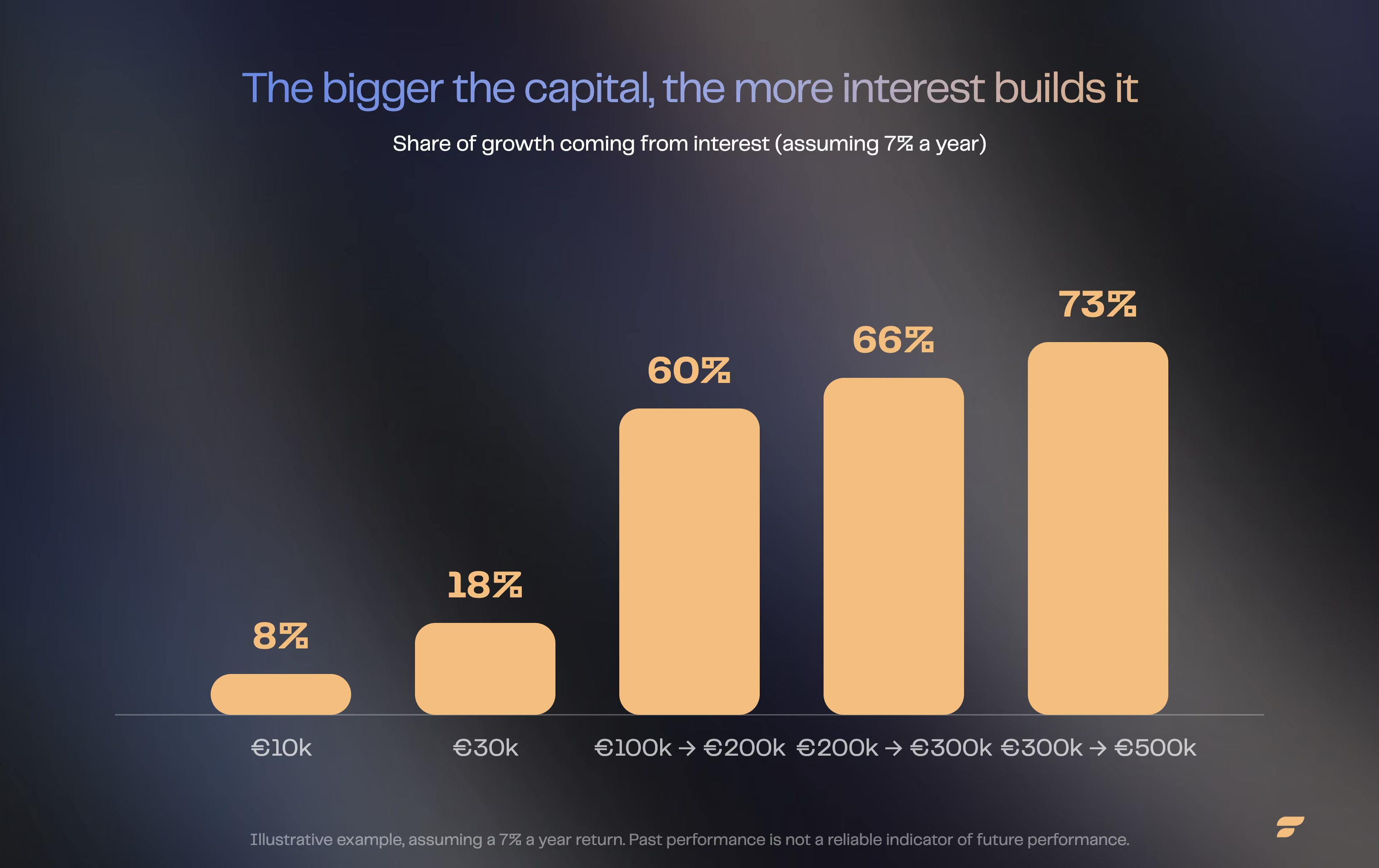
The bigger the capital, the larger the share of growth that comes from interest, and the less your savings effort counts. These figures guarantee nothing, but they show the power of time.
From €0 to €10,000: building solid foundations
The first building block is a strategy, not a lucky break. David discovers Dollar Cost Averaging (DCA), or scheduled investing: putting in a fixed amount every month, no matter what.
When markets fall, that fixed amount buys more units; when they rise, it buys fewer. The purchase price averages out over time.
One of his colleagues has been waiting for "the right moment" for three years and still hasn't invested a cent. The lesson David takes from a forum becomes his mantra: time spent invested matters more than timing your entry.
Before investing, he lays three foundations.
1. An emergency fund. David keeps €6,000 in his Livret A (France's flagship regulated savings account), about three months of expenses. Without this buffer, the slightest mishap would force him to sell at the worst possible time. The ideal is between three and six months of expenses, in a Livret A or an LDDS (Livret de Développement Durable et Solidaire, France's sustainable-development savings account).
2. Paying off expensive debt. He clears the remaining €1,000 of a consumer loan at 10%. Paying off a 10% loan is like earning a guaranteed 10% return, something no investment can guarantee.
3. The right tax wrapper. David opens a PEA. The tax clock starts running the day it is opened, and after five years capital gains are exempt from income tax: only the 18.6% social security contributions still apply.
With a securities account (CTO), the 31.4% flat tax applies to the entire capital gain. On a €50,000 gain, the difference speaks for itself.
| On a €50,000 capital gain | PEA (after 5 years) | Securities account (CTO) |
|---|---|---|
| Taxation | Social security contributions 18.6% | Flat tax 31.4% |
| Tax due | €9,300 | €15,700 |
| Difference | €6,400 saved with the PEA | |
Another advantage of the PEA: as long as the money stays inside the wrapper, switching investments triggers no tax. David can reinvest his gains without any tax drag.
What remains is the single most important step: automating. In the first month, David waits to see "what's left" at the end of January. Only €40 is left.
The following month, he sets up an automatic transfer on the 1st of the month, before he has time to spend it. He never looks back.
A few months later, he crosses €10,000 invested: about €9,000 comes from his transfers, €1,000 from his ETF's return. The effect is still tiny, but it will grow.

From €10,000 to €30,000: resisting temptation
The first enemy isn't the market, it's himself. After a few months, David is on the verge of changing everything.
Marie, a friend, turned €15,000 into €75,000 in a year with a new crypto asset, a 400% gain. She urges David to follow suit, and he is terrified of missing the boat. This is FOMO: the fear of missing out.
But many of his friends made similar bets and lost. Marie is the only winner. According to the AMF, 80 to 90% of retail investors who trade CFDs and Forex lose money.
David realises you only ever see the winners: those who lose don't brag about it. That is survivorship bias.
His monthly transfer, by contrast, depends not on luck but on discipline. In Japanese, this steady, small-steps progress is called Kaizen. A bet can multiply by five or lose 90%, whereas a consistent strategy aims for an average return, year after year.
Around age 30, David gets a €350 net raise. At the office, colleagues talk about weekends in Porto and trendy restaurants: that is the pressure to prove your status through spending.
But every raise absorbed by new spending is wealth-building's number one enemy. David decides to keep living as before for a year, then raises his transfer from €300 to €400.
After around six years of DCA, he passes €30,000. Interest now accounts for 18% of his growth, up from 8% at €10,000. His portfolio "pays for" his tank of petrol every month.
From €30,000 to €50,000: should you keep investing during a crash?
Yes, and it is even the best time to keep investing. After seven years of DCA, markets drop 37%: David's €35,000 falls to €22,000. Thirteen thousand euros gone, almost three years of contributions.
In 1992, psychologists Kahneman and Tversky showed why it's so hard: losing €13,000 hurts roughly twice as much as gaining the same amount feels good. That is loss aversion.
David looks for answers on social media, but only finds posts that confirm his fear. The more he reads, the more afraid he gets: that is confirmation bias, a vicious circle.
On the verge of selling everything, he comes across a thirty-year chart of the MSCI World. Black Wednesday, the dot-com bubble, 9/11, the subprime crisis, the European debt crisis, Covid, the war in Ukraine: despite it all, the index has multiplied more than tenfold in euros. Past performance is not a reliable indicator of future performance.
Every crisis seems like THE reason to sell everything. In hindsight, none of them stopped markets from moving higher. The real risk isn't investing during a crisis, but having too short a horizon to ride it out.
David doesn't sell. Better still: before the crash, €400 bought around 8 units at €50; afterwards, the same €400 buys 12.5 at €32. Those units bought on sale will be worth much more once the market rebounds.
An unexpected event helps: he receives a €10,000 inheritance. Rather than replace his old car, he fixes the air conditioning for €300 and invests €9,700 right at the bottom of the market. At 7% a year, €10,000 invested theoretically becomes €19,672 in ten years and €38,697 in twenty years.
Then his banker offers him a life insurance policy with "only 2% in annual management fees." David runs the numbers: on €100,000 invested for twenty years at a 7% gross return, the fee level changes everything.
At 0.3% in fees (the cost of his ETF), the capital reaches €365,838. At 1%, it drops to €320,714, or €45,124 less. At 2%, the banker's offer, only €265,330 is left, or €100,508 less: almost the size of his target, gone in fees. David turns it down.
One last temptation: family pressure. "By renting, you're throwing your money away." But David doesn't know whether he will stay in the same city, or even in France. With notary fees of 8 to 8.5% he will never see again, he would need to stay put for about ten years to make a purchase worthwhile.
To keep his flexibility and focus his effort on the PEA, he chooses to stay a renter. It isn't a rejection of real estate, only a question of timing. He passes €50,000 around age 35.
From €50,000 to €100,000: accelerating
The home stretch comes down to details. David combs through his spending and finds €47 a month leaking into a gym he never visits and two forgotten subscriptions.
By renegotiating his phone plan and car insurance, he raises his transfer from €400 to €500.
Then a headhunter offers him a role paying 15% more. He uses it to negotiate and gets an extra €300 net at his current company. According to an OpinionWay study, nearly four out of five employees who negotiate succeed: the main obstacle isn't being turned down, it's never asking.
He then raises his transfer to €550 and keeps the rest to improve his day-to-day life. His friend Marie, meanwhile, put everything into a new token that crashed 90%.
David realises he didn't win through talent, but through consistency. It is this method, not a lucky break, that got him to his first €100,000.
Frequently asked questions
How long does it take to reach €100,000?
It all depends on the monthly effort, assuming a 7% a year return. At €200 a month, it takes around 19.9 years; at €300, 15.7 years; at €500, 11.2 years. Time does the work, but a bigger savings effort clearly shortens the timeline.
Should you invest all at once or gradually?
Investing gradually (Dollar Cost Averaging) means putting in a fixed amount every month, no matter what. It smooths out the purchase price and avoids betting on the right moment. Time spent invested generally matters more than timing your entry.
PEA or securities account for investing in the stock market?
After five years, the PEA exempts capital gains from income tax: only the 18.6% social security contributions remain. The securities account is subject to the 31.4% flat tax. On a €50,000 gain, the PEA saves €6,400. The securities account is still useful beyond the PEA's cap, or for assets that aren't eligible.
Should you stop investing during a crash?
Historically, no: over thirty years, the MSCI World has multiplied more than tenfold despite the crises. Past performance is not a reliable indicator of future performance. Sticking with scheduled investing even lets you buy more units while prices are low.
How big an emergency fund do you need before investing?
Between three and six months of expenses, held in a Livret A or an LDDS, available at any time. This buffer avoids having to sell your investments at the worst possible time if something unexpected happens.
Sources
AMF - study on CFD and Forex trading in France
MSCI World - performance history in euros since 1978 (Curvo)
Service-public.gouv.fr - PEA tax rules
Kahneman & Tversky - Prospect Theory (Econometrica)
Regulatory disclaimers: Marketing communication. Investing carries a risk of partial or total capital loss. Past performance is not a reliable indicator of future performance. This article is provided for information and educational purposes only; it does not constitute personalised investment advice, a buy or sell recommendation, or tax advice. Crypto-assets are highly volatile and carry a risk of total capital loss. They are not covered by any capital guarantee or by deposit-guarantee or investor-compensation schemes. Before investing, read the Key Information Document (KID) and, where relevant, consult an authorised adviser. Finary SAS, an investment firm authorised by the ACPR (no. 19283), member of AMAFI. Insurance broker registered with ORIAS (no. 21001279), member of the CNCGP (association approved by the AMF). Crypto-Asset Service Provider (CASP) authorised by the AMF under the MiCA regime, references no. A2026-026 and no. N2026-008.