


Compound interest and investing: calculation and rate

Updated on 21 July 2026
Compound interest is the mechanism by which the interest generated by an investment is reinvested and itself generates further interest, accelerating capital growth over time. This article covers the calculation formula, a worked example, and how it interacts with the tax treatment of the PEA (a French tax-advantaged equity savings account) and life insurance.

- Over 20 years, €10,000 invested at 7% grows to about €38,700, versus only €13,500 in a Livret A at 1.5%.
- The longer the investment horizon, the stronger the effect of compound interest, provided the investment generates a genuinely positive return.
- The PEA and life insurance reduce the tax on reinvested capital gains after 5 years for the PEA, or 8 years for life insurance.
- Investing early often matters more than investing a lot: starting 15 years earlier can double the final capital even with the initial contribution cut in half.
How to calculate compound interest
You are probably wondering how to calculate compound interest.
Let's get straight to the point and break down the compound interest formula:
Vf = Vi × (1 + p)a
Here are the different components of this geometric sequence:
- Vf: final investment value
- Vi: initial investment
- p (rho) : the return on your investment over a given period (%). This rate is expressed as follows in the formula: 10% = 10 (not 0.10)
- a: the number of periods (years, quarters, months, etc.).

Goals
Illustrating compound interest with an example
Does this seem complex? Don't worry, the calculation is very simple. Here is a basic compound interest calculation. You invest €10,000 in an investment option with a 7% annual return. You keep this investment for 20 years.
€10,000 * (1+0.07)^20 = €38,696
Your initial investment was multiplied by 3.8 thanks to the power of compound interest, with no effort on your part.
To illustrate exactly what happens each year, here is another example of compound-interest investing.
- Year N: You invest €100 in a listed company whose share is worth €1. You therefore hold 100 shares.
- Year N+1: The company pays a dividend of €0.10 per share, so you receive €10. Instead of spending the dividend on an end-of-lockdown celebration, you decide to reinvest it to buy more shares in the same company. Assuming the share price hasn't moved and is still €1, you now hold 110 shares.
- Year N+2: The company pays another dividend of €0.10. This time, you receive €11, 10% more than in N+1. You have just increased your wealth without reinvesting.
- Year N+30: You now hold €1,580, 15 times more than at the start with no additional investment.
Note that this calculation does not even take into account the fact that historically, global equity markets have delivered an annual return well above 5% (about 13% a year for the MSCI World index since 2009, cf. JustETF). Rising markets will therefore amplify the power of compound interest even further. If you want to run a simulation, we recommend this wealth simulator.
If the same amount had been invested in aLivret A, whose rate was 1.5% from 1 February 2026 and rises to 1.7% on 1 August 2026 (economie.gouv.fr, 2026), you would have obtained about €13,500 after 20 years, a gain of €3,500 8 times less than on the 7% investment in our example. With inflation at 1.8% year-on-year in June 2026 (INSEE), the real return on these savings remains very limited. In other words, generating returns is essential to maximise your gains. For diversification, considerreal estate ETFs, though their performance varies and they carry a risk of capital loss.
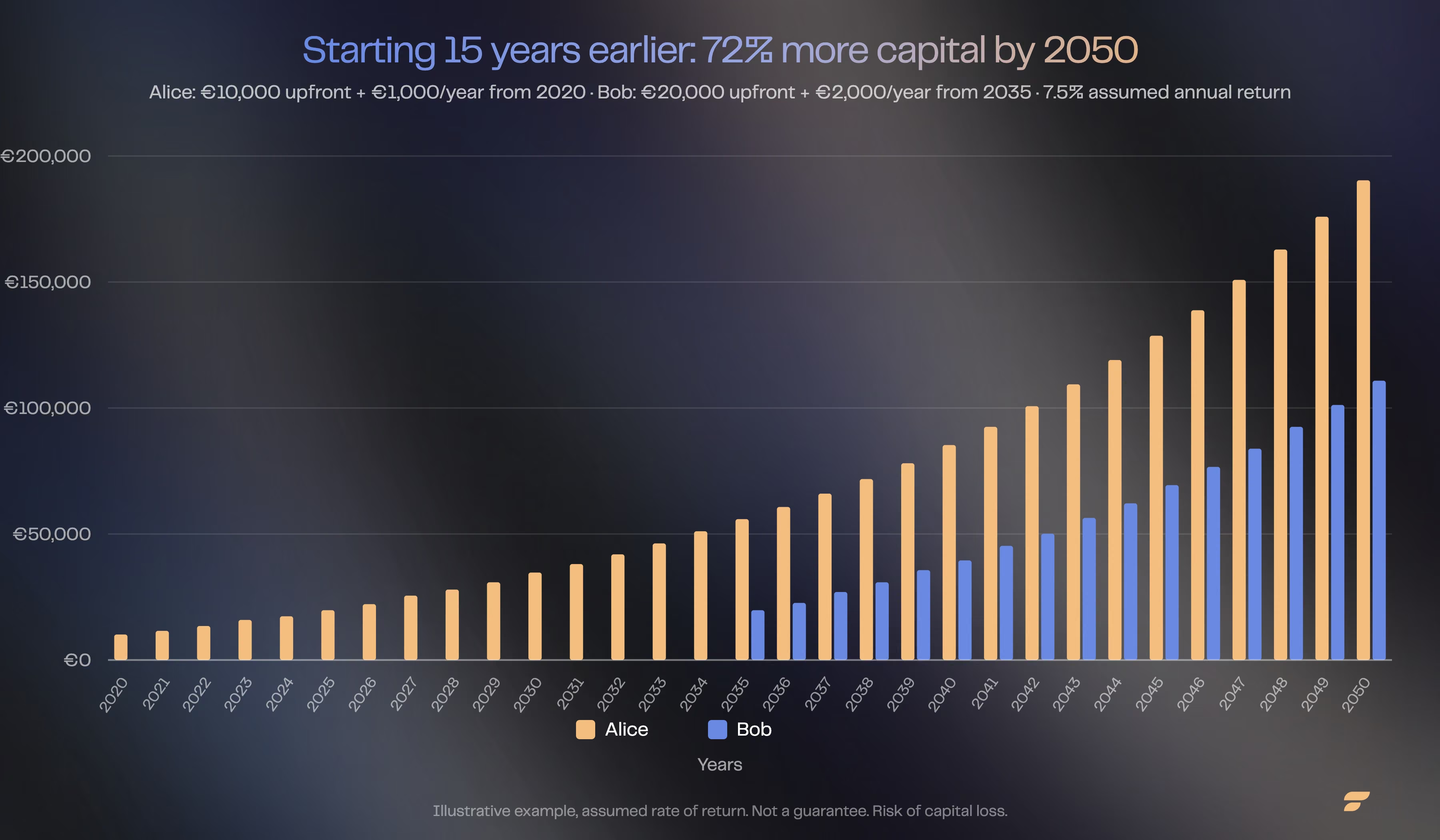
Let's compare the wealth trajectory of two friends, Alice and Bob (names chosen at random). They both decide to start investing in the stock market in order to retire in 2050. They pick the same investment option, an ETF tracking the MSCI World index, which includes the world's largest companies. To keep the example simple, we use a 7.5% annual return assumption here, well below the return actually delivered by the CW8 ETF since its creation on 16 June 2009 (about 13% a year, JustETF, 21/07/2026).
Alice wants to make the most of the power of compound interest: she starts by investing €10,000 early in her working life. Every following year, she invests an extra €1,000.
Bob prefers to spend his money and only starts investing 15 years later. With more capital available, he invests €20,000 in 2035 and €2,000 every following year.
Educational assumption: 6% gross annual return, before fees and tax, constant monthly contributions.
Non-contractual document for promotional purposes. This simulation is for illustrative purposes only.
Why is time the most powerful factor in compound interest?
Because it lets gains that have already been reinvested generate gains of their own: starting earlier often matters more than investing more, as the example of Alice and Bob below shows.
In this theoretical example, Alice ends up with more capital. Thanks to compound interest, she will have accumulated more than €190,000 for a total investment of €40,000, 4.75 times more than she put in. This shows that compound interest is a formidable tool for wealth management that everyone can benefit from.
Bob will end up with only €111,000, despite an initial investment of €50,000, 25% more than Alice put in. The gap illustrates the impact of time on compound interest.
Note that even though the CW8 ETF tracking the MSCI World has posted an average annualised return of about 13% since its creation in 2009 (JustETF, 21/07/2026), well above the simplified 7.5% assumption used earlier, annual swings can be very large. From one year to the next, performance can be catastrophic (as much as -50%), or exceptional (+20% or more). Alice and Bob are long-term investors, so these market swings do not concern them. They know that the biggest mistake would be to sell when performance is poor, and buy back in during a good year.
Compound interest is therefore perfectly compatible with long-term investing. To optimise your tax position, investing through a tax-advantaged wrapper such as the PEA or life insurance is strongly recommended. If you meet the holding-period rules for these wrappers, you can get an income-tax exemption on capital gains held beyond 5 years (PEA) and an annual tax allowance after 8 years (life insurance). Social security contributions still apply: 18.6% on the PEA since 2026 (Meilleurtaux Placement, 2026), versus 17.2% preserved on life insurance (MACSF, 2026). Tax treatment depends on personal circumstances and may change. Your compound-interest investments will be protected by these tax wrappers, letting you make the most of them when you decide to sell.
Frequently asked questions
What is compound interest?
Compound interest arises when the amounts received from an investment are reinvested: it applies to the amount initially invested as well as to the interest already accumulated. The longer the investment horizon, the stronger its effect can be, provided the investment generates a genuinely positive return (the risk of capital loss remains).
How does compound interest work?
Unlike simple interest, compound interest takes into account both the initial sum invested and the interest already accumulated over a given period. Each year, the initial capital generates interest, and if that interest is reinvested, it becomes capital and increases the base on which the next round of interest is calculated, and so on.
How do you calculate compound interest?
The compound interest formula is Vf = Vi × (1+p)a, where Vf is the final investment value, Vi the initial investment, p the return per period (%), and a the number of periods (years, quarters, months, etc.).
Does the compound interest calculation also apply to fees?
Yes: whether for a mortgage or for an actively managed fund's fees, the compound interest calculation shows the total amount of interest, or fees, you will pay the bank or the fund over the life of the investment.
Sources
Service-Public.fr, Livret A and LEP rates as of 1 August 2026
Economie.gouv.fr, Livret A at 1.5% and LEP at 2.5% from 1 February 2026
INSEE, consumer price index, June 2026
JustETF, Amundi MSCI World Swap UCITS ETF EUR Acc (CW8) factsheet
Meilleurtaux Placement, social security contributions on the PEA rise to 18.6% in 2026
MACSF, 2026 Social Security Financing Act: what savers need to know about life insurance and the PER
Regulatory disclaimers: Marketing communication. Investing carries a risk of partial or total capital loss. Past performance is not a reliable indicator of future performance. This article is provided for information and educational purposes only; it does not constitute personalised investment advice, a buy or sell recommendation, or tax advice. Before investing, read the Key Information Document (KID) and, where relevant, consult an authorised adviser. Finary SAS, an investment firm authorised by the ACPR (no. 19283), member of AMAFI. Insurance broker registered with ORIAS (no. 21001279), member of the CNCGP (association approved by the AMF). Crypto-Asset Service Provider (CASP) authorised by the AMF under the MiCA regime, references no. A2026-026 and no. N2026-008.