Announcement
The Finary connector is live: ask your AI about your wealth
Explore





Updated on 31 July 2026
To invest in the stock market in France, open the right tax wrapper (PEA, life insurance, a securities account, or PER), choose your investment options (index ETFs, direct stocks, bonds), then invest regularly over a long horizon. This 2026 guide covers every step and the capital-loss risk you need to accept.

The stock market is a dematerialised marketplace where you can buy and sell company shares (or securities). Stock exchanges exist on all 5 major continents, but the ones that attract the most investors are in the United States, Europe and Asia:
| Country | United States | United Kingdom | France | Germany | Japan | China |
|---|---|---|---|---|---|---|
| Markets | NYSE, NASDAQ | London Stock Exchange | Euronext Paris | Deutsche Börse Xetra | Tokyo Stock Exchange (Japan Exchange Group) | Shanghai Stock Exchange |
The broker is the intermediary that lets you invest in the stock market. It is through your broker that you place orders to invest, buy or sell securities. There are 3 main types of brokers in the stock market:
A share is a unit of a listed company's capital. When you buy a share, you become a shareholder and therefore the owner of a small part of the company.
The more shares you hold, the larger your stake in the company. You can build wealth by collecting dividends on these shares or by realising a capital gain on the share price. Only companies that turn a profit pay dividends, and the amounts vary from one company to another. Some companies pay none at all.
Be aware that dividends and capital gains are treated as income added to your wealth, so they are taxable.

A bond is a debt security issued by a listed company or a government. When you buy a bond, you are effectively lending your money to the company or government, which repays you by paying interest, known as coupons.
Unlike shares, a bond is not an ownership stake. You are not entitled to any dividend. You can generate additional income by collecting the interest paid via coupons or by realising a capital gain when you sell your bonds.
Again, this income is added to your wealth and is also taxable.
A stock market index is a group of shares used to track the price levels of a sector, a geographic region or an economy. It is generally made up of the most highly capitalised and most liquid companies on the relevant exchange, not the best-performing shares. The main stock market indices include:
An IPO (Initial Public Offering) is a company's listing on the stock market. The company, until then privately held, sells part of its shares (the free float) on an exchange.
Part of the company's capital then becomes public and therefore accessible to investors via their brokerage accounts (or tax wrappers). In the United States, most listings happen on the NASDAQ, the exchange for technology stocks. Globally, the Asia-Pacific region accounts for the largest number of IPOs.
If you are in a hurry and want the key facts, here is our summary:
Investing in the stock market serves three goals: helping to finance the real economy, targeting a return historically higher than savings accounts, and holding your gains in a tax-advantaged wrapper such as the PEA or life insurance. The first lever is direct: by buying shares in a listed company, you help fund the growth of businesses and therefore of the real economy.
Buying stocks is also a way to benefit from the historical return of one of the best-performing asset classes over the long term. You do, however, need to accept market volatility. Markets do not move in a straight line and can rise and fall. It is impossible to predict whether markets will rise or fall. Investing in the stock market can therefore be seen as risky, but several historical studies show that, over the long term, stocks have offered a competitive return-to-risk ratio (past performance is not indicative of future performance). Note that derivatives can generate significant losses, sometimes exceeding the capital invested. They should be avoided in a balanced wealth management strategy.
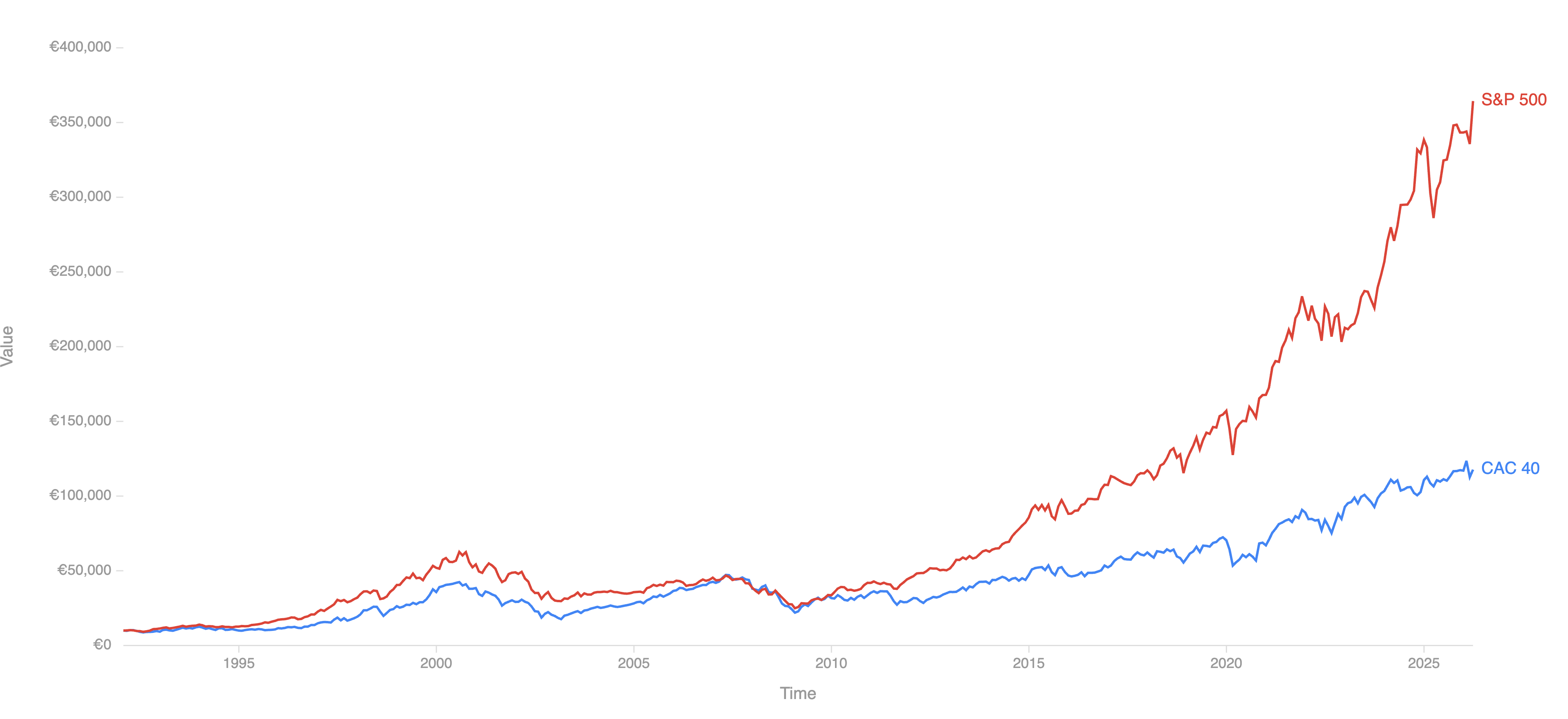
As mentioned above, the stock market has delivered a very attractive return over the long term, and the same holds true when looking at average annual performance in recent years. Since the late 19th century, the average annual performance of US stocks has exceeded 8% according to Robert Shiller's historical data, Nobel laureate in economics (S&P Composite series since 1871, dividends reinvested, past performance not indicative of future performance). US stocks are not the only ones posting good results: CAC 40 stocks, dividends reinvested, have delivered an average annual return of about 9% since the index was created at the end of 1987: the CAC 40 GR reached 28,173 points on 2 July 2026.
If you compare these figures with the returns of other major investments (gold, life insurance, bonds, the Livret A), you will understand the potential value of stock exposure in a diversified strategy. The chart below compares the annualised performance of these investments over 30 years (1994-2024).
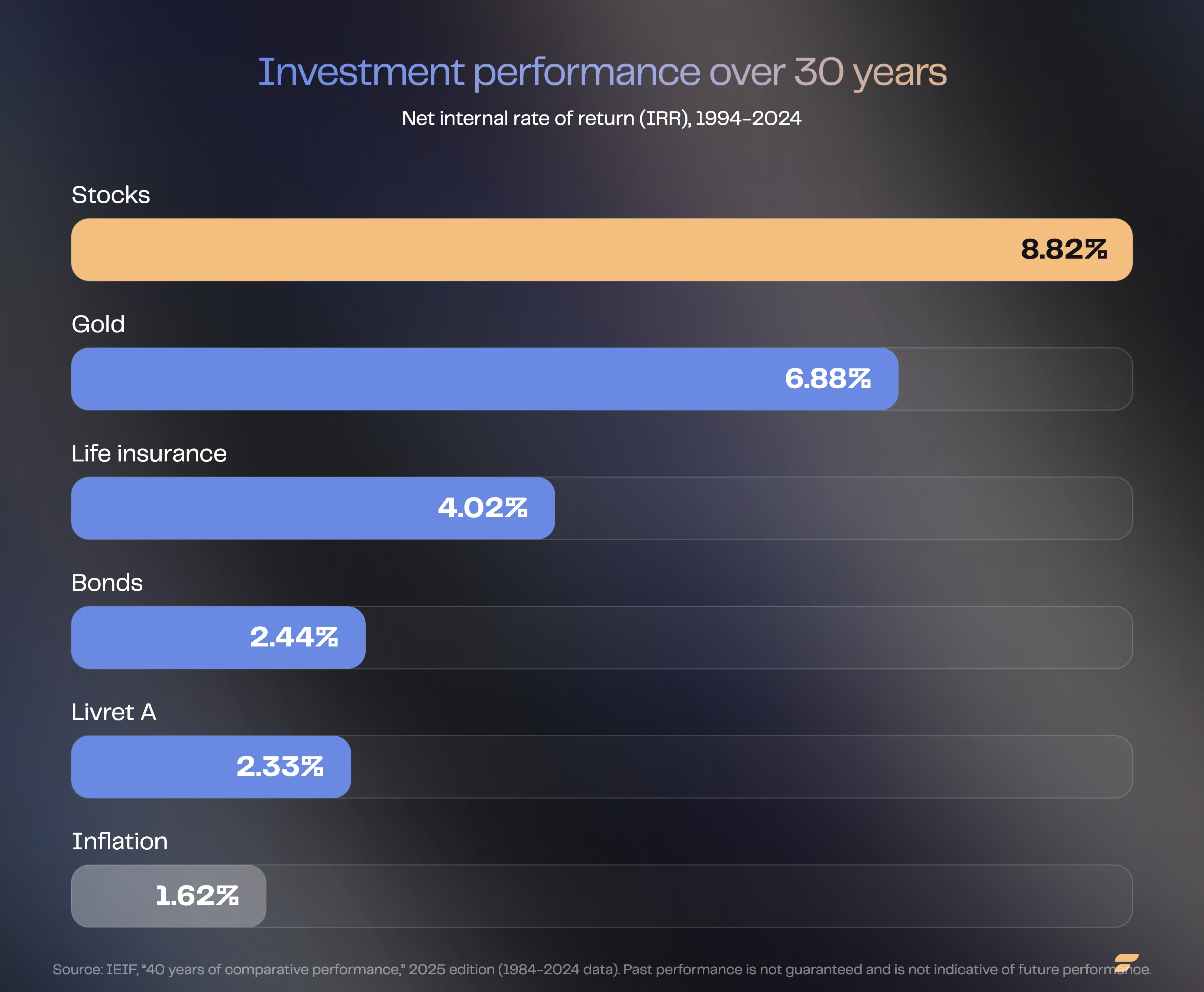
Over this period, stocks come out on top with close to 8.8% annual return, ahead of gold (6.88%) and far ahead of bonds (2.44%) and the Livret A (2.33%), barely above inflation.
It is also important to factor in the dividends generated by stocks, which are best reinvested as they accumulate. Dividends are like interest paid year after year. If reinvested in stocks, subsequent dividends are paid on a larger number of shares, provided the company keeps paying them: nothing obliges it to. This phenomenon is called compound interest.
Here is a worked example, under a simplified assumption of a constant dividend of €0.50 per share and a stable share price of €10. This is neither a forecast nor a return commitment:
Note that this example does not account for changes in the share price, assumed stable at €10. Over the very long term, US stocks have risen by about 8% per year on average, but this average masks some sharply negative years and is no guide to future performance.
As you can see, investing in the stock market can be seen as a long-term savings vehicle, with a very competitive return compared with other investments available on the market.
Investing in stocks is not the most popular financial investment among the French. It can indeed seem complicated to start investing in the stock market when you are not a finance expert. However, as we have just seen, stocks are, over the long term, among the best-performing investments, ahead of savings accounts and neck-and-neck with real estate depending on the period observed.
It is therefore worth seeing stock-market investing as a long-term savings method that helps you achieve your life projects. A few examples: saving for retirement, funding your children's education, or carrying out a property project.
Anyone can become a shareholder starting from €1. It is therefore wise to start putting your money into the stock market as early as possible and to reinvest fixed amounts regularly. This way, you put your savings to work and start benefiting as early as possible from the very powerful phenomenon of compound interest.
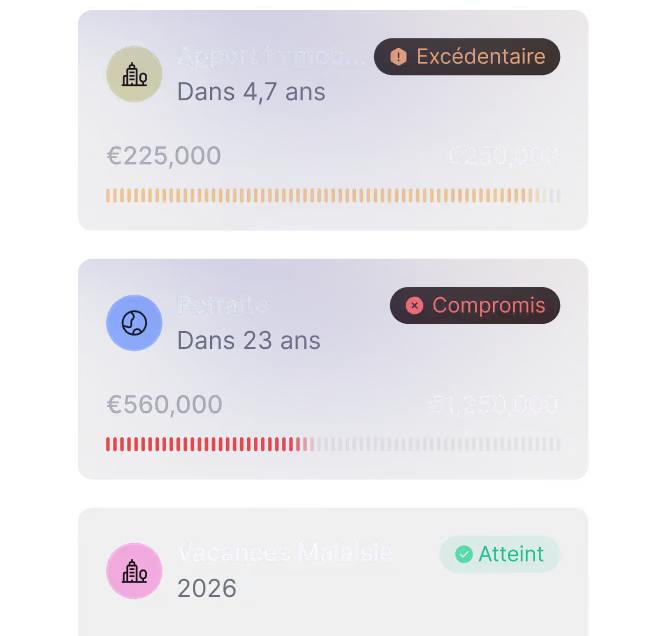
To invest in the stock market, proceed in three steps: open the wrapper suited to your horizon, decide the amount you can tie up for several years, then select your investment options. The two rules below determine how successful this journey will be.
Despite its attractive return, investing in the stock market remains a risky investment. While the idea is to grow your wealth through dividends or capital gains generated by selling shares, the return on shares can also be negative. In other words, investing in stocks can make you lose money. This loss must not impact your standard of living, so you should adapt your exposure to shares based on your risk profile, your goals and your investment horizon.
As we just mentioned, investing in the stock market can be risky, so it is important to understand it before getting started. You will find many articles and online resources to help you understand the stock market, understand the fundamentals of investor psychology, or simply sharpen your finance knowledge.
We recommend selecting resources that are relevant to your investment interests and following the corresponding economic news.
There are several ways to invest in the stock market, notably via the different wrappers we just covered. You then need to clearly define your investment strategy based on your goals, skills and preferences to choose the best financial investment.
By investing directly in stocks, you do what is known as "stock-picking" or active management. In other words, you buy shares of listed companies directly, without going through managed-portfolio services or funds (typically what is offered in life insurance), or trackers. You can therefore buy French or US shares directly by choosing whichever exchange you like best. This lets you choose to buy shares of the most popular companies on different markets, such as the CAC 40, the NASDAQ, or the S&P 500.
Stock-picking is time-consuming and statistically hard to make outperform a broad index. It is indeed difficult to predict how a particular company's share price will move unless you have a lot of time to devote to following its news. You will therefore need even more time if you diversify your stock portfolio and buy shares in several companies. Apps like Finary let you centralise the tracking of these positions across all your brokers.
By investing directly in stocks, you are trying to "beat the market" by investing directly in companies you believe in or feel a particular attachment or interest towards. Unless you are a seasoned investor, we recommend not allocating your entire portfolio to direct stock purchases. Indeed, the figures show that it is difficult to achieve outperformance on stocks and therefore to beat the market. Over the long term, statistics show that index investing (ETFs) tends to outperform most stock-picking strategies.
Investing in the stock market via trackers is an alternative if you feel you do not have enough time for stock-picking. Investing in index funds, notably via the PEA, is indeed a good way to benefit from the performance of one or more markets over the long term.
Trackers or ETFs (Exchange-Traded Funds) replicate the performance of a stock market index, such as the CAC 40 in France or the Dow Jones in the United States, for example. ETFs let you invest across the entire financial market in a single order: this is what is known as passive management, as opposed to active management, which we just covered. This approach lets your investments work on their own without needing to closely follow the activity of one or more companies, because you choose to invest in an index that can replicate the activity of a group of companies in a defined geographic area (example of a European ETF: Amundi PEA MSCI Europe UCITS ETF, ISIN FR0013412038), in a particular sector (example of a healthcare-sector ETF: Amundi MSCI World Health Care UCITS ETF, ISIN LU0533033238), or even worldwide (example of a "world" ETF: Amundi MSCI World Swap UCITS ETF, ISIN LU1681043599).
Passive investing lets you grow your wealth by benefiting from stocks' good returns without having to constantly watch market movements. As we saw above, stock performance is attractive over the long term, and investing in ETFs, notably via the PEA, is an approach that lets you diversify your wealth without spending too much time on it, while benefiting from the tax advantages of a wrapper like the PEA.
Investing in commodities is not the first thing that comes to mind when thinking about stock-market investing. Yet it is a good way to diversify your investments while contributing to the basic functioning of the economy, notably in the energy or agricultural sectors.
Here is a ranking of the most heavily traded commodities:
It is possible to trade commodities via an online broker (generally the same broker as your securities account) or via commodity ETFs.
Another alternative for investing in the stock market is investing in bonds, considered less risky than shares, notably because they are less volatile, but also because creditors rank ahead of shareholders in the event of default. Bonds are also a good way to diversify your wealth, notably because the bond market does not behave the same way as other markets during an economic crisis.
To invest in bonds, you can go through the euro fund, via life insurance or the PER. Very accessible and offering a regulated capital guarantee, the euro fund is very popular in France despite a historically modest return. The guarantee rests on the insurer and may be subject to the French "Sapin 2" law; FGAP (Fonds de Garantie des Assurances de Personnes) protection applies under certain conditions. It is also possible to invest via bond funds, accessible in life insurance through unit-linked funds or in a standard securities account. Unlike the euro fund, there is a wide range of bond funds with different return/risk profiles.
Depending on the fund you choose, you will have access to different types of bonds. Before investing, we recommend looking at bond ratings from the major rating agencies Standard and Poor's, Moody's and Fitch Ratings to fully gauge the risks. You can then choose to invest in highly rated bonds (between AAA and BBB-), or Investment Grade (IG) bonds from companies judged to be financially solid with a low risk of repayment default, which offer a degree of safety, or you can also opt for bonds rated BB+ to C, or High Yield bonds, which are riskier and therefore better paid.
You can also invest in government bonds, or Treasury bonds, where you are effectively lending money to a government. The coupon payments will then depend on the country's own credit rating and its ability to meet its debt obligations.
Good to know : We cannot say it enough: you need to invest in the stock market for the long term. It is therefore important to diversify your investments by making the most of the different wrappers available to you and benefiting from the resulting tax advantages. Investing short term significantly increases the risk of capital loss.

Outside a tax wrapper, dividends and capital gains are subject to the flat tax (PFU) of 31.4% in 2026, made up of 12.8% income tax and 18.6% social contributions. In a PEA held for more than five years, gains are exempt from income tax and only bear the 18.6% social contributions.
It all depends on the tax wrapper you choose, but there are several ways to make money in the stock market:
One of the rules of stock-market investing is that return is proportional to risk, or in other words, the higher the return, the riskier the investment.
The average historical return on stocks has been around 8% per year over the very long term (source: Robert Shiller; past performance is not indicative of future performance), so investing in the stock market is a risky investment, notably because it involves a risk of capital loss. However, having a long-term investment horizon helps reduce that risk.
It is possible to invest small amounts in the stock market: this is known as the dollar-cost averaging strategy, which involves investing small amounts at regular intervals.
This strategy lets you benefit early from the phenomenon of compound interest. It is also possible to invest in low-cost shares (some shares or trackers can be bought for less than €10). It is therefore worth getting started and beginning to invest in the stock market as early as possible.
To get off to a good start in the stock market, you should educate yourself before investing, notably to define your investor profile, your goals, the strategy you want to put in place, and the tools or tax wrappers you want to use.
Service-public.gouv.fr: social contributions on wealth and investment income, 2026 rates
Service-public.gouv.fr: taxation of income from a PEA (Plan d'Épargne en Actions)
Robert Shiller, Yale University: historical data on the US stock market since 1871
IEIF: 40 years of comparative investment performance, 1984-2024 edition
Deutsche Börse: launch of the DAX 40, expansion of the German index to 40 constituents
Japan Exchange Group: Tokyo Stock Exchange, Japan's stock exchange
Euronext: CAC 40 index factsheet, methodology and composition
France Épargne: the CAC 40 with dividends reinvested at 28,173 points on 2 July 2026
EY: trends in the global IPO market
Curvo: historical comparison of the CAC 40 and the S&P 500 in euros
JustETF: factsheet for the Amundi MSCI World Swap UCITS ETF (LU1681043599)
JustETF: factsheet for the Amundi PEA MSCI Europe UCITS ETF (FR0013412038)
JustETF: factsheet for the Amundi MSCI World Health Care UCITS ETF (LU0533033238)
Regulatory disclaimers: Marketing communication. Investing carries a risk of partial or total capital loss. Past performance is not a reliable indicator of future performance. This article is provided for information and educational purposes only; it does not constitute personalised investment advice, a buy or sell recommendation, or tax advice. Before investing, read the Key Information Document (KID) and, where relevant, consult an authorised adviser. Finary SAS, an investment firm authorised by the ACPR (no. 19283), member of AMAFI. Insurance broker registered with ORIAS (no. 21001279), member of the CNCGP (association approved by the AMF). Crypto-Asset Service Provider (CASP) authorised by the AMF under the MiCA regime, references no. A2026-026 and no. N2026-008.