


What Are the Best Investments for Your Child in France?

Updated on 28 July 2026
Giving your child the best possible future is every parent's priority in France. By saving from today, funding their education, first car or first home becomes entirely achievable, provided you use the right method.
This article shows how to turn your child's savings into a real financial springboard: the two principles to understand, the accounts to favour depending on your time horizon, and the most underrated lever of all, financial education.

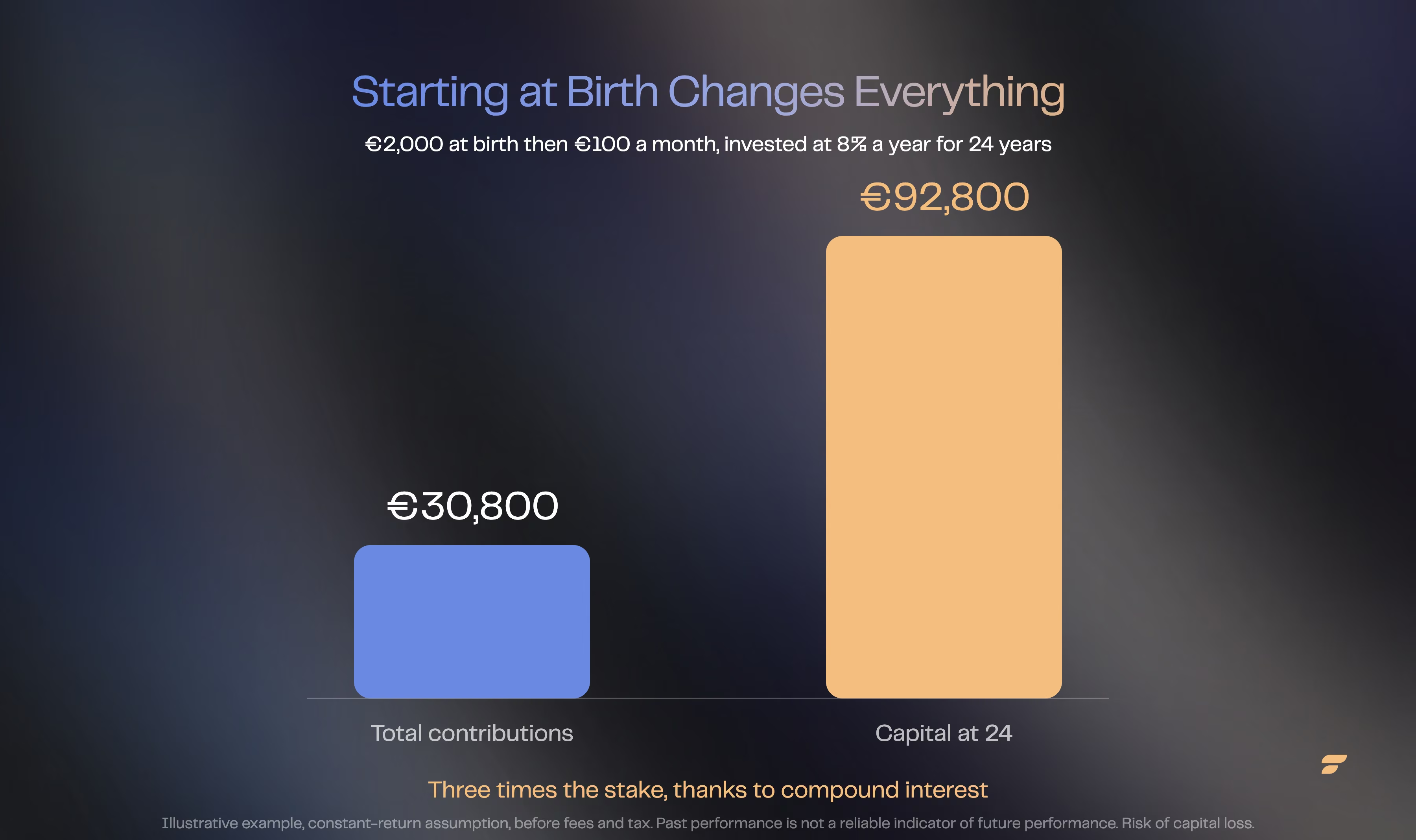
- Starting from birth gives your savings at least 18 years to grow: €2,000 followed by €100 a month at 8% a year can become €92,800 by age 24.
- The right account depends on three criteria: the goal, the time horizon and the fees.
- For the short term, the Livret A and Livret Jeune keep the capital safe; for the long term, life insurance and a securities account invested in ETFs put compound interest to work.
- The pacte adjoint attached to a manual gift lets you set conditions on how the money is used, up to the child's 25th birthday at the latest.
- The best investment remains financial education: pocket money, concrete goals and involvement in managing the savings.
Why start investing early for your child?
Because time is the greatest asset for your child's savings: by saving from birth, your child gets at least 18 years of investment horizon. And according to a Eurostat study, young people stay in the family home for an average of 23.7 years.
This span of time multiplies the effect of compound interest: the interest earned in the first year itself generates interest the following year, and so on. A snowball effect.
Example: you invest €2,000 at birth, then €100 a month, in global stock market indices with a historical return of 8% a year. By age 24, you will have paid in €30,800 in total, but the capital will reach €92,800, three times more. Past performance is not a reliable indicator of future performance.
The second principle to understand is inflation: if an account earns less than inflation, your child's savings lose value over time. The Livret A, France's flagship, government-backed, tax-free savings account, is the best illustration of this: over the past ten years, its rate has rarely beaten inflation. Investing in more dynamic assets is therefore essential as soon as the time horizon allows it.
How do you choose the right account for your child?
Three criteria determine the choice: the goal, the time horizon and the fees.
The goal. Define why you are saving: education, driving lessons, travel, a down payment for a home. A clear goal determines the right strategy.
The time horizon. How long before your child needs the money is the key factor: the stock market is not suited to a short horizon, it is too volatile.
Fees. Management or transaction fees: every percentage point translates into less return, and the snowball effect works against you too:
| Annual fees | Final capital (€2,000 over 23 years, 8% a year before fees) | Share of performance lost to fees |
|---|---|---|
| 1% | €10,147 | 20% |
| 2% | €8,098 | 36% |
| 3% | €6,450 | 49% |
Illustrative example, assuming a constant return. Past performance is not a reliable indicator of future performance.
Which accounts for the short term?
If the time horizon is short, the capital needs to stay liquid and secure: the choice comes down to regulated savings accounts.
- The Livret A: 1.7% a year since 1 August 2026 (up from 1.5% before), capped at €22,950 in contributions.
- The Livret Jeune (a regulated savings account reserved for ages 12 to 25) offers a rate at least equal to the Livret A, depending on the bank, but is capped at €1,600.
Their advantages: capital available at any time, secure, guaranteed rates net of tax. Their limits: a capped return that rarely beats inflation, and ceilings that are reached quickly.
Which accounts for the long term (more than 5 years)?
Beyond 5 years, more volatile but higher-yielding accounts let you take full advantage of compound interest.
Life insurance, the benchmark account
Two options: open a policy in the child's name, which they take over at the age of majority, or open a policy in your own name and pass it on later by donation, naming the child as beneficiary in case of accident. Our guide to life insurance for children details both scenarios.
Timing tip: open the policy before the child turns 10, so it already has 8 years of seniority, and therefore its tax benefits, by the time they reach the age of majority.
A valuable feature: the pacte adjoint attached to a manual gift (don manuel), a document that guarantees the donated money will be used as you intend. You can, for example, set the age at which the child gains access to the policy, 25 at the latest.
On the policy side, two criteria matter: low fees and a wide choice of investment options. Online banks and brokers often offer the best terms; that is Finary Life's positioning, Finary's own life insurance policy.
On the investment options side, ETFs let you gain exposure to a large number of companies through a single line and at low fees. The MSCI World covers more than 1,400 companies across 23 industrialised countries, with an average annual return of 10% over the past 45 years; the S&P 500 gives exposure to the US economy, historically higher-performing but less diversified. Past performance is not a reliable indicator of future performance. In the long run, avoid money-market funds and euro funds, which offer little potential against inflation.
within your reach
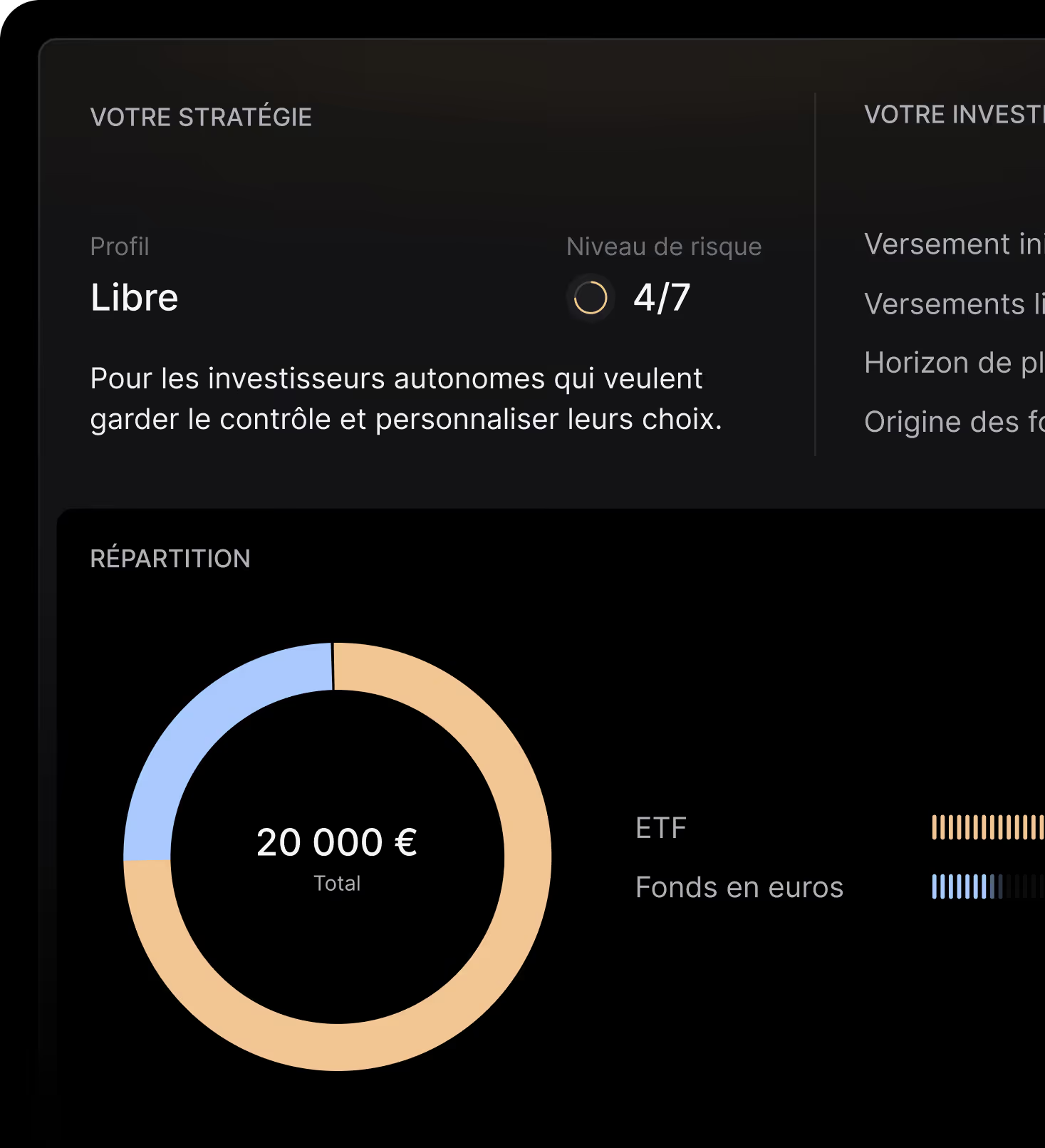
Non-contractual document for promotional purposes. Investment in unit-linked funds carries a risk of capital loss, since their value is subject to fluctuation, both upwards and downwards, depending in particular on developments in the financial markets. The insurer commits to the number of units, not to their value, which it does not guarantee. This life insurance policy (e-vie) is an individual life insurance policy, denominated in euros and/or unit-linked funds, underwritten by Generali Vie, a company governed by the French Insurance Code. Finary SAS, an investment firm authorised by the ACPR (no. 19283), member of AMAFI. Insurance broker registered with ORIAS (no. 21001279), member of the CNCGP (association approved by the AMF).
The securities account, for direct equities
An ordinary securities account lets you invest in equities, ETFs or bonds, with no cap. It is useful, for example, to hold €2,000 worth of shares in an iconic company from birth.
It offers no tax advantage, but holds one interesting trick: open the account in your own name, then make a donation whenever you choose. The transfer resets the unrealised capital gains to zero: your child receives the shares free of tax on the gains accumulated up to that point, and only the gain made after the donation will be taxable on resale.
For young adults, the PEA (a French tax-advantaged equity savings account) rounds out the toolkit: accessible from age 18, it delivers its tax benefits after 5 years of holding. Our guide how to invest in the stock market covers the basics.
Bitcoin, for parents already invested in crypto
This option is reserved for parents who already invest in crypto themselves and understand the risks. Bitcoin's historical performance exceeds that of other asset classes, but past performance is not a reliable indicator of future performance: the asset is highly volatile and the risk of total capital loss is real.
If you make this choice, limit it to a small share of the savings, held in a secure hardware wallet, with the rest invested in ETFs.
The best investment: financial education
How do you make sure the savings will not be squandered at 18? Legal solutions exist, such as the pacte adjoint. But the best protection remains financial education.
The finest legacy you can pass on is not a portfolio of ETFs. It is your child's ability to manage money for the rest of their life.
Four concrete levers:
- Explain the importance of saving from a young age: not a constraint, but a strategy for making their dreams come true.
- Encourage them to manage their own pocket money: managing a small amount themselves teaches the value of money and the difference between spending immediately and saving.
- Create concrete financial goals with the child, such as saving up for a toy.
- Involve them in managing their savings as soon as they are old enough to understand: explain where the money is invested and how the accounts work.
And if the concern remains, keep the policies in your own name and pass them on by donation whenever you judge it appropriate.
Goals
Frequently asked questions
Which savings account should you open for a child?
The Livret A (1.7% a year since 1 August 2026, capped at €22,950) from birth, and the Livret Jeune from age 12, at a rate at least equal but capped at €1,600. Capital available at any time, secure and tax-free, but a return that rarely beats inflation.
Can you open a life insurance policy in a child's name?
Yes, from birth, with the consent of the child's legal guardians. The child takes over the policy at the age of majority, unless a pacte adjoint delays its use until 25 at the latest. Opening the policy before the child turns 10 guarantees the tax benefits of 8 years of seniority by the age of majority.
What is a pacte adjoint attached to a manual gift?
A document that governs how a sum given to a child can be used: it lets you, for example, set the age at which the child can access the life insurance policy funded by the gift, 25 at the latest. It is the legal safeguard that complements financial education.
MSCI World or S&P 500 for a child's savings?
The MSCI World gives exposure to more than 1,400 companies in 23 industrialised countries (average return of 10% a year over 45 years); the S&P 500 gives exposure to the US economy, historically higher-performing but less diversified. The choice comes down to your own convictions. Past performance is not a reliable indicator of future performance.
How do you stop the child from spending everything at 18?
Two safeguards: the pacte adjoint, which can delay access to the funds until 25, and keeping the policies in your own name with a later donation. The most effective solution over the long run remains financial education: pocket money, concrete goals, involvement in managing the savings.
Sources
Service-Public - Livret A
Service-Public - Livret jeune
Eurostat - When do young people in the EU leave home ?
Regulatory disclaimers: Marketing communication. Investing carries a risk of partial or total capital loss. Past performance is not a reliable indicator of future performance. This article is for information and educational purposes only; it does not constitute personalised investment advice, a buy or sell recommendation, or tax advice. Crypto-assets are highly volatile and carry a risk of total capital loss. They benefit from no capital guarantee and are not covered by deposit-guarantee or investor-compensation schemes. Before investing, read the Key Information Document (KID) and, where relevant, consult an authorised adviser. The capital guarantee on euro funds is provided by the insurer and depends on its financial strength. In a severe systemic crisis, the French Sapin 2 law allows withdrawals to be temporarily restricted (liquidity), without affecting the guaranteed capital. Unit-linked funds are not guaranteed and carry a risk of capital loss. Finary SAS, an investment firm authorised by the ACPR (no. 19283), member of AMAFI. Insurance broker registered with ORIAS (no. 21001279), member of the CNCGP (association approved by the AMF). Crypto-Asset Service Provider (CASP) authorised by the AMF under the MiCA regime, references no. A2026-026 and no. N2026-008.