


Which Tax Wrapper Should You Choose to Invest Your Money in France?

Updated on 30 July 2026
There are four main tax wrappers for investing your money in France: the ordinary securities account, life insurance, the capitalisation contract, and the PEA (a French tax-advantaged equity savings account). Each serves a different purpose, unlimited diversification, wealth transfer, or income tax exemption after 5 years, depending on the investment horizon you are aiming for.

- The ordinary securities account (CTO) offers no tax advantage, but lets you invest with no contribution cap, anywhere in the world.
- Life insurance applies reduced taxation on gains after 8 years and a €152,500 allowance per beneficiary on wealth transfer.
- The capitalisation contract works like life insurance, but is included in the taxable estate, which means it can be gifted during the holder's lifetime.
- The PEA is capped at €150,000 (€225,000 with the PEA-PME) and exempts gains from income tax after 5 years.
| Wrapper | Contribution cap | Main tax advantage | Recommended horizon |
|---|---|---|---|
| Ordinary securities account (CTO) | None | None (flat tax (PFU) 31.4% from the 1st euro) | Any horizon |
| Life insurance | None | 24.7% on gains after 8 years (instead of 30%); €152,500 inheritance allowance per beneficiary | 8 years and more |
| Capitalisation contract | None | Same as life insurance, but transferable by gift during the holder's lifetime | 8 years and more, for early wealth transfer purposes |
| PEA / PEA-PME | €150,000 (€225,000 combined with the PEA-PME) | Income tax exemption after 5 years | 5 years and more |
What is the ordinary securities account (CTO)?
The ordinary securities account (or financial instruments account) is a wrapper that lets you hold a very wide range of financial assets and invest on the stock market. Stocks, bonds, investment funds... This wrapper offers maximum diversification, with no geographic limit and no investment cap.
Any private individual can open an ordinary securities account, provided they are of legal age (or an emancipated minor).
That said, the securities account offers no tax advantage on investment income. Interest, dividends and capital gains received are subject to ordinary taxation. According to the French tax authority (impots.gouv.fr), the flat tax (PFU) stands by default at 31.4% (12.8% income tax and 18.6% social security contributions since 1 January 2026), with the option to choose the progressive income tax scale instead.
The wide range of assets available through a securities account makes it a wrapper frequently used to build up a coherent financial portfolio. Still, because it offers no tax advantage, it is best seen as a complement to other tax wrappers (life insurance, PEA). It lets you increase your portfolio's diversification with assets that could not be held in a PEA (European equities only) or in life insurance (a more or less restricted asset choice depending on the insurer).
On fees, the ordinary securities account is one of the wrappers with the lowest costs (unless you trade frequently, since transactions can incur commissions).

How does life insurance let you pass on capital?
Despite its misleading name, life insurance is not designed to compensate you in the event of death, but to build a portfolio of financial assets that can be passed on to beneficiaries when you die. Life insurance therefore has two distinct features:
- a tax wrapper that lets you invest your money in financial assets and, on a full or partial withdrawal, benefit from a preferential tax rate on investment gains from the 8th year onward (24.7% instead of 30% on the portion of contributions below €150,000, tax regime in force as of 30 July 2026);
- the option to pass on the capital held in the life insurance policy to designated beneficiaries, outside the ordinary tax and civil inheritance rules.
On its investment side, life insurance offers a degree of flexibility:
- Euro-fund life insurance where the capital invested is guaranteed by the insurer (a guarantee that depends on its financial strength), but with generally modest returns. Euro-fund life insurance nonetheless remains an attractive alternative to a bank savings account for building your emergency fund, thanks to a higher rate of return. Just make sure the policy allows for early withdrawal facilities, so you can quickly withdraw all or part of your capital.
- Unit-linked life insurance where the capital is generally invested in a selection of investment funds (UCITS, ETF, or even property funds if your insurer offers them). Naturally, with unit-linked funds the capital is not guaranteed, offering higher return potential but a risk of capital loss. If you plan to invest in a broad, diversified selection of equities through a fund, unit-linked life insurance is an excellent solution.

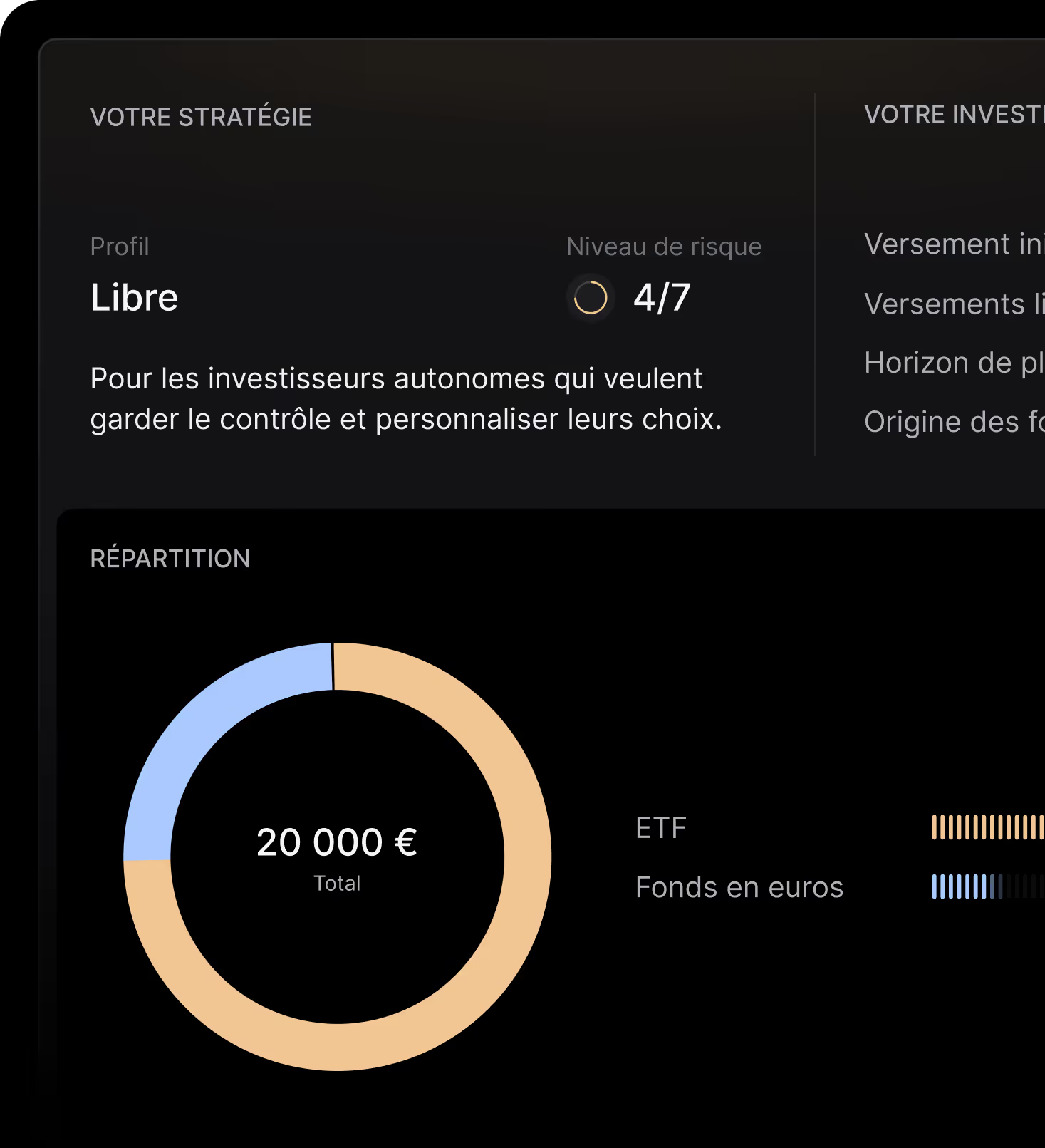
For example, it is possible to take out a life insurance policy online with Finary, underwritten by Generali Vie, with a euro fund and a selection of unit-linked funds. If your goal is to invest your money with a view to passing it on when you die under favourable tax conditions, the estate-planning side of life insurance can also be particularly worthwhile. Indeed, the capital in your life insurance policy escapes the taxable estate and is passed on to designated beneficiaries with a €152,500 allowance per beneficiary (then a flat rate of 20% on the portion between €152,500 and €852,500, and 31.25% beyond that). A tool frequently used for estate planning and for passing on part of one's wealth to friends or distant family members.
within reach
Non-contractual document for promotional purposes. Investment in unit-linked vehicles carries a risk of capital loss, since their value is subject to fluctuation, both upwards and downwards, depending in particular on developments in the financial markets. The insurer commits to the number of units, not to their value, which it does not guarantee. This life insurance policy (e-vie) is an individual life insurance policy, denominated in euros and/or unit-linked vehicles, underwritten by Generali Vie, a company governed by the French Insurance Code. Finary SAS - 58 rue de Monceau 75380 Paris 8 - ORIAS no. 21001279
The capitalisation contract, a wealth-planning alternative to life insurance
Little known to the general public, the capitalisation contract works like life insurance, letting you both invest your money in financial assets (euro funds or unit-linked funds) and pass on your wealth.
The major difference between life insurance and the capitalisation contract lies in wealth transfer. Indeed, the transfer of a life insurance policy's premiums can only happen when the policyholder dies, which winds up the contract (the investments are liquidated) under a special tax regime (since the capital in a life insurance policy is not part of the taxable estate).
With a capitalisation contract, the policyholder's death does not liquidate the investments, but the capital becomes part of the taxable estate. The heirs become the new owners of the contract and the assets held within it. However, unlike life insurance, a capitalisation contract can be gifted to plan ahead for succession. A gift made during the holder's lifetime can cover full ownership of the contract, or just the usufruct or bare ownership, to optimise gift tax.
How do the PEA and PEA-PME work for investing in European equities?
The share savings plan (PEA) is a tax wrapper dedicated to buying European equities or units in investment funds (UCITS or ETF) made up of at least 75% PEA-eligible equities. Opened with a bank or a specialised broker, it lets you hold listed and unlisted shares up to a contribution cap of €150,000. There is also its small and medium enterprise counterpart, the PEA-PME, ideal for holding shares acquired through a Private Equity deal. Combined, the two accounts' contribution cap cannot exceed €225,000.
The notable advantage of the PEA and PEA-PME lies in the income tax exemption on investment income from the 5th year onward, which makes them particularly relevant for equity investments with a horizon of 5 years or more. Note that an early withdrawal of contributions from a PEA before the 5th year closes the plan.
The only snag with the PEA is that it cannot hold anything other than European equities. So if you put all your money into a PEA, your portfolio will not be diversified enough, with significant geographic risk and a lack of diversity across asset classes. In other words, you would be 100% exposed to European equities, which is not satisfactory. There are ways to work around this limitation by using synthetic PEA-eligible ETFs. Many asset managers such as BlackRock or Amundi use this method to offer ETFs on the S&P 500 or the MSCI World.
Frequently asked questions
Which tax wrapper should you choose to start out?
To start out, the ordinary securities account or the PEA are the easiest wrappers to open. The PEA is relevant if the goal is to invest in European equities over at least 5 years, the securities account if you are looking for uncapped worldwide diversification.
Can you combine several tax wrappers?
Yes, these wrappers are not mutually exclusive: it is common to combine a PEA for European equities, a securities account for the rest of the world, and life insurance or a capitalisation contract for wealth transfer.
What happens if you withdraw before the tax deadlines?
A withdrawal before 5 years on a PEA generally closes the plan and forfeits the tax advantage. On life insurance, a withdrawal before 8 years remains possible, but gains are taxed at the full 30% rate, without the annual allowance that applies after 8 years.
Which wrapper should you favour to plan for succession?
Life insurance is the most widely used wrapper for wealth transfer, thanks to the €152,500 allowance per beneficiary outside the estate. The capitalisation contract offers a complementary advantage: it can be gifted during the policyholder's lifetime.
Sources
Impots.gouv.fr, taxation of capital gains on securities and the flat tax (PFU) rate
Finary, the ordinary securities account (CTO), everything you need to know
Finary, should you invest with a capitalisation contract
France Assureurs, key figures on life insurance
Regulatory disclaimers: Marketing communication. Investing carries a risk of partial or total capital loss. Past performance is not a reliable indicator of future performance. This article is provided for information and educational purposes only; it does not constitute personalised investment advice, a buy or sell recommendation, or tax advice.
Before investing, read the Key Information Document (KID) and, where relevant, consult an authorised adviser.
Finary SAS, an investment firm authorised by the ACPR (no. 19283), member of AMAFI. Insurance broker registered with ORIAS (no. 21001279), member of the CNCGP (association approved by the AMF). Crypto-Asset Service Provider (CASP) authorised by the AMF under the MiCA regime, references no. A2026-026 and no. N2026-008.