


Which Risk-Free Investment Should You Choose in France?

Updated on 30 July 2026
The most reliable risk-free investments in France remain government-backed savings accounts (Livret A, LDDS, LEP, PEL, CEL) and euro funds within life insurance policies, which protect the saver's capital but offer limited returns, often close to the inflation rate. This article compares their rates, caps and conditions to help you choose the option that suits you best.

- The Livret A and the LDDS have paid 1.7% net since 1st August 2026, capped at €22,950 and €12,000.
- The LEP has paid 2.50% since August 2026, but remains reserved for lower-income households under a reference-taxable-income requirement.
- Life insurance euro funds paid an average of 2.6% in 2025, a higher return than savings accounts but not guaranteed.
- Bank deposits are protected up to €100,000 by the FGDR, and life insurance savings up to €70,000 by the FGAP.
- Zero risk never fully exists: even regulated products carry a counterparty risk, very small but not nil.
| Risk-free investment | Rate as of 1st August 2026 | Key features |
|---|---|---|
| Livret A | 1.7% | €22,950 cap, no income requirement, direct State guarantee |
| LDDS (sustainable and solidarity development savings account) | 1.7% | €12,000 cap, reserved for adults (or minors not attached to a tax household), no income requirement |
| LEP (popular savings account) | 2.50% | €10,000 cap, reserved for households whose reference taxable income does not exceed €23,028 for a single person |
| Livret Jeune | Rate set freely by each bank, at least 1.7% | €1,600 cap, reserved for ages 12 to 25 |
| PEL (home savings plan) | 2% gross, 1.40% net | Rate fixed at opening and guaranteed for 15 years (for a PEL opened since 1st January 2026). Withdrawing closes the plan. €61,200 cap. Gives access to a preferential-rate home loan |
| CEL (home savings account) | 1.25% | €15,300 cap. Gives access to a home loan |
What Is a Risk-Free Financial Investment?
A risk-free financial investment is, by definition, one that tends to limit the saver's risk of capital loss. It is an ideal solution for very cautious wealth management. That said, capital-loss risk is only the result of one particular risk materialising. For example, euro funds are considered risk-free investments since the capital is protected by the insurer. However, the insurer offering the euro fund could very well go bankrupt, meaning you might not recover the full amount of your investment. Fortunately, there is a guarantee mechanism funded by insurers themselves, the Fonds de garantie des assurances de personnes (FGAP, France's personal insurance guarantee fund), which protects life insurance policies up to €70,000 per policyholder and per insurer.
This example demonstrates two things: zero risk does not exist, although the probability of a euro fund failing at the same time as the State backing it is very low, and the risk of loss is often tied to a cause independent of the investment chosen, even when the capital is protected. Several types of risk can therefore be identified.

The Different Types of Risk in a Financial Investment
In finance, there are many types of risk, including:
- the market risk, i.e. the upward or downward fluctuation in an asset's price (stocks for example). In principle, an investment is considered risk-free when it is not exposed to market risk. There can be exceptions, such as certain debt securities admitted to trading on a regulated market.
- the liquidity risk, i.e. the ability to sell your investment quickly to convert it back into euros. This is the case for certain unlisted investments or, by extension, term savings products where the money is locked in an account for a set period, with no possibility of withdrawal.
- the currency risk tied to the fluctuation of one currency against another. For example, when you make a risk-free investment in a foreign currency (buying a World ETF, which for example includes US stocks), you are exposed to exchange-rate fluctuations. Your investment is only risk-free if you hedge against this currency risk.
- the counterparty risk, i.e. the probability that the counterparty fails to honour its commitments. This is, for example, the type of risk that can arise when you invest in a euro-fund life insurance policy and your insurer goes bankrupt, or when the bank where you opened your Livret A becomes insolvent. This is very rare, but it can happen.
Alongside these known risks, there are the famous black swans introduced by Nicholas Taleb, which are unpredictable risks with a very low probability of occurring. Because they are underestimated, these black swans can have disproportionate consequences. COVID, for example, was a black swan, impossible to predict.
Good to know : the purpose of this risk inventory is not to scare you, but to sharpen your critical thinking when assessing the risks of each financial investment. Even though French regulation requires investment providers to clearly inform savers of the risks involved, remember that there is no return without risk.
What Return Can You Expect From a Risk-Free Investment?
Before covering the reasons to invest risk-free and the different types of investment, it is worth looking at the returns of this category of investment. This will help answer the question: where to invest your money?
As mentioned: in finance there is no return without risk. This saying means that, in theory, differences in return between assets reflect a proportional exposure to risk. The more profitable an investment is, the riskier it is by nature. Otherwise, it is a temporary market anomaly, and everyone would have an interest in investing in that asset rather than another, bringing its return back down to a normal level.
In practice, however, things are not perfect, for various reasons: investor psychology, market imperfections, information asymmetry, barriers to entry, and so on. There can therefore be investments with an equivalent level of risk that deliver different returns.
As a benchmark, the reference risk-free rate is often that of a government bond considered solvent (rated AAA or close to it). After several years of historically low, even negative, rates between 2020 and 2021, bond yields on trusted governments turned clearly positive again following the ECB's key rate hikes in 2022-2023: the 10-year French OAT, for example, showed a yield of around 3.2% to 3.8% in the first half of 2026. For an individual saver, however, this rate is not a directly accessible risk-free benchmark, since the price of a listed bond can fluctuate before maturity.
This is why the Livret A rate, 1.7% since 1st August 2026, often serves as a practical benchmark for risk-free investment returns for an individual saver. The Livret A ticks every box of a risk-free investment:
- no market risk: the value of your savings does not fluctuate with any market
- no liquidity risk: you can transfer money to your current account instantly
- no currency risk: the Livret A is denominated in euros
- very low counterparty risk: the bank can fail, but the State guarantees deposits up to €100,000 per banking institution.
The main drawback of the Livret A is that its return, even after rising to 1.7% since 1st August 2026, remains close to but slightly below the inflation rate (1.8% year-on-year in June 2026 according to Insee), which limits the growth in purchasing power of the savings invested. It nonetheless remains suited to short-term emergency savings.
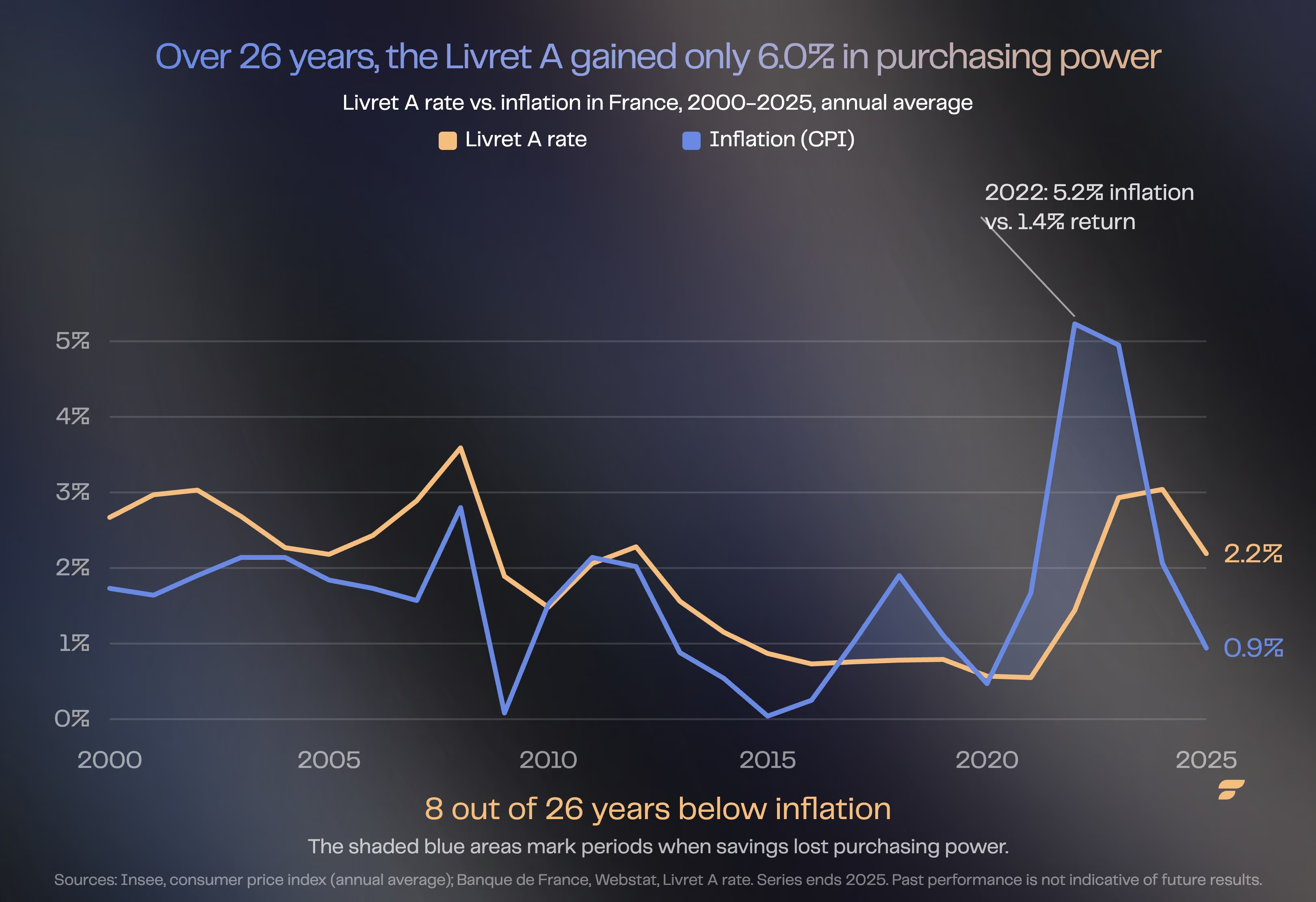
For medium- to long-term investments, it is possible (and necessary) to find risk-free investments offering higher returns.

The Different Risk-Free Investments
There are two main categories of risk-free investment:
- the regulated savings products
- the euro funds
They all share one thing in common: the saved capital is protected, either by a direct State guarantee (Livret A, LDDS, LEP) or by the deposit guarantee (FGDR) or the insurance guarantee (FGAP), depending on the product.
Regulated Savings Products
The best-known risk-free investments are the regulated savings products. Offered by banks, these are mainly savings accounts offering rates set by the State. The capital is protected and, as with the Livret A, the only identifiable risk is counterparty risk. The Livret A, the LDDS and the LEP benefit from a direct State guarantee, managed by the Fonds de garantie des dépôts et de résolution (FGDR, France's deposit guarantee and resolution fund); the PEL and the CEL are covered, like any standard bank deposit, by the FGDR's deposit guarantee up to €100,000 per depositor and per institution.
Aside from the LEP and the PEL, risk-free regulated savings products do not offer returns that keep pace with inflation.
Banks can also offer their own in-house savings solutions, such as boosted savings accounts or term deposit accounts. But returns are rarely much higher, unless the saver agrees to lock up their savings for a set period through a term deposit account.
Good to know : some people were lucky enough to open a PEL when rates were far higher than today (over 4% before the 2000s). If you are one of them, your old PEL can be a very attractive risk-free investment: its rate is fixed at opening and guaranteed for its entire term. For everyone else, a PEL opened since 1st January 2026 pays 2% gross, which is still decent for a risk-free investment, but it may be worth considering other options to invest €20,000 (or your savings)!
Euro Funds in Life Insurance Policies
Euro-fund life insurance is a risk-free investment whose capital is protected by the insurer, with returns generally higher than bank savings accounts. Euro funds paid an average of 2.6% in 2025, a third consecutive year at that level according to France Assureurs and the ACPR, making them one of the most profitable risk-free investments currently available to the general public.
Made up largely of government and corporate bonds, euro funds benefit from a ratchet mechanism: the return paid each year is locked in for good and cannot be lost. After several years of decline, their returns have stabilised since 2023, supported by rising bond yields; they nonetheless remain liable to change from one year to the next depending on markets.
Is It a Good Idea to Invest in a Risk-Free Financial Investment?
Relying solely on risk-free investments is not recommended over the medium or long term, since it exposes your savings to a gradual erosion of purchasing power from inflation. The economic climate is, in fact, not favourable to taking zero risk at all. Unless you accept watching your savings eroded by inflation every year, you will need to turn to other financial investments. The main issue with riskier investments, however, is exposure to market risk. Whether it is real estate, stocks or cryptocurrencies (via bitcoin or DeFi crypto in particular), the value of these assets can rise or fall depending on market conditions.
That said, market risk can be managed. By adopting the right investment strategy, you can significantly reduce the risk you take on. Broadly, this strategy involves:
- ensuring a sufficient level of diversification so that a decline in some investments is offset by the performance of others;
- investing your money over a long horizon. Indeed, whether in the real estate or stock market, prices are generally upward-trending over the long term. By investing over a long-term horizon, you smooth out the effects of volatility and grow your savings over time.
Want to make your savings work harder? Talk to Finary or your wealth management advisor !
Goals
Frequently Asked Questions
What Is the Most Profitable Risk-Free Investment?
In 2026, the life insurance euro fund remains the most profitable risk-free investment for an individual, with an average return of 2.6% in 2025 according to France Assureurs, compared with 1.7% for the Livret A and the LDDS, and up to 2.50% for the LEP under an income requirement.
What Are Risk-Free Financial Investments Used For?
Risk-free financial investments are mainly used to build an emergency fund that is quickly available in case of the unexpected. They also help reduce a portfolio's overall risk by offsetting more dynamic investments such as stocks or cryptocurrencies, which are exposed to market risk.
Is the Livret A a Viable Risk-Free Investment?
The Livret A remains suited to short-term emergency savings thanks to its immediate availability and the State guarantee. With a rate of 1.7% since 1st August 2026, close to inflation (1.8% year-on-year in June 2026), it does not make for a long-term performance investment.
What Is the Difference Between the Livret A, the LDDS and the LEP?
The Livret A and the LDDS share the same rate, 1.7% since 1st August 2026, with no income requirement, and caps of €22,950 and €12,000. The LEP offers a higher rate, 2.50%, reserved for households whose reference taxable income does not exceed €23,028 for a single person.
What Happens If My Bank or Insurer Goes Bankrupt?
Bank deposits, including regulated savings accounts, are protected by the Fonds de garantie des dépôts et de résolution (FGDR) up to €100,000 per institution. Life insurance policies, including euro funds, are separately covered by the Fonds de garantie des assurances de personnes (FGAP) up to €70,000 per insurer.
Sources
Service-public.fr, how the Livret A works: rate and deposit cap
Service-public.fr, Livret de développement durable et solidaire (LDDS): conditions and cap
Service-public.fr, Livret d'épargne populaire (LEP): rate, cap and income requirements
Service-public.fr, changes to the home savings plan (PEL) rate
Economie.gouv.fr, how the home savings account (CEL) works
MoneyVox, new regulated savings account rates published in the Journal officiel, August 2026
La finance pour tous, rising returns for euro funds in 2025
Insee, consumer price index, June 2026
Economie.gouv.fr, what is the deposit guarantee
FGAP, Fonds de garantie des assurances de personnes, frequently asked questions
MoneyVox, the bank deposit guarantee: amount, accounts and banks covered
Regulatory disclaimers: Marketing communication. Investing carries a risk of partial or total capital loss. Past performance is not a reliable indicator of future performance. This article is provided for information and educational purposes only; it does not constitute personalised investment advice, a buy or sell recommendation, or tax advice. Before investing, read the Key Information Document (KID) and, where relevant, consult an authorised adviser. Finary SAS, an investment firm authorised by the ACPR (no. 19283), member of AMAFI. Insurance broker registered with ORIAS (no. 21001279), member of the CNCGP (association approved by the AMF). Crypto-Asset Service Provider (CASP) authorised by the AMF under the MiCA regime, references no. A2026-026 and no. N2026-008.