


The PER, Luxembourg life insurance and Lombard loan combo in France: a three-tier wealth strategy

Updated on 8 July 2026.
Few articles explain how these three building blocks fit together.
The PER, Luxembourg life insurance and Lombard loan combo is a three-tier wealth strategy in France: the PER (France's retirement savings plan) prepares for retirement by reducing tax, Luxembourg life insurance houses the capital in a wrapper built for management and protection, and the Lombard loan, secured against that policy, frees up cash without selling anything.
It is not a miracle formula, and it is certainly not for everyone: it is a leveraged strategy, with a real risk. Here is how the three tiers fit together, who it suits, and where the limits lie.

- PER tier: contributions are deductible from taxable income (up to €37,680 for an employee in 2026), but the capital stays locked and is re-taxed on withdrawal.
- Luxembourg life insurance tier: its tax treatment is that of a French policy (17.2% social security contributions), and its added value is protection (the security triangle) and tailored management.
- Lombard loan tier: this loan, secured by a pledge over the policy, frees up cash without divesting, but it is leverage, so a real risk.
- The central risk is the margin call: if the pledged assets fall, the bank can demand, within 24 to 72 hours, additional collateral or liquidate your assets.
- 2026 asymmetry: social security contributions on the PER rose to 18.6%, while life insurance stays at 17.2%.
This article describes a mechanism and does not constitute investment advice, a recommendation, or personalised tax advice. A leveraged strategy carries a risk of amplified loss. A loan is a binding commitment and must be repaid. Implementation is a matter for a wealth management advisor.What role does the PER play in this strategy?
The PER, or Plan d'Épargne Retraite, has a simple appeal: contributions are deductible from that year's taxable income (art. 163 quatervicies of the French Tax Code for employees). The higher your marginal tax rate, the bigger the saving, which makes it a popular tool among high earners. The 2026 cap runs up to €37,680 for an employee and around €88,911 for a self-employed worker.
But two constraints that sales pitches tend to leave out need naming. First, the PER stays locked until retirement, barring a few cases of early release (buying a primary residence, life accidents). Second, the deduction is a deferral, not an exemption: on withdrawal as a lump sum, the portion matching the contributions is re-taxed under the income tax scale, and the gains face the flat tax (31.4% in 2026, PER social security contributions raised to 18.6%). The upfront benefit is a deferral, not a write-off.
The PER therefore occupies the "upstream retirement" tier of the strategy. It builds capital; it does not provide liquidity, unlike a mechanism such as the apport-cession scheme, which mobilises the proceeds of a business sale.
Why house the capital in Luxembourg life insurance?
The available capital, meanwhile, is housed in Luxembourg life insurance. Its appeal is not a tax advantage of its own: for a French tax resident, the tax treatment is strictly that of a French life insurance policy (art. 125-0 A of the French Tax Code, 17.2% social security contributions). What it brings is protection and management.
Protection first: the security triangle segregates your assets between the insurer, the custodian bank and the regulator, and the super-privilege makes you an uncapped, first-ranking creditor. Management second: through a FID (Fonds Interne Dédié, a dedicated internal fund) or a FAS (Fonds d'Assurance Spécialisé, a specialised insurance fund, reserved for financial wealth of at least €1.25 million), the investment universe is far wider than in France. We detail these mechanisms in our dedicated article on Luxembourg life insurance.
The same wrapper logic applies, on the corporate side, to a holding company's cash reserves. Above all, this policy can be pledged. That is the bridge to the third tier.
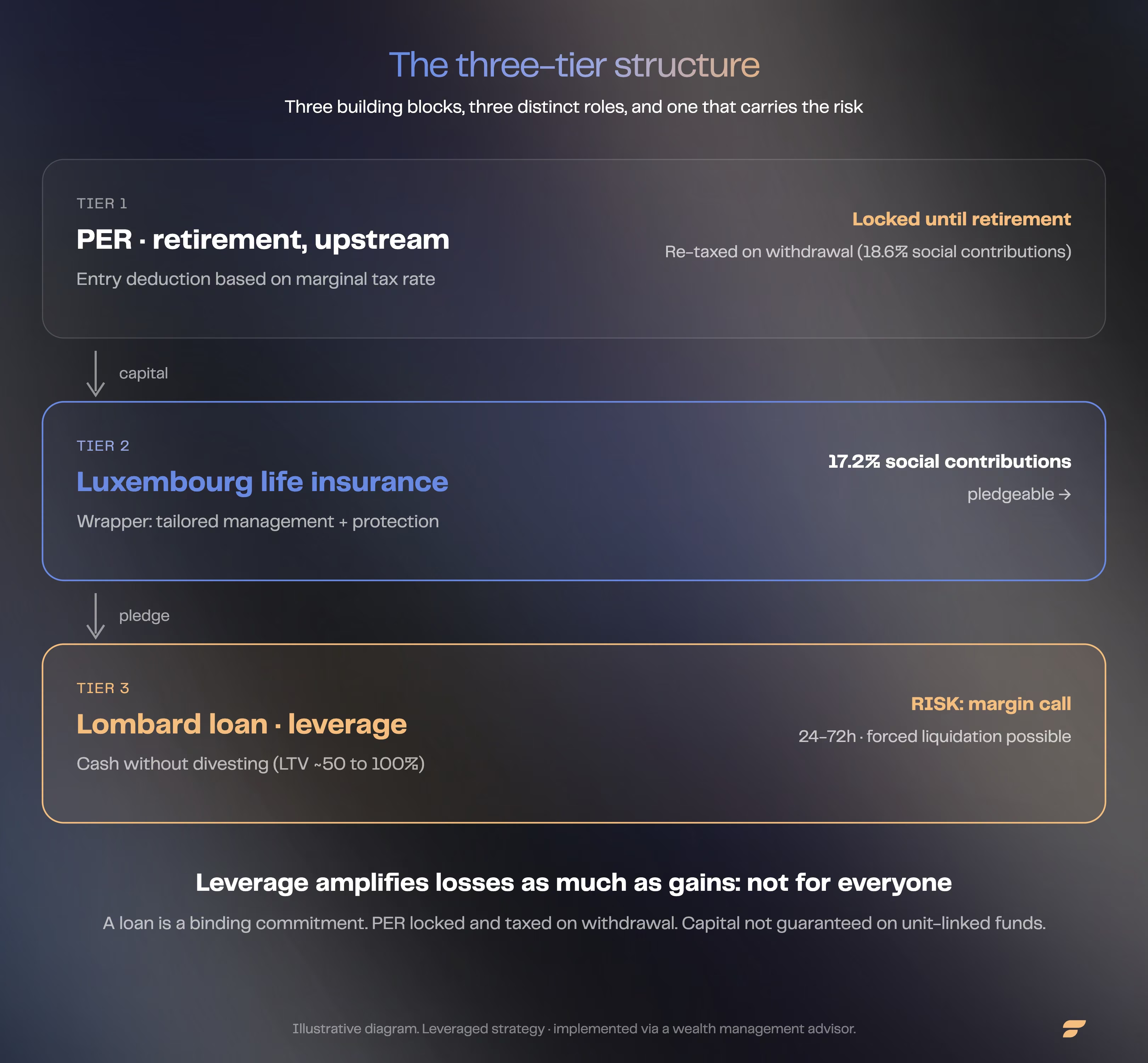
Three tiers, three distinct roles: prepare, house, mobilise. It is how they fit together that makes the strategy work, provided their functions are never confused.

How does a Lombard loan free up cash?
A Lombard loan is a bank loan secured by a pledge over financial assets, here the Luxembourg life insurance policy. You remain the owner of your assets, which keep working, but you cannot withdraw them for as long as the pledge runs. In exchange, the bank lends you a fraction of their value, the loan-to-value ratio (LTV), set case by case according to the quality of the assets: around 50% for volatile equities, up to nearly 100% for highly liquid holdings.
The appeal is real: raising cash, for a project or a reinvestment, without divesting the policy, so without triggering the tax on a withdrawal or losing the tax seniority. The rate is variable, indexed to a market reference rate (Euribor or €STR) plus a margin. It is a bank's contractual product, not a legal scheme: a loan is a binding commitment and must be repaid.
The risk you need to face head-on: the margin call
This is the point that decides whether this strategy is for you. A Lombard loan is leverage, and leverage amplifies losses as much as gains.
The regulator does not mince words. According to the Autorité des marchés financiers (AMF), the French financial markets regulator: "leverage amplifies gains and losses. If the underlying asset moves the wrong way, the holder can lose their entire investment." The principle applies to any leveraged strategy, Lombard loans included.
If the value of the pledged assets falls and the loan ratio exceeds the contractual threshold, the bank triggers a margin call: it demands, often within 24 to 72 hours, additional collateral, a partial repayment, or it forces the liquidation of your assets. In a falling market, that sale happens at the worst possible time and locks in losses. You can even remain liable for a residual debt if the liquidated value does not cover the loan. On top of that comes rate risk: since the Lombard loan carries a variable rate, its cost can climb.
This risk is not theoretical. It means a leveraged strategy is only justified for wealth able to absorb a margin call without being forced into a corner, and only after a precise assessment of repayment capacity.
Does the PER really belong here?
A fair question, since the PER is the most debatable tier of the strategy. The honest answer is: it depends on your tax situation.
The PER makes sense if your marginal tax rate is high today and you expect a lower one at retirement: the entire benefit rests on that gap between the upfront deduction and the re-taxation on withdrawal. It also makes sense as a building block for retirement capital, kept separate from your available pocket of wealth.
The PER does not belong here if you are after liquidity, since it stays locked, nor if your tax bracket will not fall at retirement, because the upfront benefit is then clawed back on withdrawal. And one point must be clear: it is not the PER that serves as collateral for the Lombard loan, it is the life insurance policy. The PER funds the upstream tier; it does not feed the leverage. Confusing it with a pocket of liquidity is the classic mistake on this strategy.
Finary One: putting it together without putting yourself at risk
A three-tier strategy like this one only makes sense when thought through against the whole of your wealth: your actual tax situation, your horizon, your capacity to absorb a setback, your estate planning goals. Taken in isolation, each building block is defensible; poorly assembled, they create a risk you do not control.
That is Finary One's role. Your wealth, professional and personal, invested with us as well as elsewhere, is aggregated and read as a whole through the Finary app. Your private wealth manager, backed by a wealth engineer, assesses whether such a structure serves your situation, measures its risks, leverage in particular, and coordinates the dialogue with your advisors. Our role is not to sell you a strategy, but to check that it protects you as much as it serves you.
Finary SAS is an investment firm authorised by the ACPR (no. 19283). This article is for informational purposes and does not constitute personalised investment advice; all investing carries a risk of capital loss.
The right instinct is not to stack up wrappers to optimise, it is to start from your own situation and add leverage only if it is sustainable.
Frequently asked questions
What does the PER + Luxembourg life insurance + Lombard loan combo involve?
It is a three-tier strategy: the PER prepares for retirement with an upfront tax deduction, Luxembourg life insurance serves as a management and protection wrapper, and the Lombard loan, secured against that policy, frees up cash without divesting. Each tier has a distinct role; it is a leveraged strategy reserved for established wealth.
Is the PER essential to this strategy?
No. The PER makes sense if your marginal tax bracket is high today and will fall at retirement, and as a pocket for building retirement capital. It does not if you are after liquidity (it stays locked) or if your bracket stays stable (the upfront benefit is clawed back on withdrawal). Above all, it is not the PER that secures the Lombard loan, but the life insurance policy.
What is the main risk of a Lombard loan?
The margin call. If the value of the pledged assets falls and the loan ratio exceeds the contractual threshold, the bank can demand, within 24 to 72 hours, additional collateral or liquidate your assets, often at the worst possible time, locking in losses. Leverage amplifies losses as much as gains. On top of that comes rate risk, since the loan carries a variable rate.
Why don't the PER and life insurance carry the same social security contribution rate?
Since 1 January 2026 (the 2026 Social Security Financing Act, LFSS 2026), social security contributions on PER gains rose to 18.6%, while life insurance stays at 17.2%. It is a regulatory asymmetry between the two wrappers, worth knowing, but it is not in itself a return argument.
Who is this strategy for?
For established wealth, in a high tax bracket, able to absorb a margin call without being forced to sell, and only after a precise assessment of repayment capacity. This is not a mass-market strategy: it calls for guidance from a wealth management advisor and only makes sense set within an overall strategy.
Sources
- Service-Public, PER contribution deduction (2026 caps).
- Article 125-0 A of the French Tax Code (CGI) (life insurance taxation).
- Finary, Luxembourg life insurance (FAS vs FID).
- Finary, what is a Lombard loan.
Regulatory disclaimers:
Marketing communication. Investing carries a risk of partial or total capital loss on unit-linked funds. Past performance is not a reliable indicator of future performance. This strategy relies on leverage (the Lombard loan), which amplifies losses as much as gains and exposes you to a margin call that can lead to the forced liquidation of the pledged assets. A loan is a binding commitment and must be repaid; check your repayment capacity before committing. The PER stays locked until retirement (barring early release cases) and is taxed on withdrawal. This article is for informational and educational purposes; it does not constitute personalised investment advice, a recommendation, or tax advice. The thresholds and rates cited are in force at the date of publication and may change.
Before any transaction, consult an authorised wealth management advisor.
Finary SAS, an investment firm authorised by the ACPR (no. 19283), member of AMAFI. Insurance broker registered with ORIAS (no. 21001279), member of the CNCGP (association approved by the AMF). Crypto-Asset Service Provider (CASP) authorised by the AMF under the MiCA regime, references no. A2026-026 and no. N2026-008.