


Infrastructure Funds in France: Investing in the Real Economy (Energy, Transport)

Updated on 11 August 2026.
Money has just come in: a business sale, an inheritance, a gift, a bonus, the sale of an asset. Whatever the liquidity event, the question that follows is almost always the same: how do you invest it for a recurring, predictable income, without having to sell anything?
Infrastructure funds in France aim at exactly that: they finance power plants, networks and transport lines, assets that collect tolls and regulated tariffs over twenty years, and pass on part of these flows to their investors.
An infrastructure fund is a private-equity fund, often structured as an FCPR (Fonds Commun de Placement à Risques, a French venture-capital fund) or an FPCI (Fonds Professionnel de Capital Investissement, its professional-investor equivalent), that finances the real economy, energy and transport above all, and some of which, known as distributing funds, pay a regular income. High entry ticket, capital locked in for several years, risk of capital loss. This is not a savings account with a better rate. It is a satellite asset, illiquid, with its own special taxation.
The real trap is not the headline return. It is the wrapper in which you hold this fund: depending on the tax wrapper you choose, a securities account or life insurance, the same euro distributed is not taxed the same way.
Before going into detail, an example of two profiles who add this type of asset, in the Finary One video:
 Investing carries risks, including the risk of capital loss. Infrastructure funds are illiquid investments: your capital can be locked in for several years and its value can fluctuate. Past performance is not a reliable indicator of future performance.
 - An infrastructure fund finances physical assets in the real economy (energy, transport, networks) through a private-equity vehicle, most often an FCPR or an FPCI.
- Two families: distributing funds (which pay a regular income, the “Income pocket”) and capitalisation funds (which reinvest everything until exit).
- High entry ticket (often €100,000 for an FPCI), capital locked in for several years, risk of capital loss and illiquidity.
- 2026 taxation: via a securities account, distributions and capital gains fall under the flat tax at 31.4%. The FCPR/FPCI tax regime (art. 163 quinquies B of the CGI) exempts income tax under conditions, but never social security contributions (18.6%). Held via life insurance, the income stays within the wrapper's own taxation.
- This is not a “plug and play” asset class: dispersion between funds is wide, and manager selection accounts for most of the result (source: France Invest).
What Is an Infrastructure Fund, Concretely?
An infrastructure fund invests in physical assets that finance the real economy: wind and solar farms, district heating networks, rail lines, ports, fibre networks, motorways. Rather than listed shares, it holds stakes in unlisted companies that build and operate these assets.
The appeal lies in the nature of these assets. A solar plant or a transport concession collects long-dated cash flows, often indexed to inflation or backed by multi-year contracts. It is this regularity that sets infrastructure apart from “classic” private equity, which is more focused on growth and reselling companies.
The Vehicle: a Private-Equity Fund
In France, the legal wrapper is most often a fonds commun de placement à risques (FCPR) or a fonds professionnel de capital investissement (FPCI).
- FCPR: at least 50% of its assets in unlisted company securities (art. L. 214-28 of the Monetary and Financial Code).
- FPCI: same 50% quota, but reserved for sophisticated investors, with a legal entry ticket of €100,000.
Distributing or Capitalising: the Distinction That Changes Everything for Income
A distributing fund periodically pays out part of the cash flows collected by the assets (infrastructure rents, dividends from project companies). This is the “Income pocket”: the goal is a regular top-up, not a capital gain on exit. A capitalisation fund, by contrast, reinvests everything and only distributes at wind-up. Same sector, two opposite logics.
The Listed Route, to Get a Foot In
Some top-tier management firms, such as Blackstone, KKR, Apollo, EQT or Tikehau, are listed on the stock market and accessible through a simple securities account. But their share price reflects the management firm itself, not the performance of the underlying funds: it is not the same exposure.
Why Do Energy and Transport Attract High Net Worth Investors?
Because these assets generate long-dated cash flows, traditionally weakly correlated with equity markets, and often indexed to inflation. For a portfolio looking to diversify beyond the stock market and real estate, it is a third leg.
The financing need is real and lasting. The energy transition (renewables, grids, storage) and the modernisation of transport require private capital over decades. The investor is not “betting” on a trend: they are financing assets that already exist and already generate cash.
The “Guaranteed Income” Mirage: an Overlooked Tax Trap
The French General Tax Code (CGI) treats certain regulated-tariff energy-production activities as providing “guaranteed income”: article 199 terdecies-0 A expressly excludes activities “providing guaranteed income owing to a regulated buy-back tariff for production, or benefiting from a contract offering a supplementary remuneration” within the meaning of article L. 314-18 of the Energy Code.
Concrete consequence: an energy fund backed by these tariffs may not be eligible for certain schemes (the IR-PME tax reduction, apport-cession reinvestment). We come back to this below: it is decisive if your capital comes from a business sale.
A Reality Check on Performance
Private markets are not a “plug and play” asset class. According to France Invest, French private equity shows an average net internal rate of return (IRR) of 11.3% since inception, across all funds (performance as of end 2024). But behind the average, dispersion is wide:
- the top quartile comes in around 23.5% net IRR (a 2.3x multiple);
- the bottom quartile shows minus 2.8% (a 0.9x multiple, i.e. less than the amount invested).
Three funds from the same vintage, three different trajectories. Manager selection accounts for most of the result.
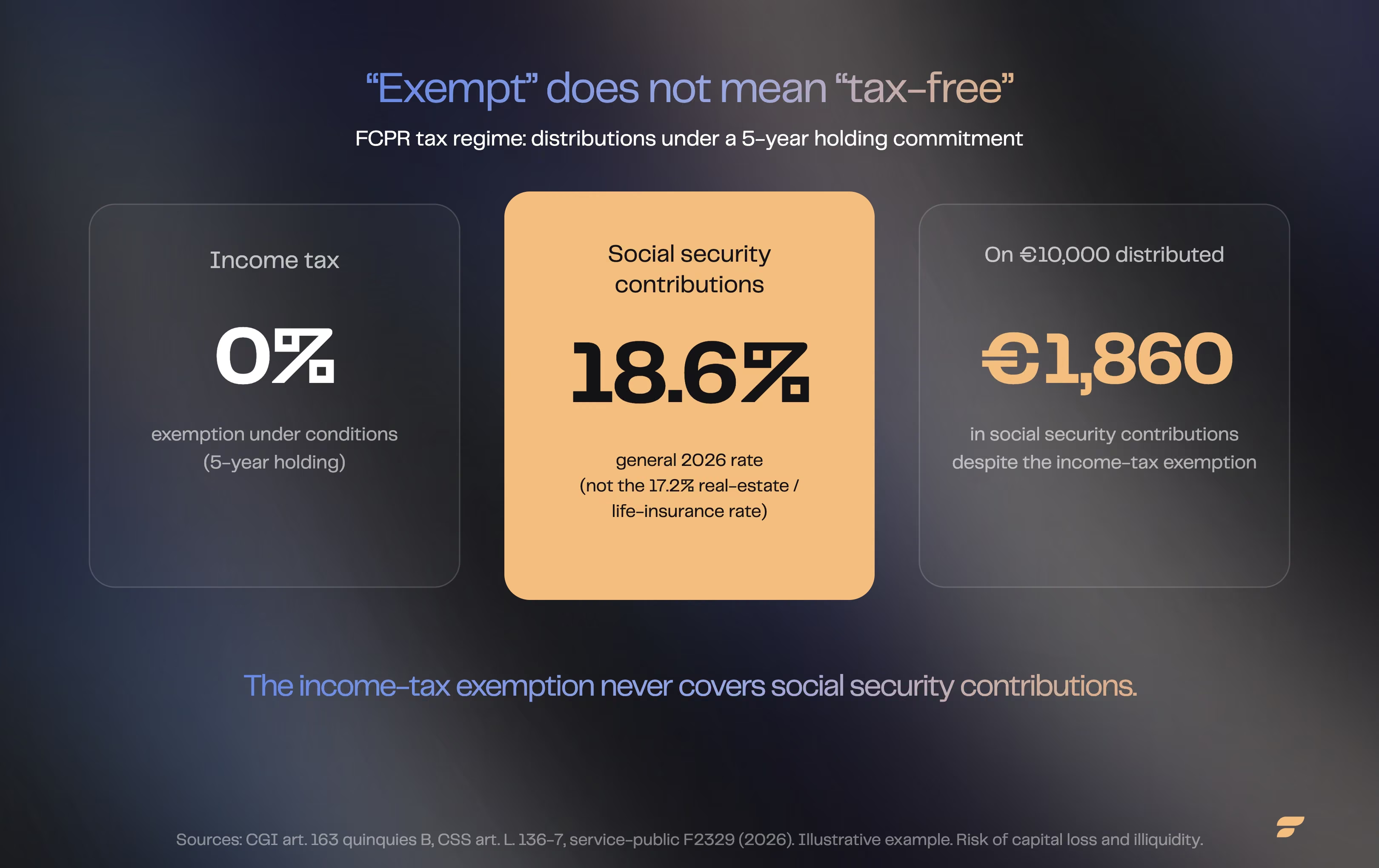
“Exempt” does not mean “tax-free”: the FCPR tax regime's income-tax exemption never covers social security contributions (18.6%).
What Taxation Applies to an Infrastructure Fund in 2026?
It all depends on the wrapper. The same euro distributed by the same fund is not taxed the same way depending on whether you hold it via a securities account, under the FCPR tax regime, or through life insurance.
Route 1, the Ordinary Securities Account: the 31.4% Flat Tax
Distributions and capital gains from a fund held via a securities account fall under the flat tax (or PFU), i.e. 31.4%: 12.8% income tax plus 18.6% social security contributions (since France's 2026 Social Security Financing Act). On €10,000 distributed, you keep €6,860 net. Simple, but it is the heaviest regime.
Route 2, the FCPR/FPCI Tax Regime: Income-Tax Exemption, Never Social Security Contributions
Article 163 quinquies B of the CGI provides that individuals who commit to holding their units for at least five years are exempt from income tax on the fund's proceeds. Three key conditions:
- hold the units for at least five years;
- immediately reinvest in the fund any sums distributed during this period, which remain unavailable;
- not hold, together with their family circle, more than 25% of the rights in the companies making up the fund's assets.
The classic mistake: assuming this exemption covers everything. It applies only to income tax. The Social Security Code (art. L. 136-7) expressly subjects FCPR/FPCI distributions made under the conditions of article 163 quinquies B to social security contributions.
The applicable rate is the one for investment income, i.e. 18.6% in 2026, not the reduced 17.2% rate. In other words: 0% income tax under conditions, but 18.6% social security contributions in all cases.
Route 3, Life Insurance: the Income Stays Within the Wrapper
Some infrastructure funds are accessible as unit-linked funds within a life insurance policy. As long as you make no withdrawal, the proceeds are not subject to income tax.
On withdrawal after eight years, gains are subject to a 7.5% levy (up to €150,000 in premiums), after an annual tax allowance of €4,600 (€9,200 for a couple). And, an exception that matters: life insurance proceeds remain subject to social security contributions at 17.2%, not 18.6%. It is the only pocket that keeps the old rate.
| Route | Income tax | Social security contributions | Constraint |
|---|---|---|---|
| Securities account | 12.8% (flat tax) | 18.6% | None, but full taxation |
| FCPR/FPCI tax regime (163 quinquies B) | 0% under conditions | 18.6% | 5-year holding, reinvestment, 25% cap |
| Life insurance (unit-linked) | 7.5% after 8 years (below threshold) | 17.2% | Fund available as unit-linked |
Illustrative example. 2026 rates. Source: CGI art. 200 A, 163 quinquies B, 125-0 A; CSS art. L. 136-7. Investing carries a risk of capital loss.
Should You Hold an Infrastructure Fund in a Holding Company After a Sale?
This is the most profitable question to ask, and the trickiest. Apport-cession (art. 150-0 B ter of the CGI) allows you to defer tax on the capital gain from a sale, provided you reinvest part of the proceeds in eligible activities, including units of private-equity funds.
The required eligible reinvestment quota rises to 75% of the fund's assets (versus 50% for the standard FCPR/FPCI quota). An infrastructure FPCI can therefore be used as a reinvestment vehicle, but on one condition that is often overlooked.
The Regulated-Tariff Energy Trap
Apport-cession reinvestment refers back to the eligible-activity definition in article 199 terdecies-0 A, which excludes energy activities “providing guaranteed income owing to a regulated buy-back tariff for production”.
A fund whose assets rest on plants backed by these tariffs may therefore fail to qualify for the deferral. The devil is in the underlying assets: two “energy” funds can face opposite tax treatment depending on the exact nature of their contracts.
A Holding Company Is Not Set Up for Tax Reasons Alone
A holding company must have genuine economic substance. A structure set up mainly for tax purposes is exposed to a reassessment for abuse of law.
And a tax deferral is not an exemption. It is a postponement: the capital gain remains due, and it is caught up as events occur that end the deferral. For more information, we recommend consulting a tax lawyer or a chartered accountant.
How Do You Build an Infrastructure Allocation Without Unbalancing Your Portfolio?
By treating it for what it is: an illiquid satellite around a liquid portfolio core, reserved for the portion of capital you accept not touching for a decade.
The Common-Sense Rule, as Mounir Laggoune Puts It in Investir pour être libre
The share allocated to private equity, infrastructure included, should not exceed 20% of financial wealth. And to be genuinely diversified, you need several funds from different vintages: a single fund is a bet on one manager and one entry year.
The J-Curve, to Anticipate
A fund calls up capital progressively, invests it, charges fees, and distributes nothing in the early years. The unit value falls first, then rises again during the distribution phase. It is mechanical.
If you have a short-term liquidity need, infrastructure may not suit your situation.
The Lock-Up, for Real
FCPR units can be locked up for up to a legal maximum of 15 years (art. L. 214-28). In practice, a fund's lifespan often runs around 8 to 10 years, but that is a contractual term, not a guaranteed floor.
An early exit is done over the counter, at a discount if the sale is forced. Infrastructure should therefore be funded with the portion of capital you can reasonably expect not to need over this horizon.
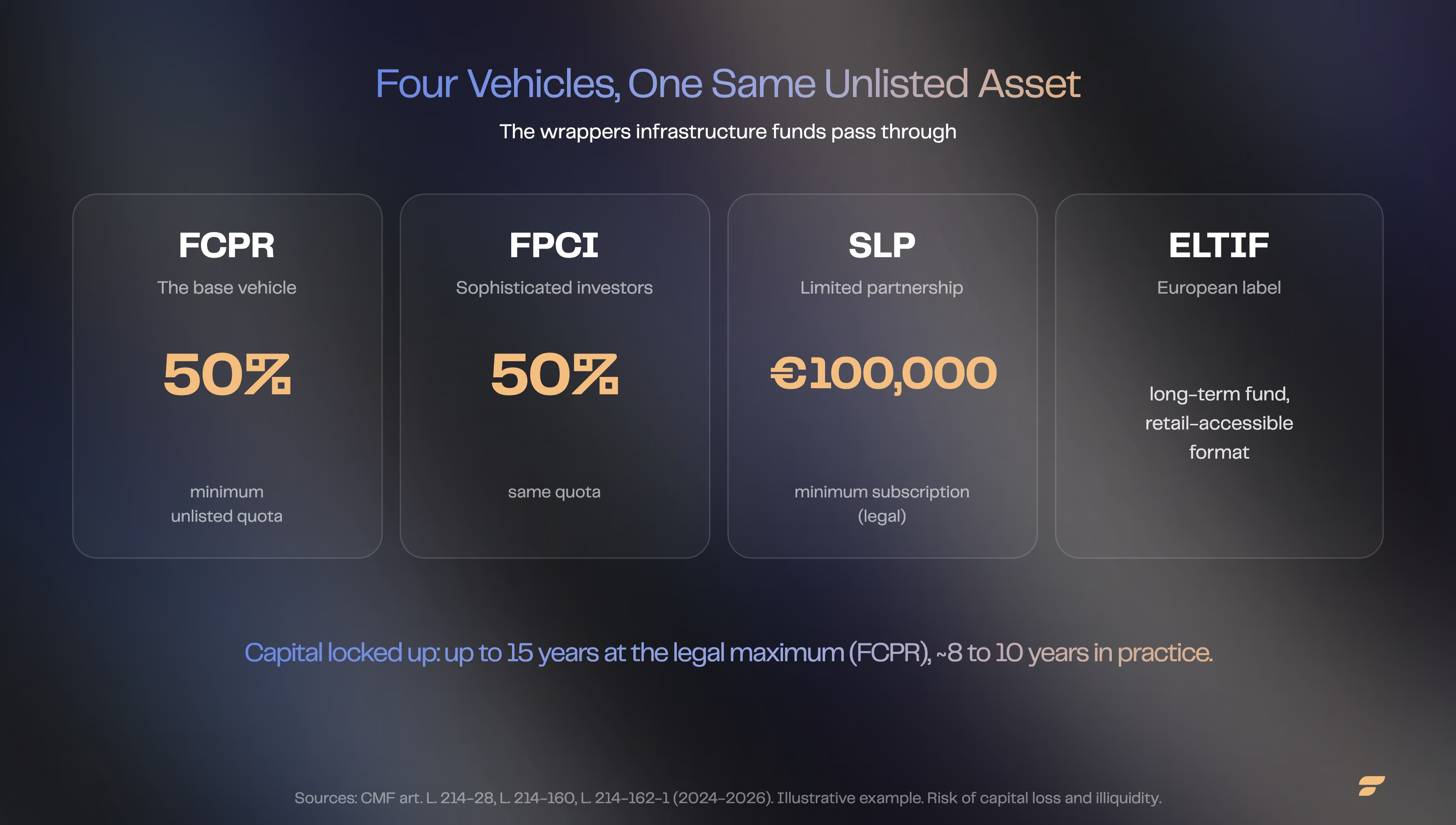
“Four vehicles, one same unlisted asset” (FCPR, FPCI, SLP, ELTIF; 50% quota, €100,000 ticket, lock-up of up to 15 years).
With this type of asset, the costliest mistakes make no noise at the moment they are made:
- the wrong wrapper: 18.6% in social security contributions where 17.2% was possible, every year, on every distribution;
- the disqualifying “energy” fund: a regulated tariff in the underlying, and an entire apport-cession deferral falls through;
- the 20% allocation cap exceeded without noticing, until the day cash is needed and everything is locked up.
None of these mistakes shows on the day you sign. All of them are paid for years later.
The calculation is arithmetic. The execution is a profession.
How Does Finary One Help You Add Infrastructure to Your Portfolio?
Finary One offers a free, no-commitment wealth assessment of your entire situation, even before you become a client. A private wealth manager reviews your wealth across three areas:
- Protection: life insurance beneficiary clause, marital property regime, personal insurance, executive protection.
- Structuring: holding companies, apport-cession, split ownership, gifts, the interplay between professional and personal wealth, where a fund's eligibility for deferral is decided.
- Investment wrappers: securities accounts, French and Luxembourg life insurance, PEA (a French tax-advantaged equity savings account), PER (France's retirement savings plan), capitalisation contracts, to hold each asset where it is taxed the least.
With an infrastructure fund, the question is not “which one”. It is “where to hold it, for what share of your capital, and whether its underlying assets qualify for what you want to do with it”. The private wealth manager coordinates the discussion between you, your notary, your tax lawyer and your chartered accountant: they steer, they do not replace anyone. This is personalised (non-independent) investment advice, over time, not a one-off decision.

Frequently Asked Questions
What Is an Infrastructure Fund?
A fund that invests in physical assets of the real economy (energy, transport, networks) through unlisted companies, most often as an FCPR or an FPCI. Capital is locked in for several years, with a risk of capital loss.
Does an Infrastructure Fund Pay Income?
Only if it is a distributing fund. A distributing fund periodically pays out part of the cash flows it collects (the “Income pocket”); a capitalisation fund reinvests everything and only distributes at exit. No income is guaranteed.
What Taxation Applies to an Infrastructure Fund in 2026?
Via a securities account, a 31.4% flat tax (12.8% income tax plus 18.6% social security contributions). Under the FCPR/FPCI tax regime (art. 163 quinquies B), income-tax exemption subject to a 5-year holding condition, but 18.6% social security contributions in all cases. Through life insurance, the wrapper's own taxation applies, with social security contributions at 17.2%.
What Is the Entry Ticket for an Infrastructure Fund?
The FPCI has a legal entry ticket of €100,000. Commercial minimums vary by fund and management firm. It is an asset reserved for the portion of your wealth you accept locking up for several years.
Can You Hold an Infrastructure Fund in Life Insurance?
Yes, when the fund is available as a unit-linked option within the policy. The advantage: as long as there is no withdrawal, there is no income tax, and social security contributions stay at 17.2% instead of 18.6%.
Is an Infrastructure Fund Eligible for Apport-Cession?
An FPCI can serve as a reinvestment vehicle (eligible quota raised to 75%), but an energy fund backed by a regulated buy-back tariff may be excluded from eligible activities (art. 199 terdecies-0 A). Eligibility is assessed fund by fund, based on the underlying assets: a tax lawyer or a chartered accountant can confirm it before you subscribe.
What Return Can You Expect From an Infrastructure Fund?
No return can be promised. As a benchmark for private equity generally, France Invest measures an average net IRR of 11.3% since inception (end of 2024), but with wide dispersion (from minus 2.8% to around 23.5% across quartiles). Past performance is not a reliable indicator of future performance.
Sources
- CGI art. 200 A (flat tax / PFU)
- CGI art. 163 quinquies B (FCPR/FPCI income-tax exemption)
- CSS art. L. 136-7 (social security contributions on FCPR/FPCI distributions)
- CMF art. L. 214-28 (FCPR, 50% quota, 15-year lock-up)
- CGI art. 199 terdecies-0 A (eligible activities, exclusion of regulated-tariff energy)
- Social security contributions on investment income, service-public.fr F2329
- Related article: Private Equity, How to Invest and Which Fund to Choose
- France Invest, Net Performance of French Private Equity (2025 study, end-2024 data)
Regulatory disclaimers:
Marketing communication. Investing carries a risk of partial or total capital loss. Past performance is not a reliable indicator of future performance. This article is provided for information and educational purposes only; it does not constitute personalised investment advice, a buy or sell recommendation, or tax advice.
This investment carries a liquidity risk (resale not guaranteed, long horizon) and a risk of capital loss. Income and valuations are not guaranteed.
Before investing, read the Key Information Document (KID) and, where relevant, consult an authorised adviser.
Finary SAS, an investment firm authorised by the ACPR (no. 19283), member of AMAFI. Insurance broker registered with ORIAS (no. 21001279), member of the CNCGP (association approved by the AMF). Crypto-Asset Service Provider (CASP) authorised by the AMF under the MiCA regime, references no. A2026-026 and no. N2026-008.