


Transferring Your Business After 60 in France: Is the pacte Dutreil Still Workable?

Updated 17 August 2026.
Yes, the pacte Dutreil (France's tax relief for handing down a family business) is something you prepare years ahead of time. The constraint is not the owner's age, it is the total holding period for the shares: up to eight years, made up of a two-year engagement collectif (collective holding commitment) followed by a six-year engagement individuel (individual holding commitment), under art. 787 B of the CGI (France's General Tax Code). Nothing signed at 60 means no sale before 68.
 Risk. Investing carries risks, including the risk of capital loss. This article is for information and educational purposes only. It does not constitute personalised investment advice, nor legal or tax advice. Implementing a transfer (donation, pacte Dutreil, démembrement - splitting ownership into bare ownership and usufruit) is a matter for a notary and a tax adviser. Tax rules may change.
- The total holding period can reach eight years: a minimum two-year engagement collectif, then a six-year engagement individuel since France's 2026 Finance Act (art. 787 B of the CGI, in force since 21 February 2026).
- The management role must be held during the two years of the engagement collectif and during the three years from the date of transfer (art. 787 B of the CGI).
- The company's eligible activity is a standalone condition, to be maintained without interruption until the end of the engagement individuel (art. 787 B, c bis, of the CGI; BOFiP - the French tax authority's official published guidance - BOI-ENR-DMTG-10-20-40-10).
- Entering into a pact does not require making a gift: the engagement collectif can be taken on by one person alone, as a preventive step (art. 787 B, a, of the CGI).
- The 50% reduction in duties is reserved for a donation in full ownership by a donor under 70 (art. 790 of the CGI).
- If death occurs with no commitment in place, the heirs have six months to enter into an engagement collectif, then start over on the full timetable (art. 787 B, a, of the CGI).
What you're really committing to: two to eight years of holding
The Dutreil is not a signature, it is a six-to-eight-year schedule you must be able to see through to the end. It is this length, not the owner's age, that decides whether the scheme is workable.
The pacte Dutreil exempts from gratuitous transfer duty 75% of the value of the shares of a company carrying on an operating business, transferred by gift or inheritance (art. 787 B of the CGI, in force since 21 February 2026). The same 75% rate applies to the transfer of a sole proprietorship (art. 787 C of the CGI). Only the remaining 25% stays taxable under the standard scale. For an operating business, it is one of the most generous relief regimes in the CGI for wealth transfer, according to the tax authority's own official doctrine (BOFiP, BOI-ENR-DMTG-10-20-40-10).
That rate is paid for in time. Four conditions structure the regime for a company:
- An eligible activity. The main activity must be industrial, commercial within the meaning of articles 34 and 35, craft-based, agricultural or a liberal profession. A company managing its own securities or property assets is not an eligible activity (art. 787 B). This condition must be met from the start of the engagement collectif until the end of the engagement individuel (art. 787 B, c bis).
- A collective holding commitment (engagement collectif) lasting at least two years, in force on the day of the transfer, covering at least 17% of the financial rights and 34% of the voting rights for an unlisted company (10% and 20% if listed) (art. 787 B).
- An individual holding commitment (engagement individuel) of the transferred shares for six years, starting when the engagement collectif ends (art. 787 B). This is the point changed by the 2026 Finance Act: the two-year collective phase is unchanged, but the engagement individuel per beneficiary went from four to six years (loi n° 2026-103 of 19 February 2026, art. 8).
- A management role held in the company during the two years of the engagement collectif and during the three years from the date of transfer, by one of the signatory partners or by one of the heirs, donees or legatees (art. 787 B, d).
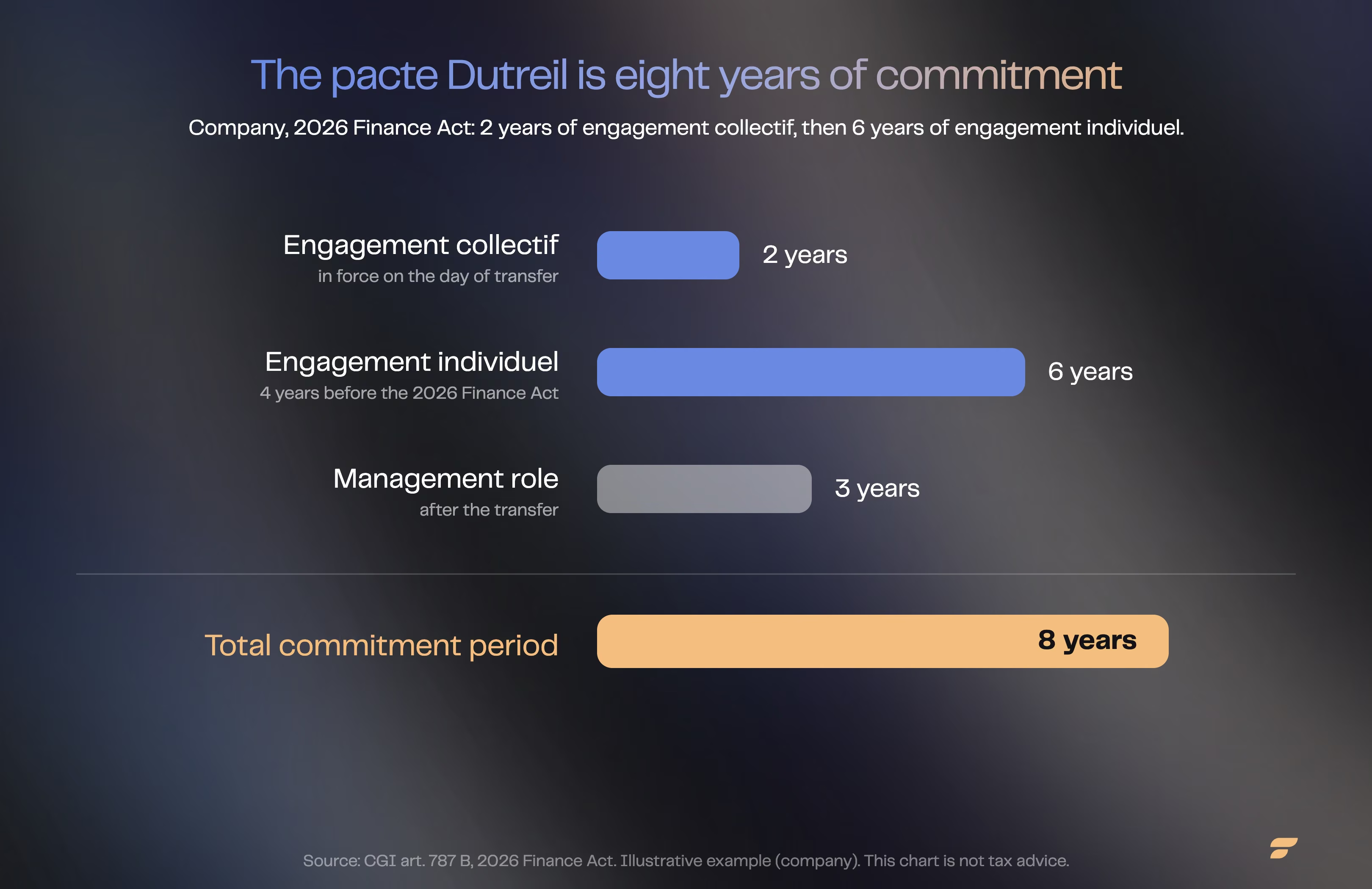
The three Dutreil clocks: a minimum two-year engagement collectif, a six-year engagement individuel since the 2026 Finance Act (up to eight years in total), and a management role held during the two years of the engagement collectif and during the three years from the date of transfer. Source: CGI art. 787 B.
Where does the eight years come from? From adding the two phases together when nothing has been signed yet. The table below summarises the three configurations commonly seen for a business owner over 60.
| Starting situation | Total holding period | Sale of shares possible |
|---|---|---|
| No commitment signed at 60, engagement collectif still to be entered into | 2 years + 6 years = 8 years | from age 68 |
| Engagement réputé acquis (shares held and managed for at least 2 years) | 6 years of engagement individuel | from age 66 |
| Death with no commitment in place, post-mortem pact within 6 months | 2 years + 6 years = 8 years | 8 years after the pact is entered into |
The engagement réputé acquis (deemed-acquired commitment) shortens the timeline, it does not remove it. It applies when the shares have been held for at least two years, alone or with a spouse, PACS partner (France's civil union) or long-term unmarried partner, when the holding reaches the 17% and 34% thresholds, and when that person has, for at least two years, carried on their main professional activity or a management role there (art. 787 B, b, 2). As the authorities put it, “the engagement collectif de conservation is deemed acquired when the shares have been held for at least two years” (BOFiP, BOI-ENR-DMTG-10-20-40-10). Six years of engagement individuel then remain to be seen through.
A trap specific to this case: without a signed engagement collectif, there is no “signatory”. The management role held after the transfer must then be held by one of the beneficiaries, heir or donee. A donor who carried on managing alone does not meet the condition (Cass. com., 24 January 2024, no. 22-10.413). The réputé acquis saves two years on the clock, but it requires a family handover of management.
The longer you wait, the less workable the Dutreil becomes
Every year of waiting reduces the odds of seeing the commitments through to the end, and therefore the chance of benefiting from the regime. It is not a door that closes, it is a feasibility that narrows.
The question is not “am I entitled to it”, it is “can I see it through”. Past 60, three situations come up regularly, and they are not handled the same way.
- A sale to a third party planned for two or three years out. The holding commitments are a head-on obstacle here: selling the shares before the engagement individuel ends puts the exemption at risk. Setting up a Dutreil in this situation is rarely worthwhile, and often impossible to secure.
- A takeover by a child. The holding period becomes a schedule to organise: who manages, from when, with what split of shares. This is the case where the Dutreil has the most impact, provided it is set up early.
- A project that is still undecided. This is the most common and the most costly situation. Every year without a signed commitment brings the end of the commitment period closer to the sale horizon, narrows the room for manoeuvre, and increases the risk that the transfer happens through death rather than by choice.
Waiting also costs on a second, less visible front: spreading the transfer out over time. The €100,000 tax allowance per child and per parent renews every 15 years (art. 779 and 784 of the CGI): starting at 60 means you can use two brackets of it, starting at 72 means only one. The same logic applies to successive donations in full ownership before 70. Every year lost closes a window, never the other way round.

Three misconceptions that cost years
Three misconceptions hold back business owners who could already have secured their pact: the compulsory successor child, the pact that forces you to give, and the single pact. None of the three survives a reading of the text.
“You need a child ready to take over.” No. The management role can be held by one of the signatory partners to the engagement collectif, so by the donor themselves, or by one of the donees (art. 787 B, d). A business owner who signs an engagement collectif, including a one-person one, can therefore keep managing their company during the two years of the commitment and the three years following the transfer, even if their children are minors. The family-handover constraint only applies in the specific case of the engagement réputé acquis, with no commitment signed (Cass. com., 24 January 2024, no. 22-10.413).
“Signing a pact means giving away my shares.” No. The engagement collectif can be taken on by one person alone, for themselves and their successors by gift (art. 787 B, a). Entering into it triggers no donation: it simply starts the two-year clock, as a preventive and defensive step. In the vast majority of cases, a pact can be signed ahead of time to prepare a future donation, or to spare the heirs the full length of a pact rushed through after a death.
“One pact, one block of shares.” Nothing requires fitting all the shares into a single commitment. Several separate pacts can be entered into over different blocks, so that one commitment being challenged only hits the block concerned, not the whole shareholding (art. 787 B of the CGI; the split needs validating case by case with your notary). It is a simple way to contain a risk and avoid losing the benefit already secured on the rest of the shares.
The eligible activity: the condition that breaks most often
The eligible activity is the most fragile condition over time, because it has to be checked continuously and the company's scope keeps moving. It is the main reason the regime is lost, well ahead of a forgotten signature.
The regime requires the operating activity to be predominant. As a practical rule, the authorities accept predominance when two conditions are both met: the eligible activity's revenue accounts for at least 50% of total revenue and the market value of the gross assets used for that activity accounts for at least 50% of total gross assets (BOFiP, BOI-ENR-DMTG-10-20-40-10).
The most litigated case is that of the holding animatrice (an active holding company that steers its group's strategy). It does qualify as an eligible activity for tax purposes: a company whose main activity, beyond managing a portfolio of shareholdings, is actively taking part in steering its group's strategy is treated as carrying on a commercial activity (art. 787 B). In practice, these cases account for a lot of disputes, for three reasons: the steering role is not actually exercised (no agreement, no record of decisions, no services provided to subsidiaries), the steering role is not predominant relative to other, often non-trading activities (cash management, property), or the steering is not documented over time. The doctrine treats the steering character as established in particular when the market value of the assets used for steering exceeds half of total assets (BOFiP, BOI-ENR-DMTG-10-20-40-10), and this character must be maintained until the end of the commitments.
Hence a discipline to put in place from the moment of signing, and to keep up for six to eight years:
- Check predominance every year, backed by revenue and gross-asset ratios, not just once at the time of the deed.
- Watch the group's scope: a subsidiary sold, an activity discontinued, a non-trading company added, and the balance tips.
- Watch cash holdings. Very large cash holdings not used for the activity can make the operating activity lose its predominance in the asset test.
- Plan a management handover: the management role often rests on a single person, whose death or incapacity during the commitment period creates a risk of breaking it.
A perfectly drafted pact protects nothing if the company stops meeting the activity condition along the way.
The levers that close as you age
Three levers stack with the Dutreil and lose value every year: the 50% reduction before 70, donation before a sale, and démembrement. Turning 70 is just one parameter among others, never the goal.
1. The 50% reduction in duties, as long as the donor is under 70
When a pacte Dutreil is transferred by a donation in full ownership by a donor aged under 70, the gift duties, already calculated after the 75% exemption, are further reduced by 50% (art. 790 of the CGI). The reduction applies to company shares (art. 787 B) as well as to a sole proprietorship (art. 787 C).
Two cumulative conditions: a donation in full ownership, and a donor under 70 on the date of the deed. On the donor's 70th birthday, this benefit disappears. It comes on top of the standard-law mechanisms: the €100,000 tax allowance per child and per parent every 15 years (art. 779 and 784 of the CGI), and the progressive scale from 5% to 45% in the direct line (art. 777 of the CGI) on what remains.
2. Donation before a sale, to wipe out the latent capital gain
If your plan is to sell, the order of operations matters a great deal. Selling then gifting the proceeds means paying the flat tax (PFU) of 31.4% (12.8% income tax and 18.6% social security contributions since the 2026 Social Security Financing Act (LFSS)) on the whole capital gain first, then giving away what's left.
Giving the shares away before the sale reverses the logic. Where the shares were acquired by gift, the acquisition price used to calculate a future capital gain is the value used to work out the transfer duties, in other words the value on the day of the donation (art. 150-0 D, 1 of the CGI). The donation therefore wipes out the donor's latent capital gain, and the donee starts afresh from the value on the day of the donation.
Two safeguards, and they are not negotiable. First, the donation must be genuine and the donee must be free to use the proceeds: a gift-then-sale scheme where the donor takes back, directly or indirectly, the cash received amounts to an abuse of rights (LPF - France's Tax Procedures Code - art. L. 64). Second, wiping out the capital gain and the Dutreil exemption do not run on the same schedule: if the gifted shares are still under commitment, selling them before the end of the engagement individuel puts the 75% exemption at risk. The two levers have to be weighed against each other, they do not simply stack.
3. Démembrement, to transfer the business while keeping the dividends
The démembrement de propriété (splitting ownership) answers the most common fear: giving without losing the income. You give away the nue-propriété (bare ownership) of the shares and keep the usufruit (the right to use them and collect their income) - in other words, the dividends.
You need to weigh the trade-off, because it is a heavy one. The pacte Dutreil is only compatible with a donation with a reserved usufruit under one condition set out in the company's articles: the usufruit holder's voting rights must be restricted, under the articles, to decisions on the allocation of profits alone (art. 787 B of the CGI). This clause protects the usufruit holder on the income side, since a distribution cannot be decided without them. But it also means the donor, now the usufruit holder, loses control and most of the voting and governance rights attached to the shares given away in nue-propriété: appointing managers, amending the articles, and capital transactions then fall to the bare owners. Giving away the nue-propriété under a Dutreil means keeping the income and giving up the power.
For tax purposes, the duties are only based on the value of the nue-propriété, set by the scale in art. 669 of the CGI according to the usufruit holder's age:
| Age of the usufruit holder | Value of the usufruit | Value of the nue-propriété |
|---|---|---|
| 61 to 70 | 40% | 60% |
| 71 to 80 | 30% | 70% |
| 81 to 90 | 20% | 80% |
The earlier the démembrement is done, the lower the nue-propriété transferred, and so the smaller the taxable base. When the usufruit holder dies, the usufruit rejoins the nue-propriété free of inheritance tax: this reunion is not a taxable transfer (art. 1133 of the CGI). A decisive nuance: the 50% reduction (art. 790) is reserved for full ownership and does not apply under démembrement. Income comfort versus a 50% bonus: the trade-off has to be judged case by case.
The real cost of every year you wait
Waiting costs twice over: in duties paid, and in options lost. For a company worth €3,000,000, crossing the age-70 threshold means roughly €53,000 in extra duties, but it is the shrinking timetable that costs the most. Take an operating company valued at €3,000,000, transferred to two children, eligible for the Dutreil.
- The Dutreil exemption. 75% of €3,000,000 is exempt. Taxable base: €750,000, or €375,000 per child.
- The tax allowance. After the €100,000 per child (art. 779), the net taxable share drops to €275,000 per child.
- The scale. Under the direct-line scale (art. 777), the duties on €275,000 come to around €53,200 per child, or around €106,400 for both.
- The effect of turning 70. If the owner is under 70 and gives in full ownership, the 50% reduction (art. 790) brings the bill down to around €53,200 for both children combined.
This is an illustrative estimate, based on the scales in force cited above. It does not take your own circumstances into account (number of children, earlier donations, marital regime, actual valuation). The exact calculation is a matter for a notary.
On top of this direct cost come three less visible costs, and often heavier ones.
The timetable stops matching the project. This is the real risk. A commitment entered into at 66 runs until 74 in the full scenario (two years plus six years). If a sale to a third party, or even to a child who changes their mind, happens before that point, the 75% exemption is put at risk. The later you start, the higher the odds of a break, and the more the Dutreil becomes a bet rather than a tool.
The article 669 scale climbs in steps. In a démembrement strategy, moving from the 61-70 bracket to the 71-80 bracket sends the nue-propriété transferred jumping from 60% to 70% of the value. For a €3,000,000 company, that is €300,000 more in taxable base, purely because the démembrement was done ten years too late.
A transfer forced by circumstance costs on every front at once. As long as nothing is signed, you are racing the clock. If the transfer happens through death, you lose, all at once, control of the timetable, the choice of beneficiaries, the wipe-out of the capital gain before a sale, the 50% reduction reserved for donations in full ownership, and the allowance brackets that spreading things out would have let you use. The heirs then fall back on the six-month post-mortem engagement collectif, under pressure, before starting over on eight years of holding.
The watchword remains planning ahead, in the strictest sense: sign early, because it is the commitments, not the age, that call the shots. Working out the numbers is notarial arithmetic. Holding six to eight years of conditions without breaking one is a craft in itself.
How Finary One helps you transfer your business
A successful pacte Dutreil is never a standalone act: it fits together with your sale horizon, your other holdings and your donation schedule. This is the spirit behind Mounir Laggoune's book Investir pour être libre("Invest to Be Free"): to take back control of your wealth before time decides for you. The private wealth managers at Finary One coordinate your notary and your tax adviser, work out the length of commitment your project can absorb, and put in place annual monitoring of the conditions for the whole life of the pact.
To go further on transferring a business, our overview of the pacte Dutreil sets out the scheme's general conditions.
Frequently asked questions
Do you really need to prepare a pacte Dutreil years in advance?
Yes. The engagement collectif must run for at least two years and be in force on the day of the transfer, and the engagement individuel then runs for six years (art. 787 B of the CGI). A business owner who signs at 60 is therefore committed until around age 68. It is this length, to be held without a break, that makes planning ahead necessary.
I haven't signed anything and I'm 63: how long a commitment am I looking at?
Six years if the engagement collectif is réputé acquis - that is, if you have held the shares for at least two years, at the 17% and 34% thresholds, and you have held a management role or your main professional activity there for two years (art. 787 B, b, 2 of the CGI). Up to eight years if an engagement collectif still needs to be entered into. In the first case, post-transfer management must be held by a beneficiary (Cass. com., 24 January 2024, no. 22-10.413).
Do you need a successor child to benefit from the Dutreil?
No. The management role can be held by one of the signatory partners to the engagement collectif, so by the donor themselves, or by one of the donees (art. 787 B, d of the CGI). A business owner can therefore enter into a pact and keep managing the company, even if their children are minors. A family handover is only required in the case of the engagement réputé acquis.
Does signing a pacte Dutreil force me to give away my shares?
No. The engagement collectif can be taken on by one person alone, for themselves and their successors by gift (art. 787 B, a of the CGI): it starts the two-year clock without triggering a donation. It is a preventive tool, which prepares a future donation and spares the heirs a pact rushed through after a death. It is also possible to enter into several pacts over separate blocks of shares, to limit the consequences of a break (terms to be validated with your notary).
What happens if the company stops meeting the conditions while the pact is in force?
The exemption can be put at risk. The eligible-activity condition must be met from the start of the engagement collectif until the end of the engagement individuel (art. 787 B, c bis of the CGI), and the predominance of the operating activity is assessed on revenue and gross assets (BOFiP, BOI-ENR-DMTG-10-20-40-10). A subsidiary sold, an activity discontinued, or cash holdings becoming very large can tip the ratios: annual monitoring is essential.
Can I keep my company's income while transferring it?
Yes, through a donation with a reserved usufruit: you transfer the nue-propriété and keep the dividends. The Dutreil still applies provided the articles restrict the usufruit holder's voting rights to decisions on the allocation of profits alone (art. 787 B of the CGI). The trade-off is real: you lose control and most of the governance rights attached to the shares given away, and the 50% reduction in duties (art. 790) does not apply under démembrement.
Sources
- Article 787 B of the CGI, in force since 21 February 2026 (loi n° 2026-103 of 19 February 2026, the 2026 Finance Act, art. 8): Légifrance
- Article 787 C of the CGI, in force since 21 February 2026: Légifrance
- Article 790 of the CGI (50% reduction): Légifrance
- Article 669 of the CGI (usufruit / nue-propriété scale): Légifrance
- Article 150-0 D of the CGI (acquisition price on a gratuitous transfer): Légifrance
- BOFiP, partial Dutreil exemption, eligible activity, holding animatrice and engagement réputé acquis (BOI-ENR-DMTG-10-20-40-10): BOFiP
- Cass. com., 24 January 2024, no. 22-10.413 (management role in the case of the engagement réputé acquis): Cour de cassation
Regulatory disclaimers:
Marketing communication. Investing carries a risk of partial or total capital loss. Past performance is not a reliable indicator of future performance. This article is for informational and educational purposes only; it does not constitute personalised investment advice, a buy or sell recommendation, or tax advice.
Before investing, read the Key Information Document (KID) and, where relevant, consult an authorised adviser.
Finary SAS, an investment firm authorised by the ACPR (no. 19283), member of AMAFI. Insurance broker registered with ORIAS (no. 21001279), member of the CNCGP (association approved by the AMF). Crypto-Asset Service Provider (CASP) authorised by the AMF under the MiCA regime, references no. A2026-026 and no. N2026-008.