


How Much Do You Need to Live on €100,000 a Year in France?

Updated on 7 July 2026.
€100,000 net a year without working is the mental threshold of financial independence in France. To produce it, count on, as an order of magnitude and under assumptions, between €2.5 and €5 million of invested capital, depending on the real net return assumed. A range, never a promised return.
Maybe you are already doing the maths. You have just sold a business, inherited wealth, or you have a holding company full of cash, and you are looking for the threshold at which work becomes optional.
The real trap is not falling short. It is confusing the headline return of an investment with what it actually leaves in your pocket once tax and rising prices are deducted. Over time, that gap can double the capital required.

- The key calculation is a division: capital required = target net income ÷ real net return. For €100,000 net a year, everything hinges on the denominator.
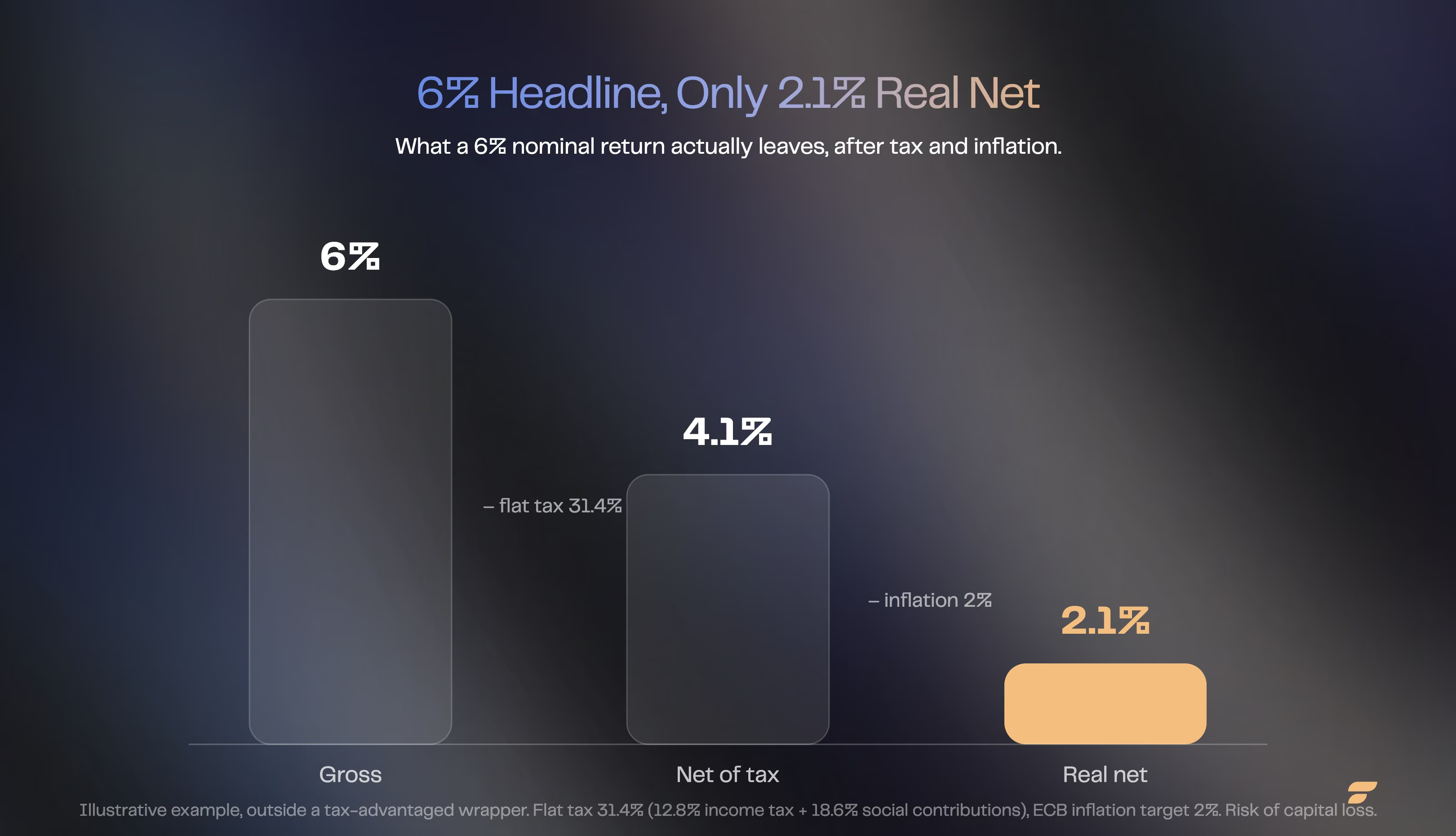
- The real net return is what remains after two deductions: tax (the flat tax at 31.4% on investment income) and inflation (the ECB's target of 2% a year). A placement returning 6% gross can leave only around 2% real net.
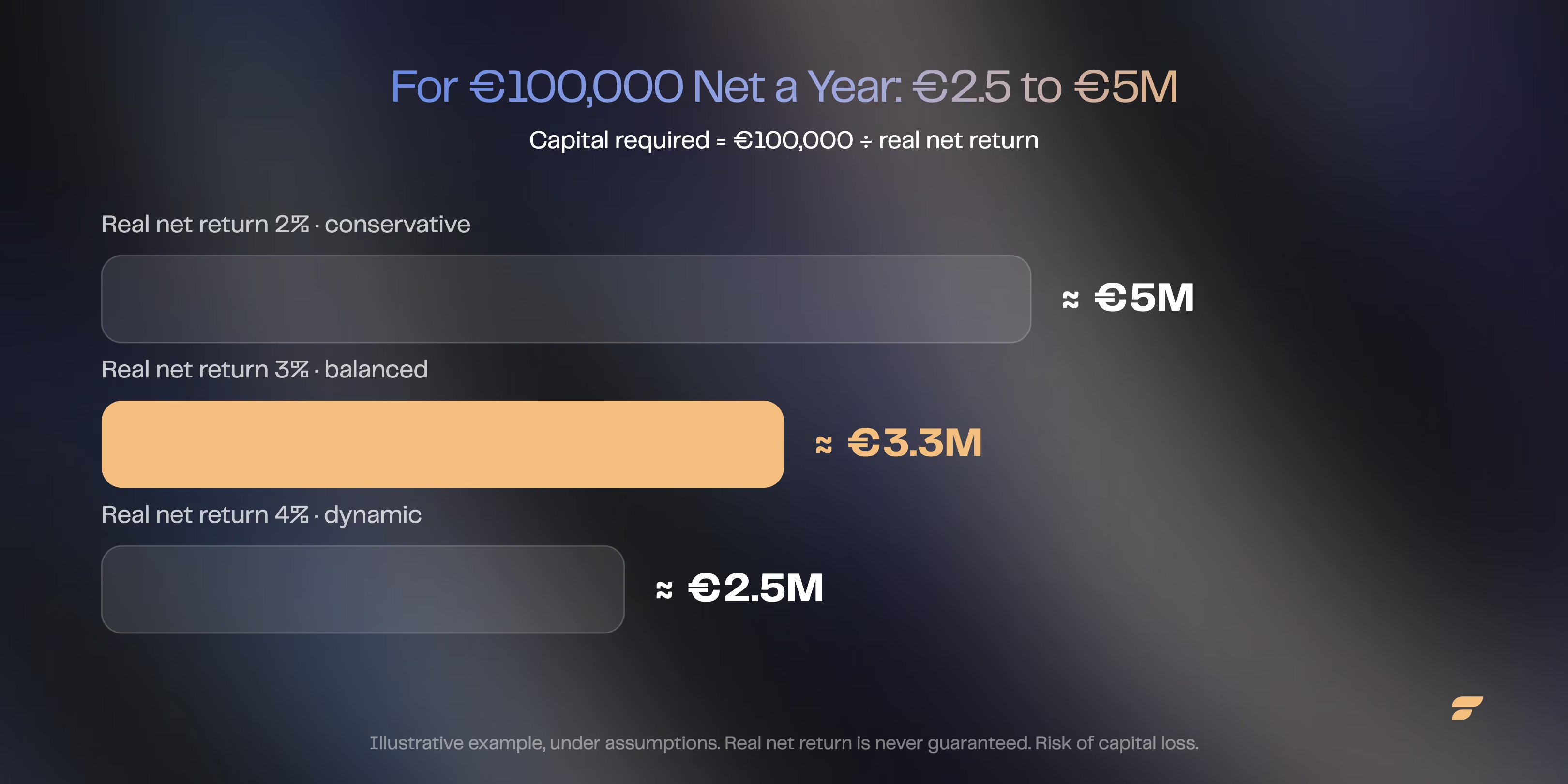
- Under assumptions, the capital range for €100,000 net a year: around €5M at 2% real net, €3.3M at 3%, €2.5M at 4%. These are illustrative orders of magnitude, not promises.
- The American 4% rule (Trinity Study, 1998) underestimates the capital required in France, because it ignores French taxation, the IFI (Impôt sur la Fortune Immobilière, France's real estate wealth tax), and an inflation history calculated on a different currency.
- No return is guaranteed. Investing carries a risk of capital loss; past performance is not a reliable indicator of future performance. Orders of magnitude under assumptions, never personalised advice.
This article is general information for educational purposes and does not constitute personalised investment advice. All return and capital figures are orders of magnitude under assumptions, presented purely for illustration: they are neither a promise nor a forecast of performance. Investing carries a risk of capital loss; past performance is not a reliable indicator of future performance.We cover elsewhere how much capital you actually need to live off your investments in France, and how to invest and pass on a large estate. Here, we take one precise target, €100,000 net a year, and work back to the capital, step by step.
How Much Capital for €100,000 in Annual Income?
The answer comes down to a division: the capital required equals the target net income divided by the expected real net return. For €100,000 net a year, everything depends on the rate you put in the denominator, and that is where almost the entire gap plays out.
Take the calculation on gross terms, the one most people make instinctively. “My life insurance policy targets 6% a year, so €100,000 divided by 6% is about €1.7 million.” The reasoning is arithmetically correct. It is wrong in real life, because that 6% never ends up in full in your pocket.
Two deductions come in between, and they are not optional:
- Tax. Investment income (interest, dividends, capital gains) is in principle subject to the flat tax, at 31.4% (12.8% income tax and 18.6% social security contributions; the official name is the prélèvement forfaitaire unique, or PFU). On 6% of gains, tax always takes a share that is never zero.
- Inflation. The European Central Bank targets price growth of 2% a year over the medium term. To preserve your purchasing power over time, that 2% is deducted from the return as well.
What remains after these two steps is the real net return. And it is the only figure that matters for calculating capital that lasts. The gap between the two is not a minor detail: it can cut a headline return by more than half.
Before setting numerical assumptions, you need to understand this cascade. It is what separates the naive calculation from the correct one.
Why a 6% Return Does Not Mean 6% in Your Pocket
Because between the headline return and the purchasing power you are left with, two deductions compound in the shadows. This is the cascade almost no one works through to the end, and it decides the capital required.
Let's walk through an illustrative example, starting from a nominal return of 6% gross, outside a tax-advantaged wrapper:
- 6% gross. The nominal return shown, before any friction.
- About 4.1% net of tax. After the 31.4% flat tax applied to the gains, roughly two-thirds of the return remains.
- About 2.1% real net. After subtracting 2% inflation, what remains in real purchasing power is around 2%.
Read that last figure slowly. An investment advertised at 6% may only defend your standard of living to the tune of about 2% a year, once tax and inflation have passed through. The headline return has fallen by more than half, and no line on any statement will ever flag it.
Inflation is precisely what makes the difference between an income and an income that lasts. According to INSEE, France’s national statistics institute, “inflation is the loss of the purchasing power of money, reflected in a general and lasting rise in prices.” In other words, capital that merely produces its nominal income gets poorer every year: it is the real net return, after price rises, that protects your standard of living.
This cascade depends on the assumptions used, and it varies according to your situation, your tax position and the wrapper used. A life insurance policy after eight years, a PEA (a French tax-advantaged equity savings account) after five years, or a well-structured combination of wrappers can meaningfully reduce the tax portion. But the principle does not change: you calculate on the real net figure, never the gross one. Everything else follows from that.
What remains is to turn that real net rate into capital. That is where the range appears.
Do You Need €2.5, €3.3 or €5 Million, Depending on the Return Assumption?
The capital required for €100,000 net a year is not a single figure; it is a range that depends on the real net return you assume. The more conservative that rate, the higher the capital climbs, and the gap between assumptions is considerable.
The formula stays the same; only the denominator changes. Here are three illustrative real net return assumptions, and the capital each one implies for a target of €100,000 net a year:
| Real net return assumption | Calculation | Capital required (order of magnitude) |
| 2% (conservative) | 100,000 ÷ 2% | ~€5,000,000 |
| 3% (balanced) | 100,000 ÷ 3% | ~€3,300,000 |
| 4% (dynamic, more risk) | 100,000 ÷ 4% | ~€2,500,000 |
The two-to-one ratio jumps out: between the conservative and the dynamic assumption, the capital required varies by a factor of two. Five million, or two and a half. It all depends on a single figure, and that figure is not a return anyone guarantees you, it is an assumption you take on.
Why not simply take the highest assumption and aim for €2.5 million? Because targeting 4% real net implies greater exposure to risk, and therefore greater sensitivity to market downturns. And targeting a high real net return every year, without a hitch, is never a given: markets do not rise in a straight line. A balanced, well-diversified portfolio instead aims, over the long term, for a real net return of around 3 to 4%, never a certainty.
As a practical benchmark, and still under assumptions, living off your investments in France often requires capital of around 28 to 33 times the targeted annual net budget. For €100,000 net, that lands in the same zone: around €3 million for a median assumption. An order of magnitude, not a guarantee.
Why the American 4% Rule Does Not Work in France
Because it was calibrated on a different tax planet. The 4% rule says you can withdraw 4% of your capital in the first year, then that amount indexed to inflation, without exhausting the portfolio over thirty years. Appealing, simple, and largely imported from American content.
This rule comes from the Trinity Study, an American academic paper from 1998, validated on the historical record of 20th-century American markets. Applied as is, it would suggest that around €2.5 million is enough for €100,000 a year (100,000 ÷ 4%). But it ignores three French realities:
- Tax. The Trinity Study reasons on a pre-tax basis, within an American framework. In France, the 31.4% flat tax on investment income changes the equation: the “net” withdrawal in your pocket is not the “gross” withdrawal from the portfolio.
- Inflation. The pace of price erosion depends on each region's monetary history. In the eurozone, the ECB's medium-term target is 2%, but recent years have been a reminder that actual inflation can depart from it sharply.
- The IFI wealth tax. Above €1.3 million of net taxable real estate, the IFI adds an annual friction that the American model never had to account for.
The consequence: transposing 4% to France means underestimating the capital required. That is precisely why this article reasons in terms of 2%, 3% or 4% real net return, rather than a 4% gross withdrawal. The nuance may look small. Over thirty years, it can be the difference between capital that lasts and capital that runs out.
There is also a risk that averages hide, and it is worth pausing on.
What Risk Hides Behind Average Returns?
Two portfolios can show the same average return over twenty years and end up one flush, the other empty, depending purely on the order in which the good and bad years arrived. This phenomenon has a name: sequence-of-returns risk.
The idea is counter-intuitive. When you live off your capital, you withdraw money every year. If a sharp market downturn hits early, in the first few years, you sell devalued assets to fund your lifestyle, and the depleted capital no longer has enough of a base to rebuild when markets recover. The same downturn arriving fifteen years later, on capital that has already grown, does far less damage.
This risk has long been documented in research on portfolio withdrawals (the Trinity Study, William Bengen's research, so-called Monte Carlo simulations). The practical lesson is simple, and it is a cautious one: reasoning on an average return means ignoring the scenario where the bad years arrive at the worst possible time. That is one more reason to hold a conservative real net return assumption, and to keep a safety cushion so you are not forced to sell at the bottom.
All of this remains arithmetic and assumptions. The real difficulty begins when this calculation has to be translated into a real-life situation.

How to Reduce the Capital Required Without Forcing the Return
There is a lever that acts on the capital required without touching the risk taken: the taxation of your wrappers. The better tax is optimised, the closer the net return gets to the gross return, and the lower the capital required for the same target.
Let's revisit the cascade. The most painful jump happens between the gross figure and the figure net of tax. But that tax share is not set in stone: depending on the wrapper, it can be significantly reduced, entirely legally.
- Life insurance after eight years. It opens up an annual tax allowance on gains withdrawn and reduced taxation, which raises the net return for the same target. It is one of the most flexible wrappers for producing a regular income.
- The PEA after five years. Capital gains are exempt from income tax (only social security contributions apply), which makes it a powerful tool for the equity sleeve, within the limit of its contribution cap.
- Combining wrappers. Intelligently combining life insurance and the PEA, and depending on the case a capitalisation contract or a holding company, lowers the weighted effective tax rate. For the same income need, this can meaningfully reduce the capital required.
The logic is clear: if you raise the real net return from 2% to 3% through better tax structuring, you go, for €100,000 net, from a need of €5 million to about €3.3 million. The “saved” capital does not come from a riskier return, it comes from a better-thought-out structure.
Allocation itself follows the same framework as for any large estate: a safety sleeve, an income sleeve, a growth sleeve via diversified ETFs, and, depending on the time horizon, a longer-term sleeve. The sizing depends on your situation, not on a universal formula. For the fundamentals, see our guide to investing in the stock market.
The Most Expensive Mistakes Make No Noise
At this level of wealth, a mistake does not cost a few hundred euros. It costs years of income. And none of these mistakes are visible at the time.
Three silent leaks come up again and again:
- Reasoning in gross terms. Sizing your capital on 6% instead of 2% real net means aiming for €1.7 million when you need double or triple that. The mistake only shows up years later, when purchasing power starts to slip.
- Forgetting inflation. €100,000 today does not buy the same thing in twenty years. At 2% a year, you need an income that grows, and therefore capital that does not just produce income, but revalues itself.
- Ignoring sequence-of-returns risk. A bad start for the market, on capital you are already drawing an income from, can durably compromise the plan. Without a safety cushion, you sell at the bottom, and you never fully recover.
Your 6% that turns out to be only 2.1% once tax and inflation have passed through. The million euros too much, or too little, of capital that a sound starting assumption would have avoided. The crash poorly absorbed for lack of a cash cushion. None of these mistakes make any noise. All of them are paid for later, often when it is too late to correct.
Finary One, to Stress-Test Your Assumptions
The calculation gives you a range. What matters next is the soundness of your assumptions: real net return, sequence-of-returns risk, taxation by wrapper, and the ability to absorb a bad year without selling at the bottom.
A private Finary One wealth manager stress-tests these assumptions with you and calibrates your allocation: protection, structuring and the wrappers (French and Luxembourg life insurance and securities accounts, PEA, PER (France's retirement savings plan), capitalisation contract).
Private banking expertise, working in your interest: your wealth is reviewed as a whole and managed over time, and you keep the final say on every decision. The assessment is free and comes with no commitment, even before becoming a client, from €500,000 in investable assets.
Finary SAS, an investment firm authorised by the ACPR (no. 19283). This article is for informational purposes and does not constitute personalised investment advice; all investment carries a risk of capital loss.
Frequently Asked Questions
How Much Capital Do You Need to Live on €100,000 a Year in France?
Under assumptions and for illustration, count on the order of €2.5 to €5 million of invested capital, depending on the real net return assumed: about €5 million at 2%, €3.3 million at 3%, €2.5 million at 4%. The calculation is a division: capital = target net income ÷ real net return. None of these returns is guaranteed.
How Do You Calculate the Capital Required for a Passive Income?
You divide the targeted annual net income by the expected real net return. The real net return is what remains after tax (the flat tax at 31.4% on investment income) and after inflation (the ECB's target of 2% a year). Reasoning on the gross return leads to a strong underestimation of the capital required.
Why Doesn't the 4% Rule Apply in France?
The 4% rule comes from the Trinity Study (United States, 1998) and was calibrated on American markets, pre-tax. It factors in neither the French flat tax, nor the IFI wealth tax, nor the eurozone's monetary history. Transposed as is, it underestimates the capital required in France.
What Real Net Return Can You Target on a Diversified Portfolio?
As a benchmark and under assumptions, a balanced, diversified portfolio targets, over the long term, a real net return of around 3 to 4%, after tax and inflation. This is never a certainty: markets do not rise in a straight line, and investing carries a risk of capital loss.
What Investments Generate €100,000 in Passive Income?
There is no single investment. At this level, you reason by sleeve: safety (cash, euro funds), income (bonds, income-generating real estate), growth (diversified equities and ETFs), sometimes a long-term sleeve. What matters is not the highest return, but a steady real net return, after tax and inflation. The split depends on your situation and your risk tolerance, never on a universal formula; investing carries a risk of capital loss.
Do You Need €2.5 or €5 Million for €100,000 a Year?
Both figures are true, under different assumptions. €2.5 million corresponds to a dynamic assumption (4% real net, more risk); €5 million to a conservative assumption (2% real net). The two-to-one gap illustrates just how much the result depends on the return assumption, which is never guaranteed.
How Can You Reduce the Capital Required Without Taking More Risk?
By optimising the taxation of your wrappers. Life insurance after eight years, the PEA after five years, and a well-structured combination of wrappers all raise the net return for the same target. Moving from 2% to 3% real net return brings the capital need for €100,000 net down from €5 million to about €3.3 million.
What Is Sequence-of-Returns Risk?
It is the risk that a sharp market downturn hits early, while you are already withdrawing an income from your capital. You sell devalued assets, and the portfolio no longer has enough of a base to rebuild. At the same average return, two portfolios can end up very differently depending on the order of the good and bad years.
Sources
- impots.gouv.fr, taxation of investment income under the prélèvement forfaitaire unique (flat tax).
- European Central Bank, 2% medium-term inflation target.
- INSEE, consumer price index (France’s measure of inflation).
- INSEE, definition of inflation (loss of the purchasing power of money).
- service-public.fr, wealth tax on real estate (IFI), threshold of €1.3 million.
- Trinity Study (Cooley, Hubbard, Walz, Trinity University, 1998) and research by William Bengen on sustainable withdrawal rates (cited for historical comparison, American markets).
Regulatory disclaimers:
Marketing communication. Investing carries a risk of partial or total capital loss. Past performance is not a reliable indicator of future performance. This article is for informational and educational purposes; it does not constitute personalised investment advice, a recommendation to buy or sell, or tax advice. The return and capital figures quoted are orders of magnitude under assumptions, presented for illustration, and constitute neither a promise nor a forecast of performance.
Before any investment, read the Key Information Document (KID) and, where relevant, consult an authorised adviser.
Finary SAS, an investment firm authorised by the ACPR under no. 19283, member of AMAFI. Insurance broker registered with ORIAS under no. 21001279, member of the CNCGP (association approved by the AMF). Crypto-Asset Service Provider (CASP) authorised by the AMF under the MiCA regime, references no. A2026-026 and no. N2026-008.