


Living Off Your Investments in France: How Much Capital Do You Really Need?

Updated on 7 July 2026.
The transfer landed on a Tuesday morning: €5 million net, the day after selling a small business, and a single question that keeps you up at night.
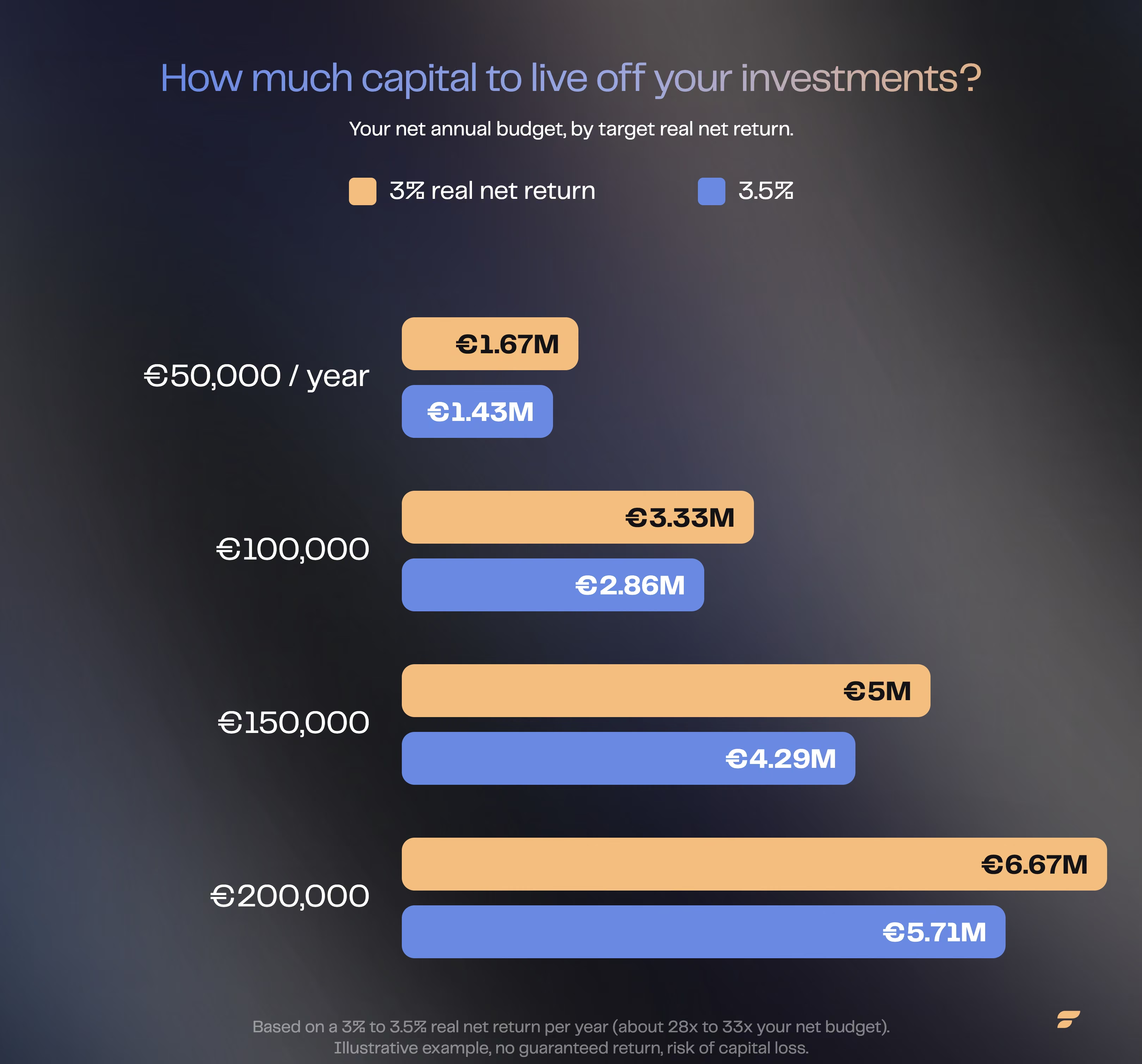
The answer comes down to a calculation almost nobody gets right. Count on 28 to 33 times your net annual budget. About €3 million for €100,000 net per year. €1.5 million for €50,000. Assuming optimised tax wrappers.
This is Thomas's story, 51, twenty-five years of work summed up in a single line on an account statement. You might be in the same place: you just sold your company, you inherited, or your holding company is sitting on excess cash. The question doesn't change: how much do you really need to live off your investments in France?
The real trap isn't running out of money. It's overestimating what your capital produces once tax and inflation have taken their share. This guide gives you the 2026 French assumptions, the architectures that hold up over 30 years, and the tax wrappers that cut the bill by 15% to 25%.

- How much capital do you need to live off your investments in France? 28 to 33 times your net annual budget: about €3 million for €100,000/year, €1.5 million for €50,000/year.
- Realistic real net return: 3% to 3.5% per year, after the 31.4% flat tax and 2% inflation.
- The American 4% rule doesn't hold up in France (heavier taxation and inflation).
- Tax wrappers (life insurance, PEA, PER, a holding company) bring taxation down from 31.4% to 12-15%, meaning 15% to 25% less capital needed.
- Orders of magnitude based on assumptions; investing carries a risk of capital loss.
The figures shown are projections based on explicit assumptions, not promises of income. Investing carries a risk of capital loss. Past performance is not a reliable indicator of future performance.How Much Do You Need to Live off Your Investments in France?
In France, count on 28 to 33 times your net annual budget: a real net withdrawal rate of 3% to 3.5% per year. Four variables explain this figure.
- Your target net annual budget. Your cost of living after tax: housing, food, transport, leisure, health, travel. This is the most underestimated input in the calculation: most people planning to live off their capital understate their lifestyle costs by 15-20%.
- The expected annualised return. Over the long run, a diversified portfolio of global equities, bonds and real estate delivers 5% to 7% gross. The real return after inflation and tax runs around 3% to 4% net for a balanced HNWI profile making full use of tax wrappers.
- Inflation. The ECB targets long-term inflation of 2%, the same reference INSEE uses. Over 30 years, 2% inflation erodes 45% of purchasing power. Your return has to beat inflation, not just taxation.
- The safety margin. The sequence of returns matters as much as the average. A crash in the first three years can deplete the capital faster than expected.
Simple formula: capital needed ≈ net annual budget ÷ real net return.
The cost of a default architecture. Take two €1 million portfolios. The first is actively managed: optimised tax wrappers, calibrated allocation, regular rebalancing. The second just sits in a plain securities account (CTO). Over 20 years, the gap can reach €200,000 to €400,000 (based on typical HNWI allocation comparisons). Over 30 years, it doubles. Tax friction compounds, exactly like returns, which is why a private wealth manager keeps paying for itself over time.
And what about the famous 4% rule? If you've already looked into this, that figure probably rings a bell. It's everywhere: withdraw 4% of your capital per year (so 25× your budget) and it lasts 30 years. Born from the Trinity Study (Trinity University, 1998), it held up on US markets from 1925 to 1995. In France, it breaks down. Three reasons:
- Taxation. The flat tax (PFU) at 31.4% (12.8% income tax + 18.6% social security contributions since the 2026 Social Security Financing Act, LFSS) takes 31 cents out of every euro of capital income. To net 4%, aim for around 5.8% gross.
- Inflation. The US rule assumed 3%; the ECB targets 2%. But recent spikes (5.2% in 2022, 4.9% in 2023, 2.0% in 2024) have eaten into the purchasing power of those already living off their capital.
- The IFI (France's real estate wealth tax). Above €1.3 million of taxable non-business real estate, expect an extra 0.3% to 0.5% of annual friction.
That's the whole gap: 28 to 33 times your budget in France, versus 25 times in the United States. For the general framework behind this projection, see our wealth management guide. To fine-tune the numbers for specific amounts, see how much €100,000, €500,000 or €1 million invested actually earn.
What 2026 Assumptions Is This Calculation Based On?
A serious projection isn't invented, it rests on official sources. Here are the seven 2026 assumptions, and where they come from.
| Assumption | Range used | Source |
|---|---|---|
| Long-term global equity return | 6% to 8% gross / year | MSCI ACWI, 30-year historical performance |
| Private Equity return (average, all segments) | 10% to 12% net / year | France Invest / EY, 2024 net performance (net IRR) |
| High-quality bond return (French OAT) | 3% to 3.5% gross / year | Banque de France, bond indices + AFT, OAT yield curve |
| Long-term France inflation | 2% per year | ECB (target), INSEE (measured) |
| Default taxation on capital income | 31.4% flat tax (excluding life insurance, which keeps 30%) | Article 200 A of the CGI, 2026 LFSS |
| Reduced life insurance taxation after 8 years | PFNL 7.5% + €4,600 tax allowance (€9,200 for a couple) | Article 125-0 A of the CGI |
| PEA contribution cap | €150,000 in contributions | Article L221-30 of the CMF |
For wealth that makes full use of its tax wrappers: 6-7% nominal, 2% inflation, 10-15% weighted taxation. That works out to 3.5% to 4.5% real net return.
The 12% Private Equity myth. According to the France Invest / EY study to end-2024, "the net IRR stands at 11.3% per year since inception." But that's the average across all quartiles. The top quartile climbs to around 23.5% net IRR (2.3x multiple). The bottom quartile falls into negative territory (-2.8% net IRR, 0.9x multiple, France Invest data, end-2024). In other words: PE isn't an asset class, it's a game of manager selection. Pick the wrong fund, and you pay 7 to 10 years of illiquidity to lose capital.
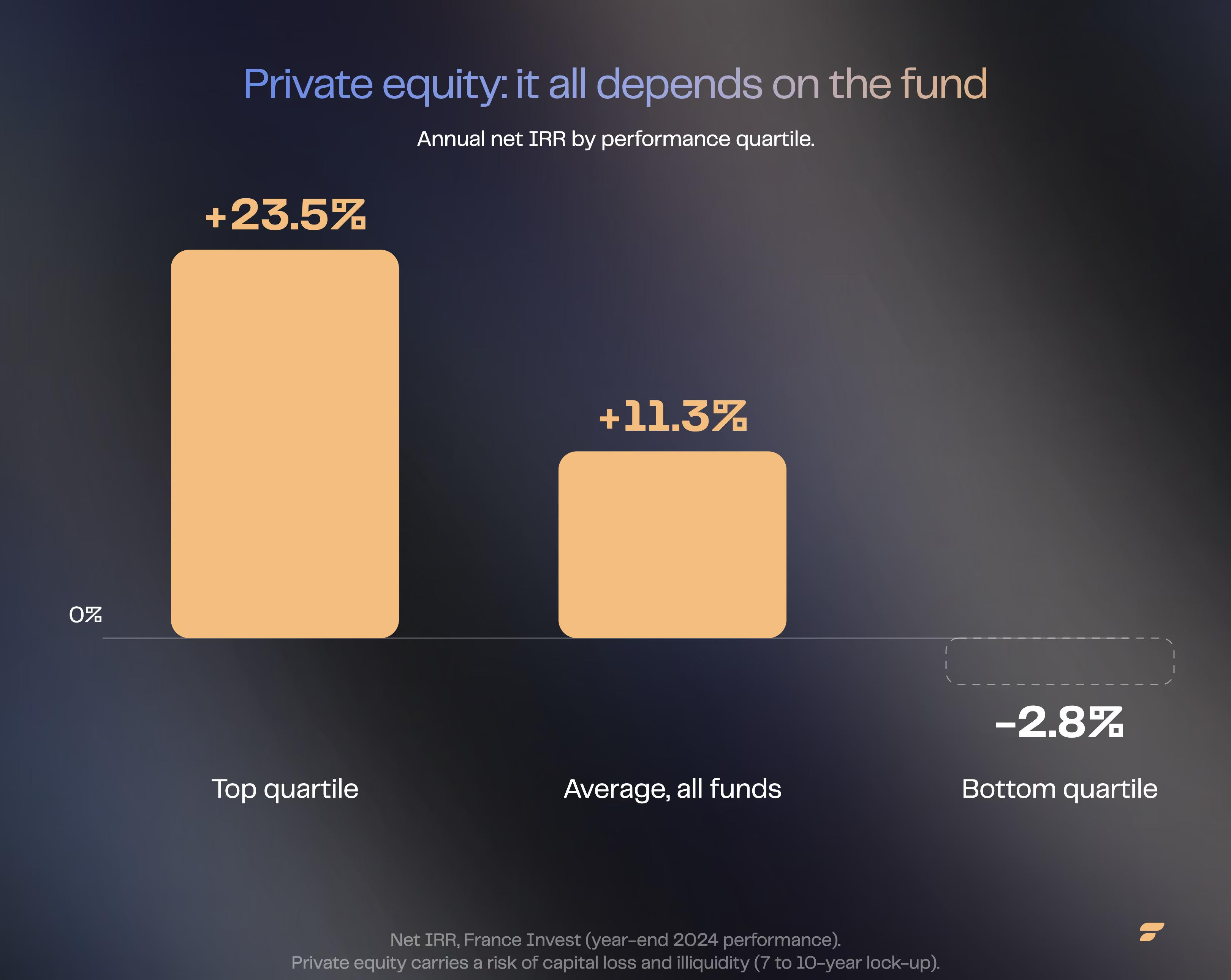
Past performance is not a reliable indicator of future performance. Private Equity carries a risk of capital loss and illiquidity, with a typical lock-up horizon of 7 to 10 years. For the full range of accessible vehicles (FCPR, FCPI, FIP, FPS, SLP, specialised ETFs), see our guide to Private Equity vehicles.
How Much Capital Depending on Your Profile? Three Worked Scenarios
All three rest on the same framework: a bucket strategy (the 4-bucket strategy), a classic in wealth management, adapted to French law. The principle: the Cash bucket pays out every month, topped up by the coupons from the Protection bucket and the rents from the Income bucket, while the Growth bucket works separately for the long term.
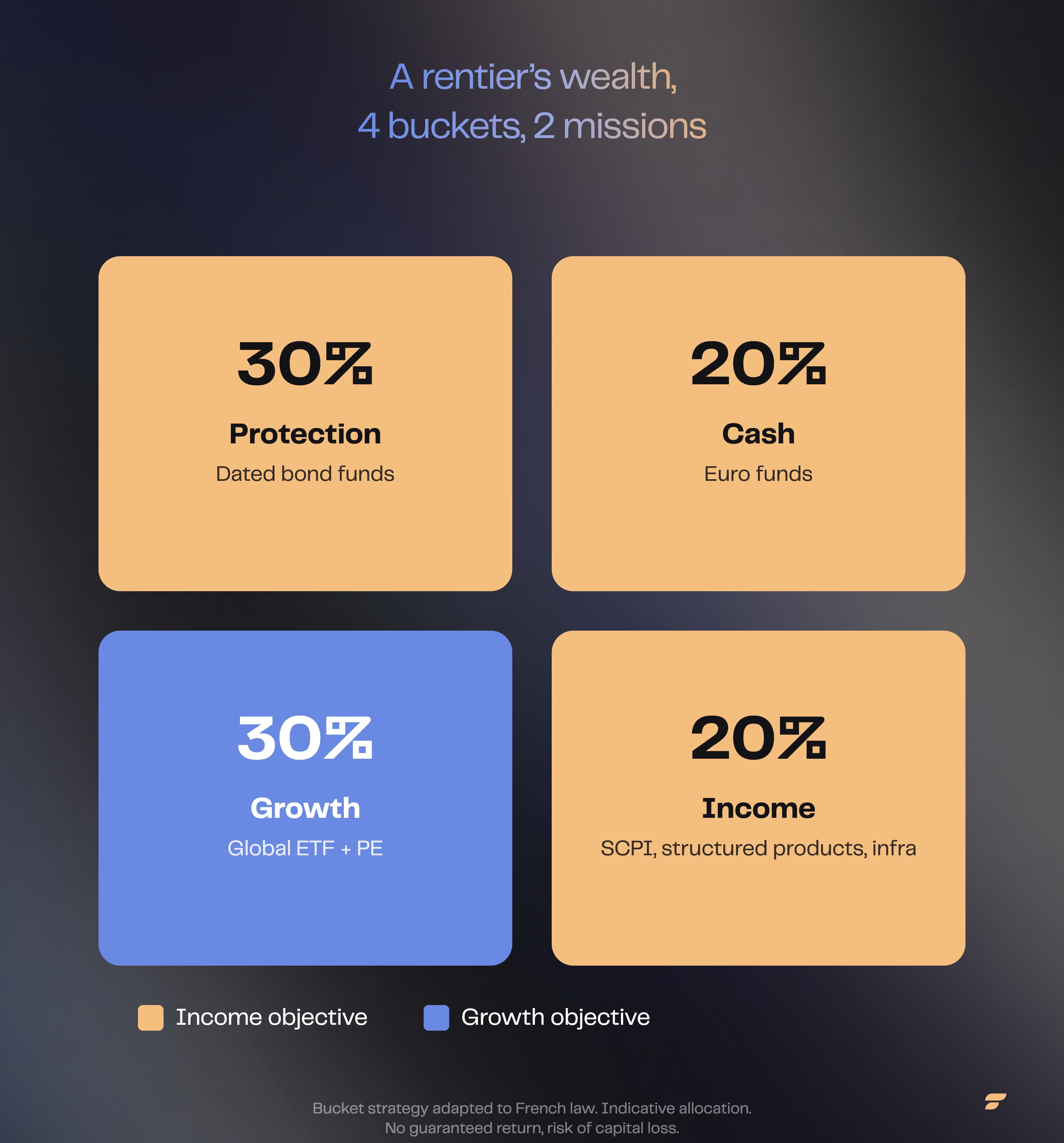
Three HNWI profiles show how to calibrate capital to your situation: a 51-year-old business owner who just sold his company, a 34-year-old heir seeking financial independence, and a 30-year-old entrepreneur with excess cash sitting in a holding company.
Scenario 1. Thomas, 51, Sold His Business, €5 Million After Tax
Thomas sold his industrial SME for €5 million net. The real question for him isn't return, it's structuring a daily life after 25 years of 70-hour weeks. His wife brings in €80,000 net from her salary; the couple needs €200,000 net per year, meaning €120,000 has to come from their wealth.
Allocation outside of investing: €1.5 million (€800,000 for a holiday home in Pornic, €700,000 in planned wealth transfer to his two children).
Investable capital: €3.5 million. For €120,000 net per year, Thomas needs a real net return of around 3.4%. That's achievable with a 4-bucket architecture (a bucket strategy adapted to French law):
- Cash: €750,000 in euro funds (3 years of needs, independence in case of a crash).
- Protection: €1 million in dated bond funds (regular coupons, low volatility).
- Income: €750,000 in coupon-paying structured products, income-distributing SCPI (a French non-listed real-estate investment fund, comparable to a REIT) and infrastructure funds.
- Growth: €1 million, split between €600,000 in global equity ETFs and €400,000 in Private Equity.
The logic: Cash pays out every month, the coupons and rents from the Protection and Income buckets keep topping it up, and Growth stays invested for the long term to beat inflation. Why 4 buckets and not 3 or 5? Because it isolates 3 years of needs from the market (Cash) so you never have to sell at the bottom during a crash, and it separates recurring income (Protection + Income) from long-term growth (Growth), so the two goals never get mixed up.
For business owners looking to defer capital gains tax on a sale under the 150-0 B ter mechanism, see the apport-cession reinvestment rule.
Scenario 2. Hugo, 34, Inherited €1.2 Million, Financial Independence at 45
Hugo, a dentist in Lyon, inherits €1.2 million after inheritance tax (a generation-skipping transfer from his grandfather). He earns €100,000 net per year from his practice. His real concern: not letting down an inheritance he didn't build himself. He's aiming for financial independence at 45, so he can scale back or stop practising if he wants to.
Immediate allocation: €200,000 as a down payment on a primary residence, topped up with a mortgage that becomes his long-term wealth-building leverage. Investable capital: €1 million.
Since Hugo doesn't depend on this capital to live today, the goal is maximum growth over 11 years:
- €150,000 in euro funds (liquidity bucket, for the unexpected).
- €600,000 in diversified global equity ETFs (life insurance + PEA capped at €150,000 + CTO).
- €250,000 in Private Equity (25% of the allocation, inspired by American family offices, which allocate 20-40% to illiquid assets).
The power of time. With a weighted average real return of 6% to 7% per year, capital doubles every 10 to 12 years (the rule of 72). By 45, Hugo could have close to €2 million investable under this assumption. At that point, the allocation can shift back to the Cash / Protection / Income buckets from Thomas's scenario to generate a stable income. Past returns are not a reliable indicator of future performance.
For an HNWI who wants an FAS/FID architecture, funds not eligible under French law, and a different legal framework, Luxembourg life insurance is the complementary wrapper worth looking into.
Scenario 3. Camille, 30, €1 Million in Excess Cash in a Holding Company
Camille, a content creator, has 850,000 followers and a holding company sitting on €1 million in excess cash. She pays herself a modest salary (€80,000 gross); the rest accumulates. Her real challenge: her income depends on a platform she doesn't control. One algorithm change, one bad buzz moment, and the machine stops within 6 months. The million sitting in the holding company is her career safety net.
The classic trap. Taking the million out directly as a dividend to her personal account would trigger the 31.4% flat tax (12.8% income tax + 18.6% social contributions since 1 January 2026), plus the Exceptional Contribution on High Incomes (CEHR, 3% to 4% above €250,000 of reference taxable income for a single person), plus the Differential Contribution on High Incomes (CDHR, introduced by the 2025 Finance Act, art. 10, and extended by the 2026 Finance Act, which guarantees a minimum effective rate of 20%, already exceeded here). In total, the tax cost reaches about 34% (31.4% PFU + CEHR), or close to €340,000 in the very first year.
The wealth planning solution. Keep the money in the holding company and invest it through a corporate capitalisation contract. The holding company compounds the returns under corporate tax (IS) rules: 15% on the first €42,500 for eligible SMEs (subject to revenue ≤ €10 million and at least 75% of capital held by individuals), 25% above that. On top of that, the parent-subsidiary regime exempts 95% of dividends from subsidiaries (an effective rate of around 1.25%), and capital gains on equity investments held for more than 2 years are taxed at 0% (with a 12% add-back for costs and expenses).
The ratio, in numbers. Immediate dividend: around €340,000 in tax in year 1 (about 34%). Holding company + capitalisation contract with a cautious allocation: around €12,500 in corporate tax per year on average, or roughly 27 times less annual tax friction. Over 10 years, the structure pays around €125,000 in cumulative corporate tax, compared with the roughly €340,000 taken in the first year alone with a direct payout. The structure pays for itself in under 3 years.
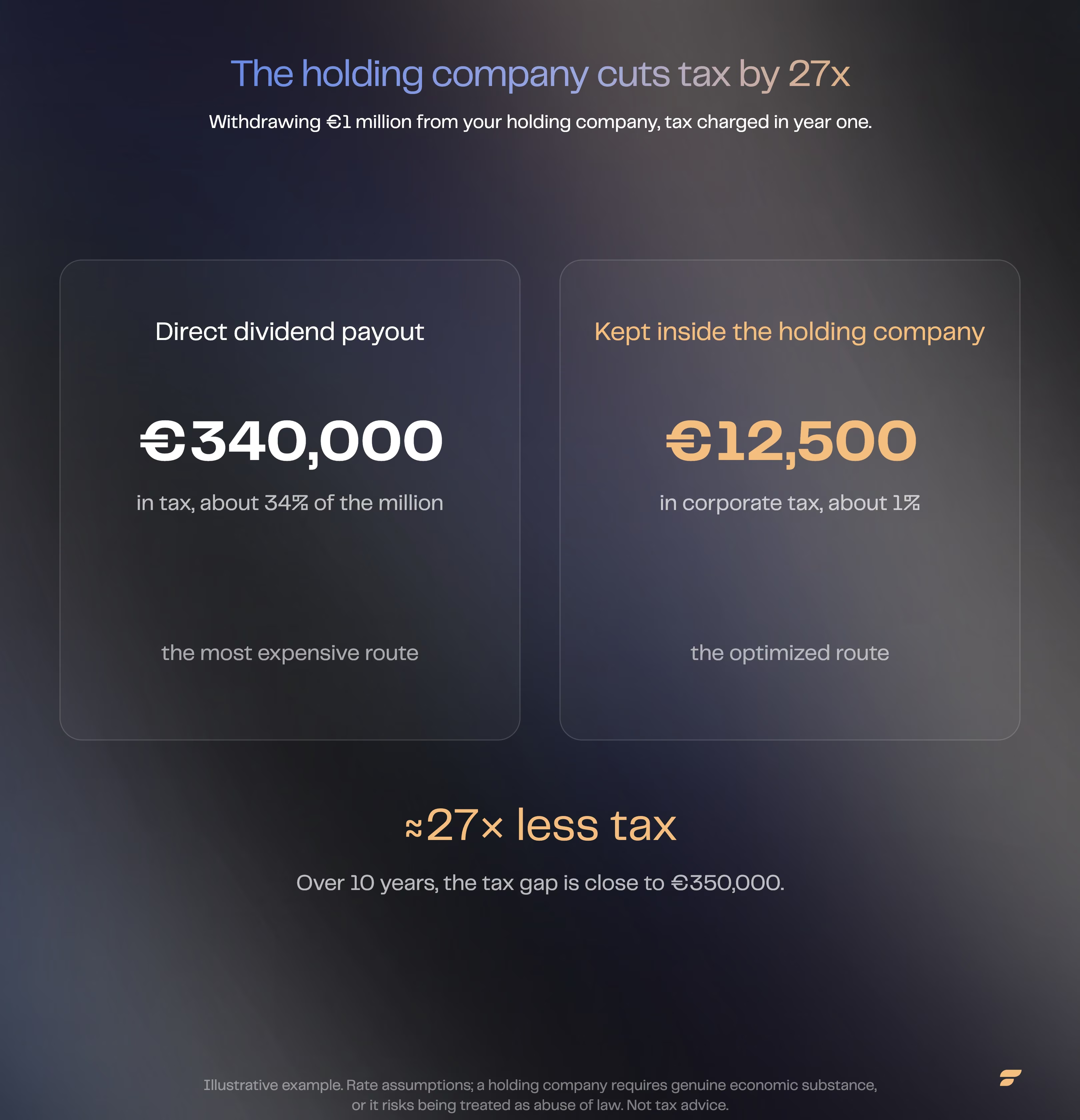
Word of caution: using a holding company has to reflect genuine economic substance. A wealth holding company set up purely for tax optimisation risks a reassessment for abuse of law (French tax authority, 2022 map of abusive practices).
Allocation within the capitalisation contract: €200,000 in euro funds, €250,000 in coupon-paying structured products, €150,000 in dated bond funds, €300,000 in global equity ETFs, €100,000 in Private Equity (a lower-risk profile than Hugo's, since her earned income is less stable and 4 people depend on her audience).
Placed side by side, these three profiles make the point: at comparable wealth levels, it's the objective (generating income or growing capital) that shapes the allocation, not the amount.
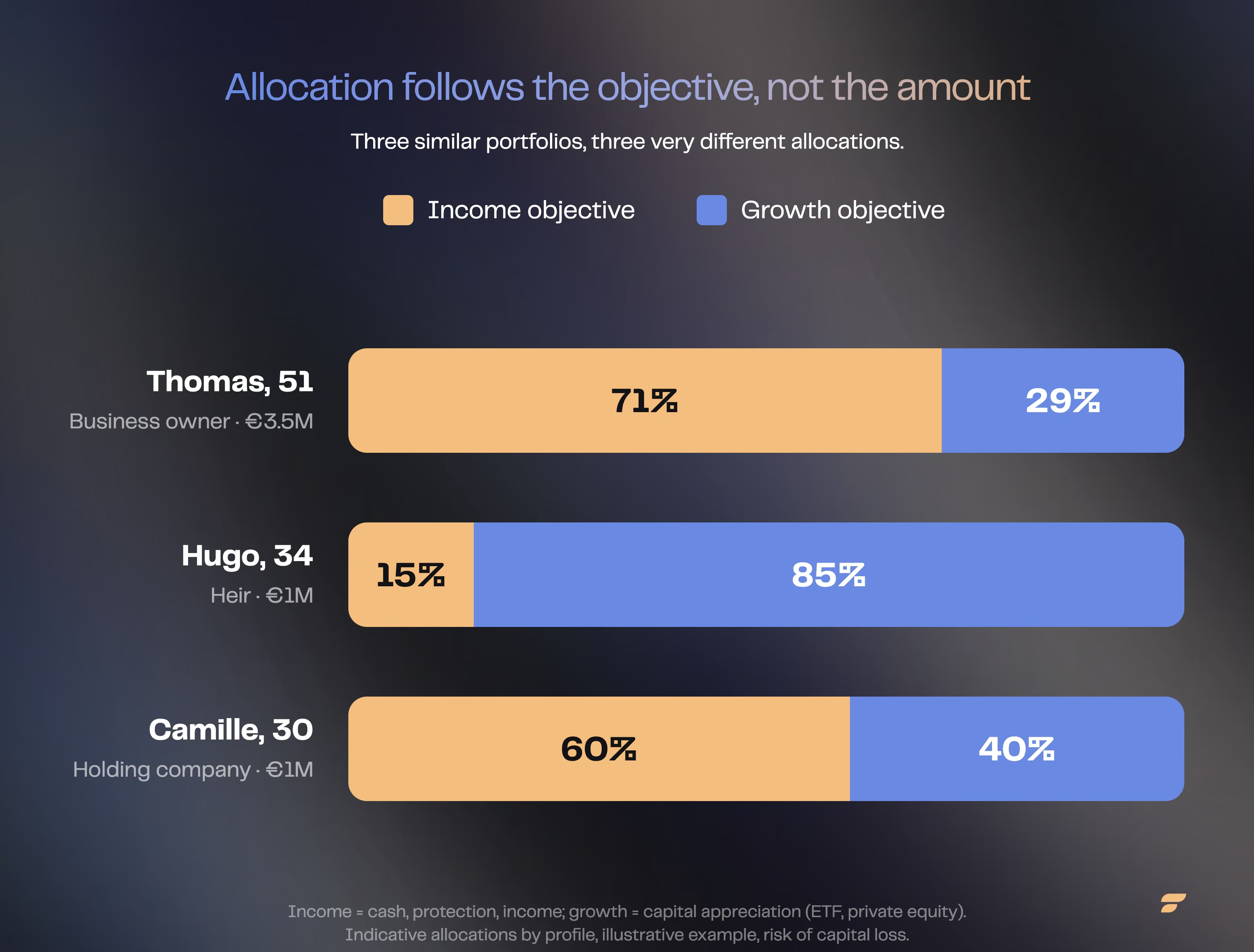
Reading these balances is simple. Translating them into a line-by-line allocation, then rebalancing it every year, is far less so.

Which Tax Wrappers Reduce the Capital You Need?
Five tax wrappers bring the effective tax rate down from 31.4% (the plain flat tax) to a weighted 12-15%. For the same need, they cut the required capital by 15% to 25%.
Life insurance, after 8 years. Gains on withdrawals drop to 7.5% (a non-final flat-rate levy, PFNL, an advance on income tax) for premiums paid after 26/09/2017, with an annual allowance of €4,600 (€9,200 for a couple). That rate only applies up to €150,000 in outstanding assets; above that, it goes back up to 12.8%. Note: life insurance keeps a 30% flat tax (12.8% income tax + 17.2% social contributions), an exception to the 2026 LFSS increase. Full details in our guide to life insurance taxation in 2026 and how the tax allowance is calculated.
The PEA, after 5 years. Gains are exempt from income tax. Contribution cap: €150,000. Only social contributions (18.6% since 2026) remain due. For long-term equities, it's the most efficient wrapper. For the trade-off between the two wrappers, see PEA or life insurance: which one to choose.
The holding company + capitalisation contract. For wealth from a business sale or a company's activity: the holding company compounds returns under corporate tax (IS) rules (15% up to €42,500 for eligible SMEs, 25% above that), with 95% of dividends from subsidiaries exempt (parent-subsidiary regime) and 0% on capital gains from equity investments held for more than 2 years (with a 12% add-back).
The PER. Contributions are deductible from taxable income going in. Especially powerful for high earners still working, in the 41% or 45% marginal tax bracket (TMI).
The HNWI combination. A €3 million portfolio is typically split between life insurance (two contracts at the tax-efficient cap), PEA (€150,000), PER, a CTO for the remaining liquid equities, and a holding company for business income. Enough to bring taxation down from 31.4% to a weighted 12-15%. That's why a private wealth manager stays useful long after a sale: optimising an exit over 20-30 years takes yearly rebalancing, not a one-off decision.
What Traps Wreck the Numbers Behind Living Off Your Capital?
Three biases regularly wreck projections for living off your capital. Each has its fix.
Trap 1. Underestimating inflation. 2% a year sounds harmless. Over 30 years, it wipes out 45% of purchasing power. A €120,000 lifestyle today is €218,000 in 2056 for the same comfort. Your real net return has to beat inflation every year, or the capital quietly erodes.
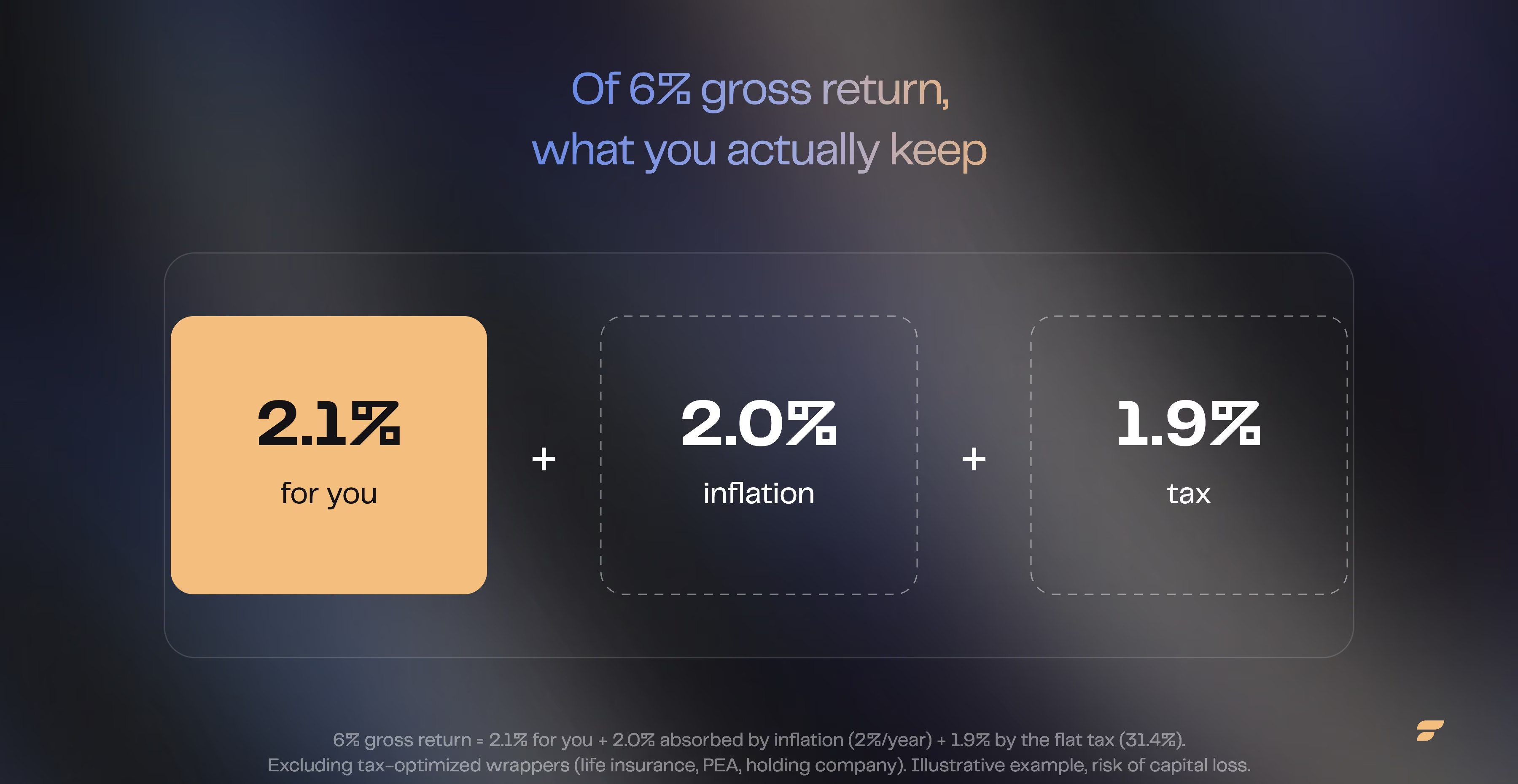
Trap 2. Forgetting exit taxation. Many people think in gross return. But what actually pays for your lifestyle is the net figure: after the flat tax, social contributions and, potentially, the IFI. 6% nominal becomes around 4.1% net outside of tax wrappers (after the 31.4% flat tax), and around 2.1% real after 2% inflation. Almost half of what the brochures promise.
Trap 3. Ignoring the sequence of returns. The 4% rule assumes a smooth average over 30 years. But if the market loses 30% in your first two years of withdrawals, the depleted capital has to climb much higher to recover. Researchers (Bengen, Kitces, the Trinity Study) call this sequence of returns risk: at the same average return, two withdrawal plans can survive very differently depending on whether the losses hit early or late. Monte Carlo simulations show it clearly: a crash in year 1 can knock down the portfolio's 30-year survival probability, sometimes well below the theoretical 95%. The fix: keep 2 to 3 years of needs in the Cash bucket, so you never have to sell at the bottom.
The thread running through all three traps: the most expensive mistakes make no noise. Your 6% that's really only 2.1%. The €200,000 to €400,000 gap between an actively managed and a "default" portfolio over 30 years. The crash handled badly, because you had to sell at the worst possible time. None of it shows up in the moment. All of it gets paid for later, often when it's too late to fix.
Investing carries a risk of capital loss.
Finary One, for a Complete View
You can work out the numbers in this article yourself. What actually decides whether you can live off your investments is the structure: which wrappers, in what order, and how the rebalancing holds up over twenty or thirty years.
A Finary One private wealth manager, backed if needed by a wealth engineer, looks at your whole estate: protection (beneficiary clause, marital property regime, personal protection insurance), structuring (holding company, split ownership, gifts) and wrappers (French and Luxembourg life insurance and securities accounts, PEA, PER, capitalisation contract).
Your wealth is reviewed as a whole and managed over time, and you keep the final say on every decision. The assessment is free, with no obligation, even if you're not a client, from €500,000 in investable assets.
Finary SAS, an investment firm authorised by the ACPR (no. 19283). This article is for information purposes only and does not constitute personalised investment advice; all investing carries a risk of capital loss.
Frequently Asked Questions
How much do you really need to live off your investments in France?
For a net budget of €100,000 per year, count on between €2.5 million and €3 million invested, depending on the tax wrappers used. For €50,000 net per year, around €1.3 million to €1.5 million. These figures assume a real net return of 3.5% to 4% and a safety margin against the sequence of returns.
Does the 4% rule work in France?
Not directly. It was calibrated on the US market between 1925 and 1995, with light taxation and different inflation. In France, after the 31.4% flat tax and INSEE inflation, the realistic version sits between 3% and 3.5% net withdrawal from capital, or 28 to 33 times your net annual budget versus 25 times for the US version.
What taxation applies to capital income in France?
By default, the 31.4% flat tax (12.8% income tax + 18.6% social contributions since the 2026 LFSS) applies to dividends, interest and capital gains on securities. Life insurance keeps a 30% flat tax (12.8% income tax + 17.2% social contributions), an exception to the increase. Several wrappers reduce the rate further: life insurance after 8 years (7.5% PFNL + tax allowance), PEA after 5 years (income tax exemption, 18.6% social contributions), PER (deduction going in), a holding company via corporate tax (15-25%).
What reasonable annual return can you expect?
Over the long run, a diversified portfolio of global equities, bonds and real estate delivers 5% to 7% gross per year. The real net return after inflation and tax runs around 3% to 4% for a balanced HNWI profile making full use of tax wrappers. Past performance is not a reliable indicator of future performance.
Why not put everything into life insurance?
Because the €150,000 cap per contract for the reduced taxation of premiums paid after 26/09/2017 limits the tax benefit beyond that. On larger balances, the standard rate (12.8%) takes back over. A well-rebalanced combination of life insurance, PEA, a holding company and a CTO captures the tax niches better, depending on cash flows and time horizon.
How can you reduce the capital needed to live off your investments?
Three levers. Optimise taxation (combine life insurance, PEA, PER, a holding company) to gain 10% to 15% in net return. Stagger tax wrappers by time horizon (8 years for life insurance, 5 years for PEA). Keep the capital meant to generate income separate from tied-up wealth (primary residence, planned wealth transfer).
How much wealth do you need before you can live off your investments in France?
There's no universal threshold. The right indicator is the ratio of net income to investable capital. For a Finary One private wealth manager, investable wealth of €1,000,000 already allows for a serious architecture. Above €2 million investable, tax rebalancing really starts to make the difference in optimising net return.
How do you live off your investments in France?
By building invested capital that generates enough real net income to cover your lifestyle without depleting the capital. In practice: aim for 28 to 33 times your annual budget, spread it across tax wrappers (life insurance, PEA, PER, a holding company) to limit taxation, and structure the allocation into buckets (cash, protection, income, growth) so you never have to sell at the wrong time.
How much capital do you need to live off your investments at 50?
The capital you need depends on your budget, not your age: 28 to 33 times your net annual budget (around €3 million for €100,000 net/year, €1.5 million for €50,000). At 50, the long horizon (30 years or more) allows for a larger equity growth bucket, which helps beat inflation over time. The reasoning is the same at 55 or 60.
Can you live off your investments with €1 million?
With €1 million invested and a real net return of 3% to 3.5%, count on €30,000 to €35,000 net per year. Enough to supplement an income, rarely enough to fund a high-end lifestyle without eating into the capital. For €100,000 net per year, aim for €2.5 million to €3 million instead. Past performance is not a reliable indicator of future performance.
Sources
- Cooley, Hubbard, Walz (Trinity University, 1998), Retirement Spending: Choosing a Sustainable Withdrawal Rate, the paper behind the "4% rule," tested on US market returns from 1925 to 1995.
- INSEE, indice des prix à la consommation, série longue.
- France Invest / EY, performance nette du capital-investissement français à fin 2024.
- Banque centrale européenne, stratégie de politique monétaire et cible d'inflation 2 %.
- Banque de France, indices obligataires + AFT, taux de référence OAT.
- impots.gouv.fr, fiscalité des plus-values mobilières (PFU 31,4 %).
- impots.gouv.fr, fiscalité du PEA après 5 ans (PS 18,6 %).
- impots.gouv.fr, retraits d'assurance-vie après 8 ans (PFNL 7,5 % + abattement).
- Article 200 A of the French General Tax Code (PFU), via Légifrance.
- Law no. 2025-127 of 14 February 2025 (2025 Finance Act, CDHR) and law no. 2025-1403 of 30 December 2025 (2026 Social Security Financing Act, LFSS, CSG increase bringing the PFU to 31.4%).
- UBS Global Family Office Report 2024. Target allocation of family offices.
Regulatory disclaimers:
Marketing communication. Investing carries a risk of partial or total capital loss. Past performance is not a reliable indicator of future performance. This article is for information and educational purposes only; it does not constitute personalised investment advice, a buy or sell recommendation, or tax advice.
This investment carries a risk of illiquidity (resale not guaranteed, long horizon) and a risk of capital loss. Income and valuations are not guaranteed.
Before investing, read the Key Information Document (KID) and, where relevant, consult an authorised adviser.
Finary SAS, an Investment Firm authorised by the ACPR under no. 19283, member of AMAFI. Insurance broker registered with ORIAS under no. 21001279, member of the CNCGP (association approved by the AMF). Crypto-Asset Service Provider (CASP) authorised by the AMF under the MiCA regime, under references no. A2026-026 and no. N2026-008.