


Structured Products: How They Work, Returns and Risks

Updated 6 July 2026.
An 8% annual coupon, and your capital protected as long as the index does not fall by more than 40%. On paper, the pitch is irresistible. It comes up in almost every structured product presentation, and that is exactly what should make you cautious.
You may have just sold your company, be managing a holding company's cash, or be looking to turn wealth into regular income. An advisor has suggested a structured product to “secure” part of your allocation. The real question is not “how much does it pay”, it is “what am I actually buying, and what can go wrong”.
A structured product is a contract whose rules (the coupon, the protection, the term) are written in advance, but whose outcome depends on an underlying and on the strength of the bank that issues it. The trap is not the headline return. It is the confusion between “protected capital” and “guaranteed capital”, and the risk almost everyone forgets: the issuer’s.
Before we get into the mechanics, two investors explain how they use them, in this Finary One video:
 Investing carries risks, including partial or total loss of capital. Structured products are complex instruments: their return is not guaranteed and depends on a market scenario and on the issuer's solvency. Past performance is not a reliable indicator of future performance.
 - A structured product is a complex debt security (most often an EMTN, Euro Medium Term Note) whose return follows a predefined formula linked to an underlying: a stock, an index, a basket. The AMF classifies it as a “complex debt security” (position DOC-2010-05).
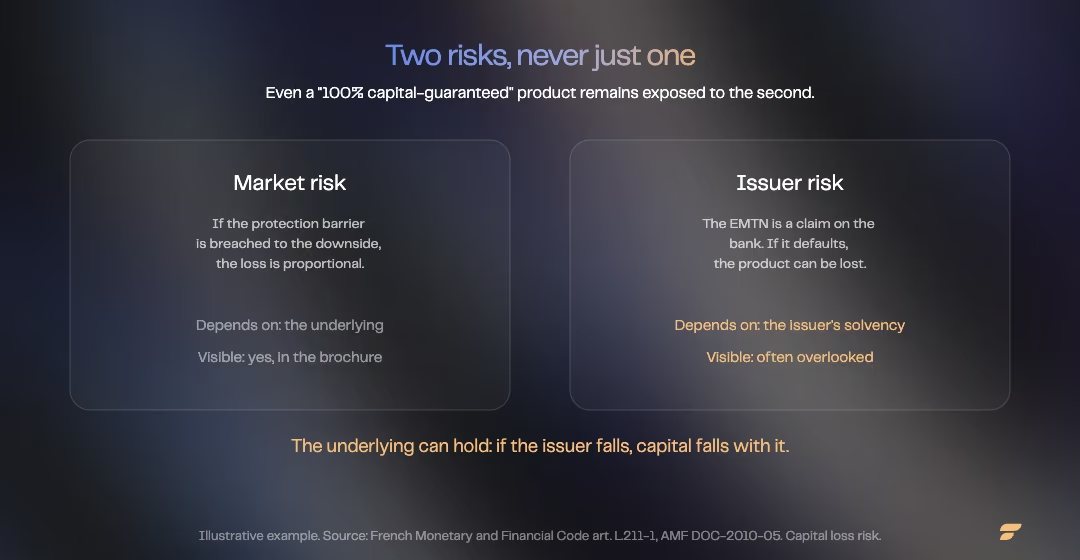
- Two risks always come together: the risk of capital loss (if the protection barrier is breached to the downside) and issuer risk (if the issuing bank defaults, the product can be lost regardless of how the underlying performed).
- “Protected capital” does not mean “guaranteed capital.” A 50% protection level covers a fall of up to 50% in the underlying; beyond that, the loss is proportional. Only a capital-guaranteed product protects the full nominal amount, and it still carries issuer risk.
- Taxation depends on the wrapper, not the product. In a securities account, gains fall under the flat tax (PFU) at 31.4%. In life insurance or a capitalization contract, they follow the wrapper's own regime.
- Every retail structured product comes with a KID (Key Information Document, required under the PRIIPs Regulation), which shows a risk indicator from 1 to 7 and, for products that are hard to understand, a complexity warning. Having a KID does not make a product simple: it is the opposite.
What is a structured product, exactly?
A structured product is an instrument whose return rules are fixed in advance, whatever the market's actual path turns out to be. Its most common form is the EMTN, a debt security issued by a bank.
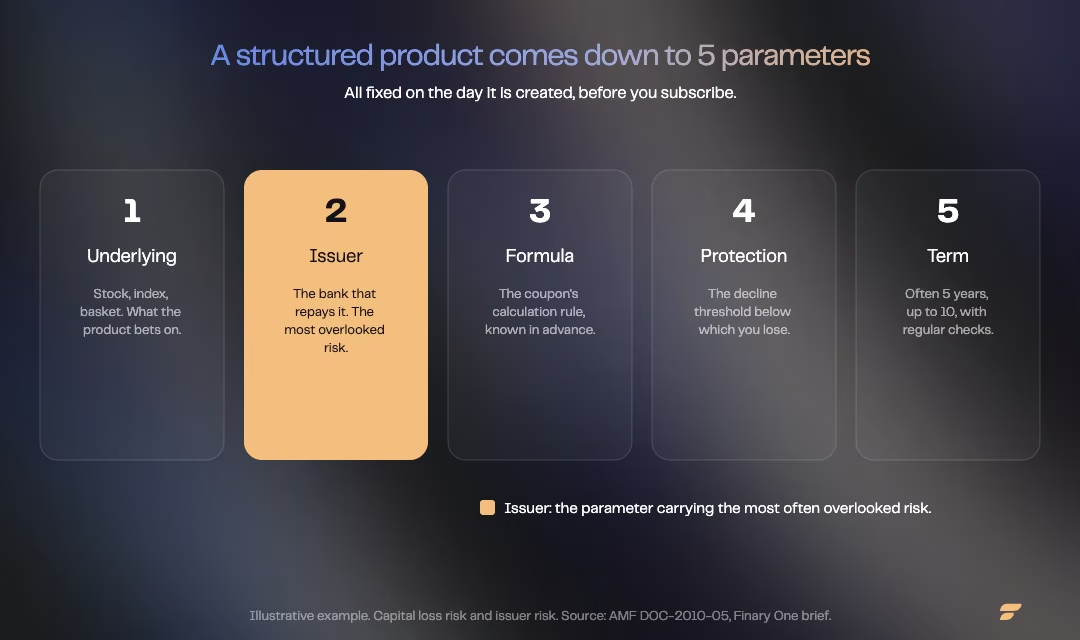
To understand it, take it apart. A structured product always assembles the same building blocks, defined on the day it is created:
- The underlying: what the product “bets” on. A stock, an index such as the Euro Stoxx 50, a basket of shares. It is the underlying that triggers, or does not trigger, the coupon payment.
- The issuer: the bank that structures the product on its trading desk and commits to repaying it. Remember this one, we will come back to it: it is the link most often overlooked.
- The formula: the calculation rule. If the underlying is above a given threshold on a given date, you receive a given coupon. If not, a different scenario applies.
- Capital protection: the level of decline in the underlying beyond which you start to lose money. 30%, 50%, or a full capital guarantee.
- The term and the observation dates: often 5 years, sometimes up to 10, with regular checkpoints where the formula is assessed.
Two families structure most of the market. The Athena pays a single coupon, at redemption. The Phoenix Memory pays coupons at regular intervals, as long as the underlying stays above a distribution barrier. Most also embed an early-redemption mechanism, or autocall: from a given date, if the underlying is above a threshold, the product ends immediately and pays the coupon due. You do not choose the term, the market chooses it for you.
Keep the central idea in mind. You are not buying a share or a plain bond. You are buying a bet whose rules are known in advance, but whose outcome depends on a market scenario and on a bank.
How does the return on a structured product work?
The return on a structured product is never a given: it depends on the formula being triggered, so on how the underlying behaves. No coupon can be presented as guaranteed or inevitable.
Take a typical mechanism, purely for illustration. A product indexed to a European index, an 8% target coupon, a protection barrier at minus 40%, annual observation.
- Favourable scenario: on the observation date, the index is above its starting level. The product is called, you get your capital and the coupon back. This is the autocall: short, clean, and the product ends.
- Intermediate scenario: the index has fallen, but stays above the minus-40% barrier. Depending on the formula, you receive the coupon (Phoenix) or wait for the next observation, with capital preserved for now.
- Unfavourable scenario: at maturity, the index is below minus 40%. The protection gives way. You absorb the loss, proportional to the actual decline. An index down 45% means a 45% loss on your capital.
The AMF also requires, for any product with partial protection, that the risk of loss “of up to X%” be stated in plain terms. When this wording appears in the documentation, it is not a formality: it is the scenario to look at first.
A coupon is not rent. Rent comes in as long as the tenant pays. A structured product's coupon comes in as long as a market condition is met, and it may never come in at all. That is the nuance the brochure tends to blur, and the one that changes everything.
What are the real risks of a structured product?
The main risk of a structured product is not the one people assume. Beyond the capital loss tied to the underlying, there is issuer risk, which never goes away, even on a “100% capital-guaranteed” product.
Legally, an EMTN is a debt security. Buying one makes you a creditor of the issuing bank (French Monetary and Financial Code, art. L.211-1). The direct consequence: if the issuer defaults, the product can be lost, regardless of how the underlying performed. A product that promises “100% of the nominal amount at maturity” is therefore never risk-free. The 2008 collapse of Lehman Brothers left holders of “guaranteed” structured products with a claim on a bank that no longer existed. Depending on the ranking of the issue (senior, non-preferred senior, subordinated), the note can even be exposed to the bail-in mechanism in the event of a bank resolution.
Here are the risks to weigh before subscribing to one:
- Capital loss risk. If the protection barrier is breached at maturity, the loss is proportional. Protection is conditional, not absolute.
- Issuer risk. The product is only worth as much as the solvency of the bank that issued it. That is why an informed investor checks the issuer's credit rating first.
- Complexity risk. The AMF considers that beyond three different calculation mechanisms within a formula, a product becomes hard to understand. The more complex it is, the less you know what you are buying.
- Liquidity risk. A structured product is not designed to be sold before maturity. Doing so means accepting a market value that can be well below the nominal amount.
On this last point, a simple rule of thumb: a structured product ties up your money for years. It complements an allocation, it does not replace one.
“Protected Capital” or “Guaranteed Capital”: What Is the Difference?
“Protected capital” and “guaranteed capital” are not synonyms, and the confusion is costly. Protection is conditional, tied to a barrier; a guarantee covers the full nominal amount, subject to issuer risk.
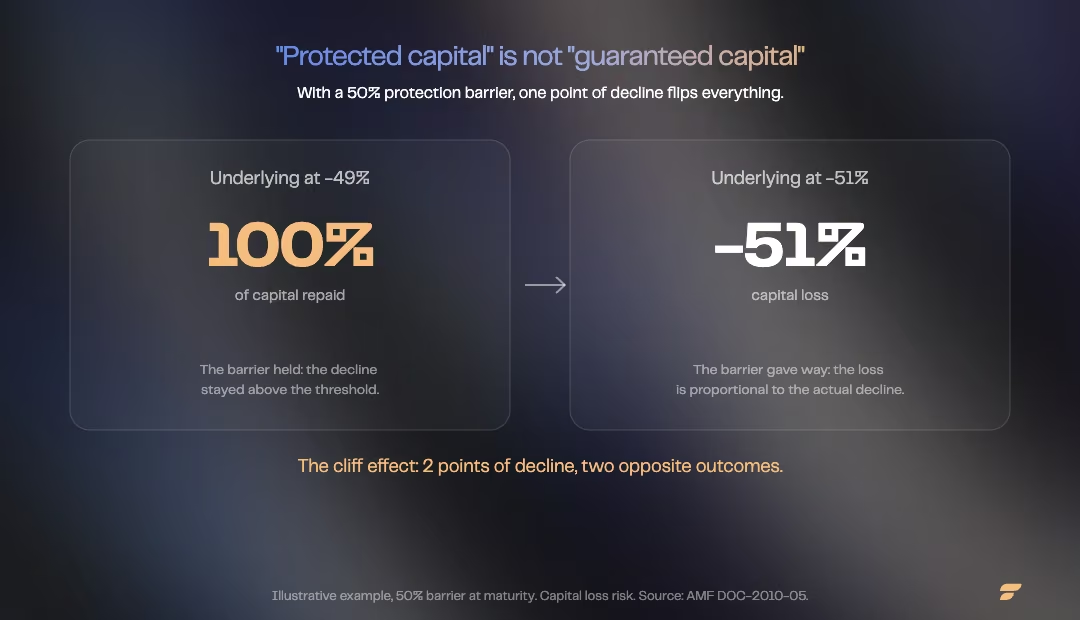
The barrier mechanism deserves a concrete example. With 50% protection:
- If the underlying ends 49% below its starting level, your capital is repaid in full. The barrier held.
- If the underlying ends 51% below, the barrier gives way. You lose 51% of your capital, not 1%. The loss is proportional to the actual decline, not to the gap with the barrier.
This is the “cliff” effect of barrier products: one more percentage point of decline, and the repayment profile flips entirely. A 30% or 50% protection level is not a half-guarantee, it is protection that works within a zone and disappears beyond it.
The word “guaranteed” should be reserved for cases where an explicit legal guarantee exists. And even then, issuer risk remains: “guaranteed by whom?” is always the right question. Barrier levels (30%, 50%, full capital guarantee) are parameters specific to each product, not market standards. You read them in the documentation, you never assume them.
How Are Structured Products Taxed in France?
How a structured product is taxed depends on the wrapper that holds it, never on the product itself. In France, the same product is not taxed the same way depending on the tax wrapper you choose, a securities account or life insurance.
- In a securities account. Gains (coupons and capital gains) fall under the standard regime for securities: the flat tax (PFU) at 31.4%, made up of 12.8% income tax and 18.6% social security contributions since 2026.
- In life insurance or a capitalization contract. Gains follow the wrapper's own tax regime. As long as nothing is withdrawn, they compound with no annual tax. On withdrawal, after 8 years, the income tax rate drops to 7.5% up to €150,000 in outstanding value (12.8% beyond that), after an annual allowance of €4,600 for a single person, €9,200 for a couple. Social security contributions stay at 17.2%.
This difference is not a detail. On a product that pays out regular coupons, the life insurance wrapper lets you compound with no tax drag year after year, then control the exit. That is exactly the logic of an income sleeve built to last.
A word on the real estate wealth tax (IFI). A structured product held directly is a debt security: it falls outside the IFI base. Held within a life insurance unit-linked fund, only the fraction that represents real estate assets, if any, counts towards the base. A product backed by an equity index generates none, in principle.
The KID, MiFID II, Execution-Only: What Does the Regulation Say?
Any structured product marketed to a retail investor requires its manufacturer to hand over a KID (Key Information Document), and rules out a pure self-service sale. The regulation treats these products as complex, and that changes how they can be sold to you.
The KID is required under the EU's PRIIPs Regulation. A maximum of three A4 pages, standardised sections, and above all two things to read first:
- The risk indicator, on a scale of 1 to 7, which combines market risk and credit risk. The higher the number, the riskier the product.
- The complexity warning: for a product that is hard to understand, the KID carries the standardised wording “You are about to purchase a product that is not simple and may be difficult to understand.” Having a KID is therefore not proof of simplicity, it is the tool that makes the risk visible.
On the client-relationship side, MiFID II classifies the structured product among complex instruments. As a result, it is excluded from execution-only, the “the client asks, we execute without checking” mode. The seller must at least assess whether the product is appropriate for you, and, if advice is given, whether it suits your profile. “You’re the one who asked for it” never waives that test for a structured product.
Finally, the AMF (position DOC-2010-05) has set a useful benchmark: a product whose capital protection at maturity is below 90% and that ticks at least one complexity criterion presents, in its view, a risk of unsuitable distribution. In plain terms: the less the capital is protected and the more convoluted the formula, the higher your guard should be.
Structured Products: For Whom, and How Much of a Portfolio?
A structured product only makes sense within an allocation that already exists, as a complement, for a specific goal: generating a clear income stream or cushioning the volatility of one sleeve. It is never justified as the core of a portfolio.
That is exactly how they show up in real wealth-management architectures. Two profiles use them, for two different reasons.
Thomas, 51, has just sold his small business. His need: €120,000 net of income a year, without having to sell assets at the worst possible moment. In his “Income” sleeve, the structured product sits alongside SCPI (a French non-listed real-estate investment fund, comparable to a REIT) and infrastructure funds. Its role: pay a recurring coupon while partially protecting capital, to feed a cash pool that pays out month after month.
Camille, 30, runs a holding company that has built up €1 million in surplus cash. Her risk tolerance is low: her income depends on an audience that could disappear. A first structured-product position, held in a capitalization contract in the holding's name, targets a regular, known-in-advance return, without exposing all the cash to equity markets.
In both cases, the structured product is a tool for the defensive allocation or the income sleeve, never the growth engine. The rule of caution that applies to these setups: do not devote an outsized share of the portfolio to it, precisely because liquidity is low and the horizon long. And a technical detail that matters for anyone using a Lombard loan: structured products are generally excluded from the portfolio that can be pledged as collateral.
The Right Tool, in the Right Place, in the Right Proportion
A structured product is neither a trap nor a sure win. It is a precise tool that delivers exactly the service it was calibrated for, and nothing more. The danger never comes from the product. It comes from the sentence that sums it up badly.
“Protected capital” heard as “guaranteed capital.” A “target” coupon read as a “certain” one. Issuer risk, invisible until the day it becomes the only thing that matters. None of these mistakes shows up at subscription. All of them are paid for at maturity, when it is too late to fix.
That is where the difference between buying a product and building an allocation plays out. Picking the right underlying, reading the right barrier, checking the right issuer, holding the product in the right wrapper, and sizing it to the right proportion: each of these choices is a discipline of its own.
That discipline echoes a simple rule, one Mounir Laggoune makes in Investir pour être libre: a product is only ever worth the place it occupies within a wealth strategy built with intent. That is precisely what a private wealth manager works through with you as part of Finary One, before even discussing a specific product.

Frequently Asked Questions
Is a structured product risk-free?
No. No structured product is risk-free. Two risks are always present: capital loss, if the protection barrier is breached to the downside, and issuer risk, if the bank that issued the product defaults. Even a “100% capital-guaranteed” product remains exposed to its issuer’s solvency.
What is the difference between protected capital and guaranteed capital?
Protected capital is conditional: it depends on a barrier. As long as the underlying does not fall beyond that threshold (50%, for example), the capital is repaid; beyond it, the loss is proportional to the actual decline. Guaranteed capital covers the full nominal amount at maturity, subject to issuer risk.
How are gains on a structured product taxed?
It depends on the wrapper. In a securities account, gains fall under the flat tax at 31.4% (12.8% income tax and 18.6% social security contributions). In life insurance or a capitalization contract, they follow the wrapper's own regime, with more favourable exit taxation after 8 years.
What return should you expect from a structured product?
No return is guaranteed. The coupons advertised are target coupons, conditional on the formula being triggered, so on how the underlying behaves. A coupon may not be paid, and capital can be eroded. Past performance is not a reliable indicator of future performance.
What is the KID for a structured product?
The KID (Key Information Document) is a mandatory pre-contractual document, required under the EU's PRIIPs Regulation. It runs to three A4 pages, presents a risk indicator on a scale of 1 to 7, and, for products that are hard to understand, a complexity warning. It must be handed to you before you subscribe.
Does a structured product count towards the IFI (real estate wealth tax)?
Held directly, a structured product is a debt security: it falls outside the base of the real estate wealth tax (IFI). Held within a life insurance unit-linked fund, only the fraction that represents real estate assets, if any, is taxable, which is generally nil for a product backed by an equity index.
Sources
- AMF, position DOC-2010-05 (marketing of structured products and complex EMTNs): amf-france.org
- EU PRIIPs Regulation no. 1286/2014 (Key Information Document): eur-lex.europa.eu
- MiFID II Directive 2014/65/EU (complex instruments, art. 25): eur-lex.europa.eu
- French Monetary and Financial Code, art. L.211-1 (debt securities): legifrance.gouv.fr
- French General Tax Code, art. 200 A (flat tax, PFU): legifrance.gouv.fr
- impots.gouv.fr, taxation of securities: impots.gouv.fr
Regulatory disclaimers:
Marketing communication. Investing carries a risk of partial or total capital loss. Past performance is not a reliable indicator of future performance. This article is provided for information and educational purposes only; it does not constitute personalised investment advice, a buy or sell recommendation, or tax advice.
Structured products are complex financial instruments. They carry a risk of capital loss (capital protection is conditional, unless an explicit guarantee applies) and issuer risk (the product is a claim on the issuing bank). They also carry liquidity risk: resale before maturity is not guaranteed and may occur at a value below the nominal amount. Returns and coupons are not guaranteed.
Before investing, read the Key Information Document (KID) and, where relevant, consult an authorised adviser.
Finary SAS, an investment firm authorised by the ACPR (no. 19283), member of AMAFI. Insurance broker registered with ORIAS (no. 21001279), member of the CNCGP (association approved by the AMF). Crypto-Asset Service Provider (CASP) authorised by the AMF under the MiCA regime, references no. A2026-026 and no. N2026-008.