Best robotics ETFs in 2026: ranking and comparison

Updated on 21 July 2026
Robotics ETFs give exposure to global automation and artificial intelligence without picking individual companies, but most remain ineligible for the PEA (a French tax-advantaged equity savings account). According to Spherical Insights, the global robotics market grew from $100.7 billion in 2023 to a projected $435.7 billion by 2033, a CAGR of 15.78%.

- Five ETFs dominate the market: iShares Automation & Robotics, L&G ROBO Global, Amundi MSCI Robotics & AI, Xtrackers AI & Big Data and WisdomTree AI.
- Management fees (TER) range from 0.35% to 0.80% depending on the fund, a gap that erodes net performance over ten years.
- Annual volatility on these ETFs frequently exceeds 20%, a level of risk suited to investors with a long time horizon.
- Without PEA eligibility, French investors must choose between an ordinary securities account and less pure European sector ETFs that do qualify for the PEA.
Why invest in robotics through ETFs?
Robotics ETFs give access to the entire automation ecosystem (software, sensors, semiconductors, embedded artificial intelligence) in a single product, without picking the sector's companies one by one.
Robotics, a growth megatrend
Robots are no longer confined to the car industry. They now run warehouse logistics, assist surgeons in the operating theatre and optimise energy management in buildings. Robotics and automation now reach every sector of the economy: transport, healthcare, finance, agriculture.
That growth is accelerating fast: in 2023 the global robotics market reached nearly $100 billion, with expected annual growth above 15%. Falling industrial-robot prices are opening the sector up to smaller companies, widening access to large-scale automation.
Robotics stands out for its ability to transform value chains. A robot is more than a tool: it improves productivity, safety and quality, and frees up human creativity. Companies that adopt these technologies can improve their competitiveness.
ETFs: simplified access to the robotics market
Investing in robotics is not only about buying shares in robot manufacturers. The sector spans:
- software,
- sensors,
- semiconductors,
- systems integrators,
- cloud platforms,
- embedded artificial intelligence.
The rise of ETFs has made this sector easier to reach, a structural trend confirmed by the Autorité des marchés financiers, which reports a steady rise in retail investor activity on ETFs. They offer diversified, transparent exposure to the whole robotics ecosystem. A well-designed thematic ETF holds both the established leaders and the innovative newcomers.
For the investor, that means:
- benefiting from the sector's growth without mastering every technical detail,
- reducing single-stock risk,
- avoiding emotional bias when markets swing.
Robotics ETFs condense global innovation into a single listed product. They offer sector diversification, access to foreign markets and management fees that are often lower than those of traditional funds. Investing in these ETFs also has limits, though.

Which are the best robotics ETFs in 2026?
The main robotics ETFs are the iShares Automation & Robotics UCITS ETF, the L&G ROBO Global Robotics and Automation UCITS ETF, the Amundi MSCI Robotics & AI UCITS ETF, the Xtrackers Artificial Intelligence & Big Data UCITS ETF and the WisdomTree Artificial Intelligence UCITS ETF, each with a different take on the sector.
The differences between them matter. Some favour large US companies, others focus on Japanese or European specialists. Holdings vary too: some look like classic technology funds, others like industrial baskets.
iShares Automation & Robotics UCITS ETF: holdings and performance

The iShares Automation & Robotics is one of the most popular ETFs in the sector, with more than €4 billion under management. Its portfolio stands out for its heavy weighting in technology companies such as MicroStrategy, SAP, Garmin, Intuitive Surgical and Snowflake. Technology accounts for around 70% of the index, followed by industrials.
Intel is currently RBOT's largest holding at 9.88% of the portfolio, ahead of AMD (8.02%) and Advantest (5.28%). Those three positions show how much semiconductor equipment makers and foundries weigh in the robotics and automation theme.
This ETF is not limited to robotics. It also covers artificial intelligence, industrial digitalisation and connected healthcare. US companies dominate, but Japan and Germany also carry significant weight. That geographic split reflects the reality of the sector, where the global leaders are not European.
On performance, the ETF is highly volatile, often above 20% over one year. Price swings can be large, which makes it an investment for risk-tolerant investors only.
This ETF offers broad exposure to global robotics. Its 0.40% TER remains attractive for a thematic product.
L&G ROBO Global Robotics and Automation: a more diversified alternative

The L&G ROBO Global takes a different approach. Its index, designed by sector specialists, favours deep diversification. The top ten holdings account for only about 20% of the portfolio, which is rare for a thematic ETF.
Industrials come first, ahead of pure technology. Holdings include Harmonic Drive Systems, FANUC and HIWIN, along with lesser-known Asian and European companies. Robotic healthcare also takes a significant share. This fund gives a broader view of the global industrial base than the iShares, which leans on the tech giants.
In exchange, its TER is 0.80% and its performance can diverge from other ETFs in the sector. Sector and geographic diversification cushions some market shocks, even though volatility stays high.
Amundi MSCI Robotics & AI: focused on the tech giants

The Amundi MSCI Robotics & AI takes a more pragmatic route. Its index, the MSCI ACWI IMI Robotics & AI Filtered, puts large US companies such as AMD, Cisco, Alphabet and Apple front and centre. The screening keeps the robotics and AI theme, but the presence of those heavyweights shapes the portfolio heavily.
That choice has advantages: liquidity, financially solid companies and exposure to innovation. It does raise the question of thematic purity. Do Apple and Microsoft really play a central role in robotics, or do they simply benefit from their dominance in tech? The investor has to accept that trade-off.
This ETF's performance depends heavily on large US technology stocks. When the tech sector rallies, it often outperforms. In a sector rotation, it can lag the more industrial ETFs. Its 0.40% TER stays competitive, but heavy geographic concentration (around 77% in the United States) limits diversification.
Xtrackers Artificial Intelligence & Big Data UCITS ETF: AI and big data

The Xtrackers Artificial Intelligence & Big Data offers broad exposure to artificial intelligence and large-scale data management. The fund manages more than €7.3 billion and charges a competitive 0.35% TER.
It targets companies that build or use AI and big data, in particular:
- semiconductor suppliers,
- software publishers,
- cloud platforms.
Robotics is one of the sectors covered, but it stays a minority next to the range of digital companies in the fund.
For investors who want to play the convergence of robotics, AI and data, this fund is a relevant option. Those looking for concentrated robotics exposure will need to look elsewhere.
WisdomTree Artificial Intelligence UCITS ETF: an ETF dedicated to artificial intelligence

The WisdomTree Artificial Intelligence focuses exclusively on artificial intelligence in all its forms: machine learning, language processing, computer vision. Robotics is one application among others here.
This fund rigorously selects companies seen as AI “pure players”, often mid-sized and sometimes little known to the wider public. Its TER is 0.40%, in line with the sector average. Geographic exposure spans the world, but the United States remains heavily represented.
For investors who want to back AI as the engine of robotics, this fund is consistent. It does require accepting high volatility and returns that can diverge sharply from traditional indices, depending on innovation cycles.
| ETF | Index tracked | AUM (€m) | TER | Dominant sector | Diversification | Geographic exposure | Robotics purity |
|---|---|---|---|---|---|---|---|
| iShares Automation & Robotics | iSTOXX FactSet Automation & Robotics | 4,039 | 0.40% | Technology | Medium | US, Japan, Europe | High |
| L&G ROBO Global | ROBO Global Robotics & Automation | 1,436 | 0.80% | Industrials | Strong | US, Japan, Europe, Asia | Very high |
| Amundi MSCI Robotics & AI | MSCI ACWI IMI Robotics & AI Filtered | 1,148 | 0.40% | Technology/Industrials | Low | US (77%), Europe, Asia | Medium |
| Xtrackers AI & Big Data | Nasdaq Global AI and Big Data | 7,356 | 0.35% | Technology/AI | Low | US, Global | Low |
| WisdomTree AI | Nasdaq CTA Artificial Intelligence | 1,197 | 0.40% | AI | Medium | US, Global | Low |
Each robotics ETF takes a different approach. Some focus on pure robotics, others bet on diversification or on the strength of the large technology companies.
The choice depends above all on the investor's conviction about how robotics and AI will reshape the global economy. It is not only about comparing past performance, but about picking the fund that best matches that view of the future.
Are robotics ETFs eligible for the PEA?
No: almost no robotics ETF is eligible for the PEA, because they invest mainly outside Europe while the PEA requires at least 75% European equities.
The PEA works as a wrapper reserved for European companies. To qualify, an ETF must meet two conditions: be domiciled in the European Union or the European Economic Area, and invest at least 75% of its assets in European companies, as the official service-public.fr page sets out.
But robotics remains a global sector. The main players, such as Nvidia, Intuitive Surgical, Fanuc and Keyence, are American or Asian. The indices tracked by specialist ETFs therefore span the globe. The result: almost none of the leading robotics ETFs can sit inside a PEA.
That tax constraint leaves French investors with a hard choice:
- Use an ordinary securities account (compte-titres ordinaire, CTO) to reach a global robotics ETF, but accept heavier taxation.
- Stay inside the PEA's tax wrapper, but settle for exposure limited to Europe, far from the sector's global leaders.
Some investors pick European sector ETFs such as the Lyxor STOXX Europe 600 Technology or Industrials. These funds are PEA-eligible and give partial, indirect robotics exposure through companies like Siemens or Schneider Electric. However, robotics accounts for only a small share of their overall business. Thematic exposure therefore stays limited.
Others prefer synthetic ETFs that replicate the MSCI World or the S&P 500, made PEA-eligible through financial structuring. These funds hold the tech and automation giants, but their weight stays small among hundreds of other companies.
This tax puzzle shapes how French savers reach global innovation. It forces a trade-off: precise exposure, or tax efficiency. Many juggle a CTO and a PEA, trying to balance thematic volatility against a favourable tax treatment.
To get a clearer view of how robotics ETFs are taxed, see how to choose the best tax wrapper for your money.
Management fees (TER): a decisive criterion
The TER (Total Expense Ratio) is a recurring cost that reduces your investment's performance. Even if a robotics ETF posts strong annual growth, fees of 0.80% a year can eat a large share of the gains over ten years.
Some ETFs, such as the L&G ROBO Global, charge close to that level. Others, such as the iShares Automation & Robotics or the Amundi MSCI Robotics & AI, keep their fees below 0.40%.
A high TER can be justified when the ETF gives exposure that is hard to obtain elsewhere. Paying up for an ETF that simply replicates the large technology companies already held in other indices adds no value.
ETF holdings: sectors, regions and companies
Robotics spans several fields. An ETF can target technology, industrials, healthcare, or combine them. Some, like the Amundi GOAI, favour large US companies (Apple, Alphabet, AMD). Others, like the L&G ROBO, diversify into mid-sized Japanese or European companies, often innovative but less well known.
The geographic split also drives risk. An ETF heavily exposed to the United States will depend more on US tech cycles. A more international fund cushions some shocks, but reduces exposure to the sector's leaders.
It is worth checking how many genuine robotics specialists the portfolio holds. Many ETFs include companies for which robotics is a secondary activity. Read the list of the top ten holdings to spot surgical-robot makers, industrial automation experts, or companies built around robotics.
Performance and volatility: assessing the risk
Past performance guarantees nothing about the future, but it says something about how an ETF behaves. Robotics ETFs often go through phases of strong growth followed by sharp corrections.
Annual volatility frequently exceeds 20%, which means large short-term swings. Keep in mind that this level of risk calls for a matching tolerance and a long-term view. It is not a flaw, it is the nature of a fast-changing sector.
Comparing a robotics ETF with a broad index such as the MSCI World or the S&P 500 helps measure the risk premium. If a robotics ETF is more volatile but consistently underperforms the broad market, its relevance can be questioned.
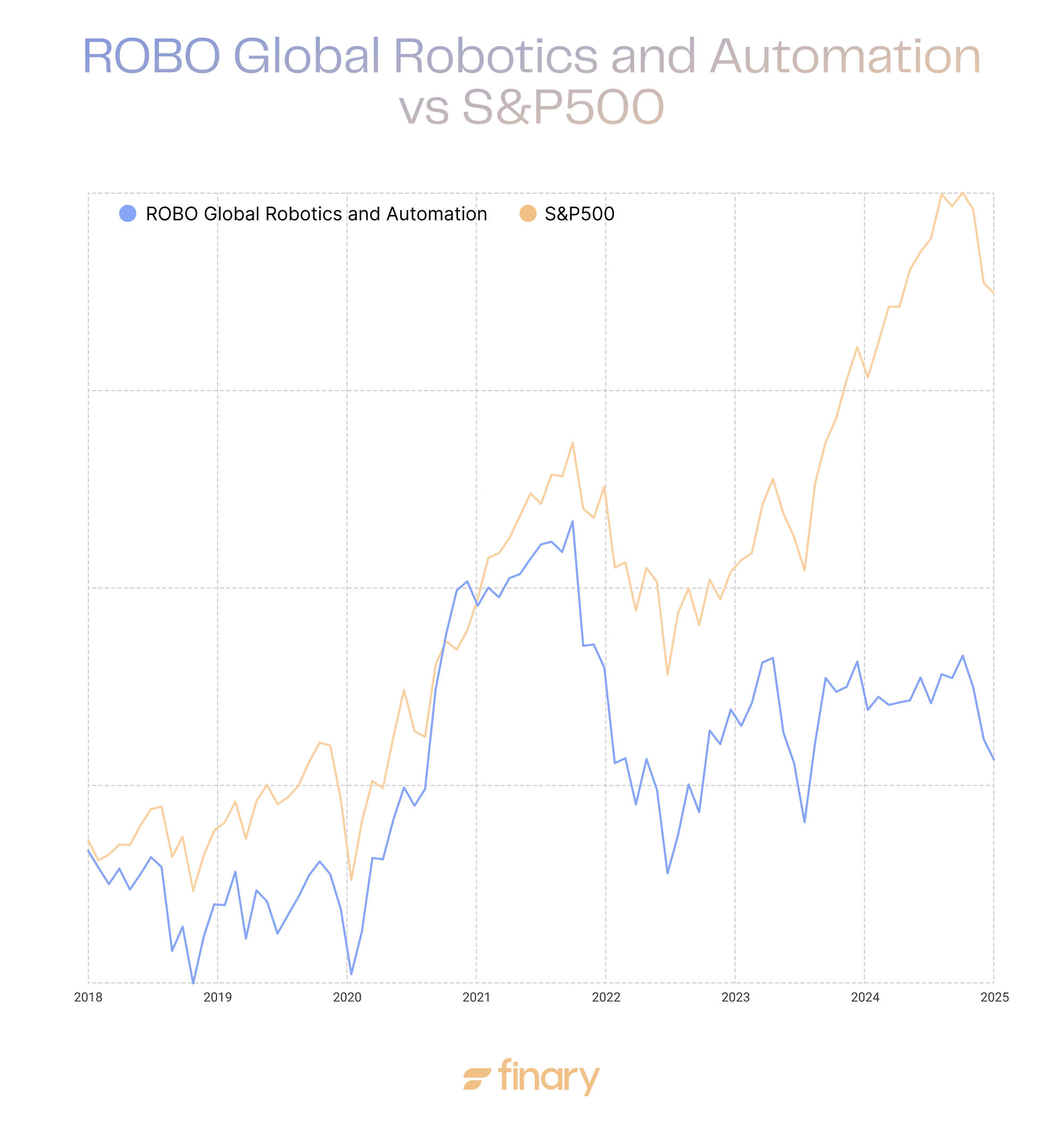
The chart above shows sharper volatility for the ROBO index, with pronounced peaks and troughs. The S&P 500 dominates over the period with cumulative gains, which is why the risk premium attached to robotics ETFs has to be weighed.
Diversifying robotics exposure without losing sight of the PEA
Fitting a robotics ETF into an overall view of your wealth avoids over-exposure to the technology sector. Diversification is a core portfolio management principle. Aggregation tools such as Finary give a live overview of all your investments, robotics included. Investing in robotics ETFs can open access to a fast-growing technology trend. It does mean taking France's specific tax constraints into account.
Experienced investors have to balance:
- Targeted robotics exposure
- Tax efficiency
The choice between an ordinary securities account and a PEA depends on each investor's wealth objectives. The wrapper you choose drives the net return after tax.
Goals

Frequently asked questions
What is a robotics ETF?
A robotics ETF is a listed fund that tracks an index of companies active in automation, industrial robotics, sensors, semiconductors or embedded artificial intelligence. It gives exposure to the whole sector in a single product, without picking each company yourself.
What is the difference between a robotics ETF and an artificial intelligence ETF?
A robotics ETF targets makers of robots and industrial automation systems first, while an artificial intelligence ETF favours semiconductors, cloud and AI software. Some funds, such as the Xtrackers AI & Big Data, combine both themes with robotics in the minority.
Can a robotics ETF lose value?
Yes. Robotics ETFs show annual volatility often above 20%, with sharp falls during technology corrections. The investment carries a risk of partial or total capital loss and suits a long time horizon.
Should you prefer a concentrated or a diversified robotics ETF?
A concentrated ETF, such as the Amundi MSCI Robotics & AI, bets on the US technology giants and tracks their cycles closely. A diversified ETF, such as the L&G ROBO Global, spreads risk across industrials, healthcare and technology, at the cost of higher management fees.
How do you choose between several robotics ETFs?
Compare the TER, assets under management, the number of holdings and the geographic and sector split of each fund. Large assets and low fees limit closure risk and long-term cost, provided the exposure matches your sector conviction.
Sources
Spherical Insights, Global Robotics Technology Market: size and forecasts 2023-2033
Service-public.fr, factsheet F2385: Plan d'épargne en actions (PEA)
AMF, report on retail investor activity in ETFs
JustETF, iShares Automation & Robotics UCITS ETF profile
JustETF, L&G ROBO Global Robotics and Automation UCITS ETF profile
JustETF, Amundi MSCI Robotics & AI UCITS ETF profile
JustETF, Xtrackers Artificial Intelligence & Big Data UCITS ETF profile
JustETF, WisdomTree Artificial Intelligence UCITS ETF profile
Regulatory disclaimers: Marketing communication. Investing carries a risk of partial or total capital loss. Past performance is not a reliable indicator of future performance. This article is provided for information and educational purposes only; it does not constitute personalised investment advice, a buy or sell recommendation, or tax advice.
Before investing, read the Key Information Document (KID) and, where relevant, consult an authorised adviser.
Finary SAS, an investment firm authorised by the ACPR (no. 19283), member of AMAFI. Insurance broker registered with ORIAS (no. 21001279), member of the CNCGP (association approved by the AMF). Crypto-Asset Service Provider (CASP) authorised by the AMF under the MiCA regime, references no. A2026-026 and no. N2026-008.