Tax Relief in France in 2026: Which Tax Schemes Should You Choose?

Updated on 30 July 2026
Tax relief in France covers the legal schemes (real estate, PEA, life insurance, PER, SME investment, donations) that let an individual reduce their income tax. This article covers the main solutions available in France in 2026, from the Denormandie scheme to Girardin industriel.

- The Pinel scheme has been closed since 1 January 2025; only the Denormandie scheme and the Malraux law remain open for older properties.
- The PEA and life insurance remain the most advantageous wrappers, with income-tax exemption after 5 years (PEA) or 8 years (life insurance).
- Since 21 February 2026, standard FCPI funds have lost their tax credit; only FCPI funds invested in young innovative companies (JEI) keep the 30% rate.
- Girardin industriel offers a one-off tax reduction, capped at €18,000 net per year under the overseas-investment tax-relief ceiling.
- It is generally worth looking into these schemes once a household pays more than €2,500 in income tax per year.
What Is Tax Relief?
Tax relief is a set of legal schemes that let individuals and businesses reduce their tax burden. Depending on personal circumstances, there are many ways to achieve financial tax relief. It covers various measures aimed at encouraging rental property investment, optimising the management of one's wealth, or supporting specific sectors of the economy.
Other solutions exist thanks to the various schemes set up by the French government to steer household savings. Standard savings products, tax-relief investment in SMEs, or alternative investments, the choice is wide.
In this article, we cover the main tax-relief solutions available to French taxpayers to help you choose the one best suited to your needs.
What Are the Real-Estate Tax-Relief Schemes?
The main real-estate tax-relief schemes are the LMNP status, the Denormandie scheme, the Malraux law and the déficit foncier mechanism. The Pinel scheme, for its part, has been closed to new subscriptions since 1 January 2025.
Investing in real estate is one of the most common strategies for benefiting from tax-relief schemes. Several laws have been put in place to encourage real-estate investment and let investors reduce their income tax while building up a property portfolio.
Goals
The Pinel scheme
The Pinel scheme (a French tax incentive for buying new rental housing, now closed) offered a personal income-tax reduction, under certain conditions, to individuals buying new housing for rental. The amount of the reduction depended on the length of the rental commitment, up to 21% of the purchase price spread over 12 years. The Pinel scheme has been closed since 31 December 2024 and is no longer available to new investors. It was open to individual investors as well as to companies and property partnerships. The minimum investment term to benefit from the Pinel scheme's tax advantages was 6 years.
The property also had to meet certain energy standards and be located in an eligible geographic zone.
Non-Professional Furnished Rental (LMNP)
When investing in rental property, rental income is taxed as property income by default. Rental income is taxed at the investor's marginal tax bracket (0% to 45%), plus 17.20% in social security levies (after a flat 30% allowance, or actual deductible costs, at the investor's choice). The combined rate can therefore climb above 50% of that rental income. The combined taxation can be high, especially once the investor is in the 30% marginal bracket. Optimising the taxation of these investments is therefore essential.
The Loueur Meublé Non Professionnel (LMNP), France's non-professional furnished-rental status, is therefore an excellent option to consider. LMNP lets you buy a property, furnish it and rent it out to tenants. This status offers many tax advantages and means your income is taxed under the BIC (Bénéfices Industriels et Commerciaux) category, France's industrial and commercial profits tax rules.
In that case, rental income is taxed after a flat allowance of 50% (instead of 30%). Better still, by opting for actual costs it is possible to depreciate the property for accounting purposes and, depending on the situation, significantly reduce taxable income, even with positive cashflow, down to €0 in tax on rental income.
Note: LMNP cannot be combined with the Pinel scheme on the same property. The 2025 Finance Act also changed the LMNP regime, notably by reinstating depreciation previously deducted when calculating the capital gain on resale. The Censi-Bouvard scheme, however, ended in 2023 and can no longer be used. By investing in furnished property and choosing LMNP status, you can grow your wealth while reducing your tax bill simply and effectively.

The Denormandie Scheme
The Denormandie Scheme (a French tax incentive for renovating older housing for rental) is an interesting option to consider. It aims to encourage investment in older property by offering tax reductions to investors who renovate a property to put it up for rent. By buying and renovating a property under the Denormandie scheme, you can reduce your taxes while helping to upgrade France's housing stock and build up your wealth.
The Malraux Law
The Malraux law (a French tax incentive for restoring heritage buildings) is aimed at investors who want to restore a property located in a protected heritage area or a listed architectural, urban and landscape zone (ZPPAUP). It allows a tax reduction of up to 30% of the restoration costs, capped at €400,000 over 4 years.
Investing Through SCPI
You can invest in SCPI under bare ownership: a discounted purchase price, no income for a set period, and therefore no tax. The longer the bare-ownership period, the larger the discount. This is ideal if you do not need immediate passive income.
Alternatively, you can also invest in SCPI holding property abroad. Rental income is then taxed less heavily (Germany, for example).
The Déficit Foncier Mechanism
The déficit foncier mechanism is an appealing tax-relief solution for owners of older rental properties requiring renovation work. It consists of deducting the costs of that work from the owner's property income, which helps reduce their income tax. The deductible deficit is capped at €10,700 per year. That cap is doubled to €21,400 per year when the work upgrades a property rated E, F or G on the DPE (France's energy performance rating) to a rating of A, B, C or D, a benefit extended until 31 December 2027.

What Are the Financial Tax-Relief Schemes?
The main financial tax-relief schemes are the ordinary securities account (CTO), the Plan d'Épargne en Actions, or PEA (a French tax-advantaged equity savings account), life insurance and the Plan d'Épargne Retraite, or PER (France's retirement savings plan), which reduce taxation on capital gains or on taxable income.
Tax relief is not limited to real-estate investment. Several solutions exist to optimise the management of your financial wealth and benefit from tax advantages.
The default wrapper for investing in the stock market is the ordinary securities account (CTO). Brokers such as Trade Republic or DeGiro offer it. In that case, the flat tax of 31.4% (12.8% income tax plus 18.6% social security levies) applies each year to realised capital gains and dividends. You do not pay tax on unrealised gains.
To optimise tax outcomes, you should favour tax-deferred wrappers: even when you make gains on buying and selling, or receive income, you are not taxed as long as that money stays inside the wrapper.
In practice: PEA and life insurance are tax-deferred wrappers, the two best tax-relief vehicles for French savers. You can invest in international companies through both life insurance and PEA: ETFs (S&P 500, World, Nasdaq…) or individual shares. Life insurance can also hold US shares, keeping in mind that picking individual stocks (stock picking) carries a high risk of capital loss - see stock picking.
Life Insurance
Life Insurance is a financial investment that offers favourable tax treatment for passing on wealth. Amounts paid into a life insurance policy are exempt from inheritance tax within certain limits, depending on the policyholder's age at the time of each contribution. There is no tax as long as no money is withdrawn from the policy. Withdrawals made after 8 years can be exempt from income tax on gains (annual tax allowance: €4,600 for a single person, €9,200 for a couple).
The Plan d'Épargne en Actions (PEA)
The PEA is a savings product that lets you invest in shares while enjoying favourable taxation. A complement to life insurance, capital gains and dividends are exempt from income tax as long as the account is not closed for 5 years. They remain subject to social security levies of 18.6% (the rate in force since 1 January 2026). Unlike life insurance, a taxpayer can hold only one PEA.
Making withdrawals from a PEA that is more than 5 years old without closing the account is possible.
The contribution cap is €150,000 per holder (one PEA per person); a couple can therefore hold two PEAs, for a combined cap of €300,000. However, any partial withdrawal before 5 years closes the PEA (with some exceptions). After 5 years, withdrawals no longer close the account.
The PER Retirement Savings Plan
The PER (Plan d'Épargne Retraite), France's retirement savings plan, was introduced in October 2019 by the PACTE law and replaces all the earlier French retirement plans.
The insurance-based PER works like a life insurance policy. You can choose self-directed or managed-portfolio management, in a euro fund (capital protected by the insurer, except where the French Sapin 2 law is triggered, with generally modest returns) or in unit-linked funds, which carry a risk of capital loss. The range of assets on offer is very broad (equity funds, real-estate funds, and more).
For tax purposes, it is a sealed wrapper like life insurance: realised gains are not taxed as long as the money stays inside the wrapper. The feature that sets it apart from life insurance: contributions are deductible from taxable income.
The drawback of the PER is its lack of flexibility: money can only be withdrawn at retirement or in a few defined cases (buying a primary residence or a life accident).
within your reach
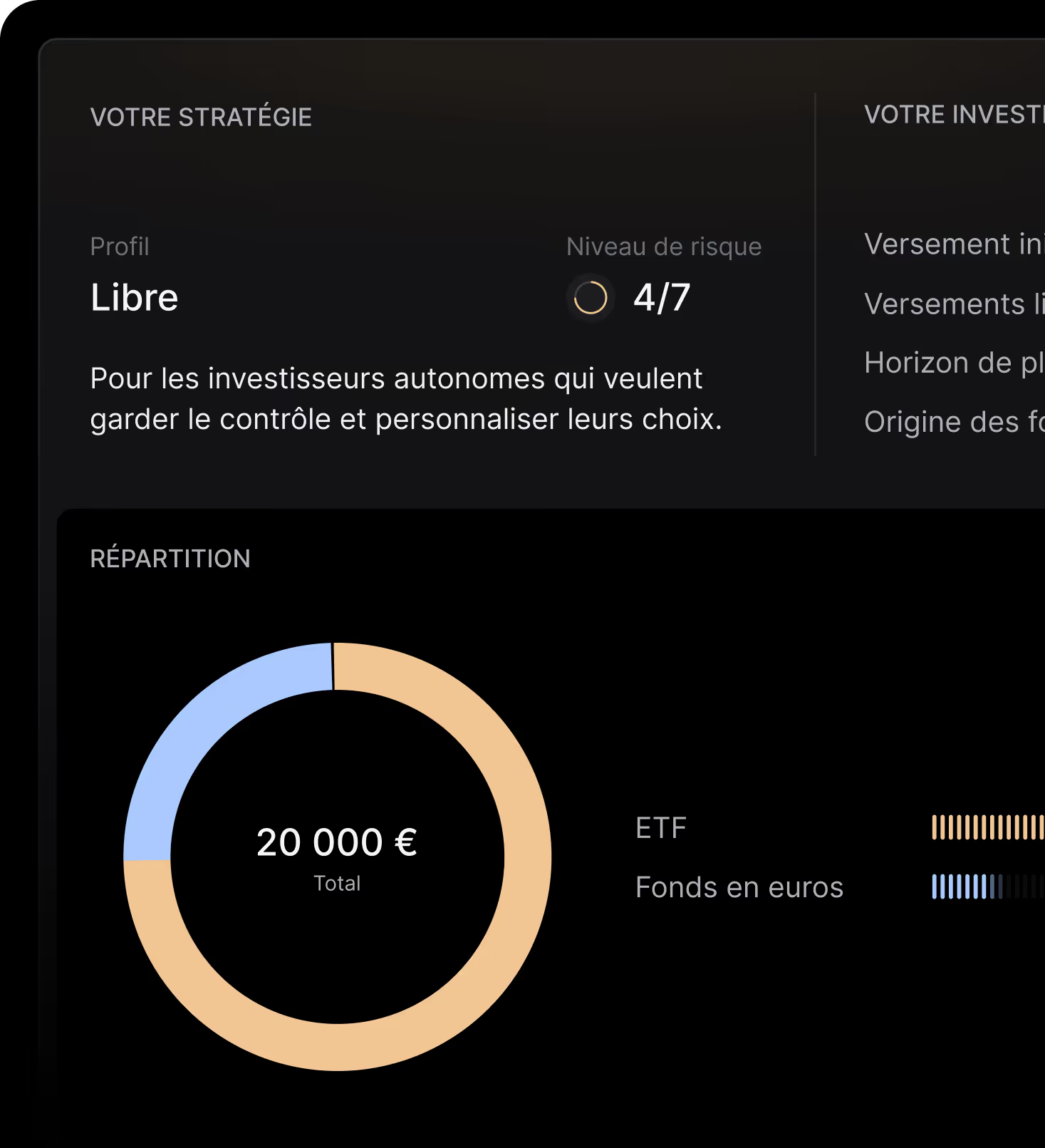
Non-contractual document for promotional purposes. Investment in unit-linked investment options carries a risk of capital loss, since their value is subject to fluctuation, both upwards and downwards, depending in particular on developments in the financial markets. The insurer commits to the number of units, not to their value, which it does not guarantee. The e-vie life insurance policy is an individual life insurance policy, denominated in euros and/or unit-linked vehicles, underwritten by Generali Vie, a company governed by the French Insurance Code. Finary SAS, 58 rue de Monceau 75380 Paris 8, ORIAS no. 21001279
Tax-Relief Schemes Linked to Entrepreneurship
The creation and growth of businesses are also encouraged through various tax schemes aimed at investors. These are often more attractive, and have the advantage of being less exposed to a financial-market crisis. They appeal to individuals passionate about forestry, vineyards or film, or keen to fund a project close to their heart.
The Tax Reduction for Subscribing to SME Capital
This type of tax-relief investment is now within everyone's reach thanks to online crowdfunding platforms. You can therefore choose the SME that interests you.
By subscribing directly to an SME's capital, the tax benefit is an 18% income-tax reduction on the amount invested, provided the shares are held for 5 years, capped at €50,000 for a single person or €100,000 for a couple. This measure aims to support the financing of French and European SMEs while offering tax advantages to investors. This investment carries a high risk of partial or total capital loss, as well as a liquidity risk (shares in unlisted SMEs are hard to resell).
The Madelin Scheme
The Madelin Scheme (a French pension and welfare-contribution deduction for the self-employed) lets self-employed workers (TNS) deduct from their professional income the contributions paid into a supplementary retirement or protection plan. It aims to encourage self-employed people to save for retirement and secure optimal social protection.
Innovation Mutual Funds (FCPI)
Since 21 February 2026 (Law No. 2026-103 of 19 February 2026), the tax reduction on standard FCPI (Fonds Commun de Placement dans l'Innovation) funds has been abolished. Only FCPI funds invested at least 50% in young innovative companies (JEI) still carry a 30% tax reduction on the amount invested, with a minimum 5-year holding commitment.
The investment cap remains €12,000 for a single person and €24,000 for a couple.
The standard Fonds d'Investissement de Proximité, or FIP, a regional venture-capital fund, lost its tax reduction as of 1 January 2025 (Law No. 2025-127 of 14 February 2025). Only Corsica-focused and overseas-focused FIP funds keep a 30% tax reduction, within the same caps.
Beyond the tax reduction, this tax-relief investment can also carry an income-tax exemption on capital gains (social security levies of 18.6% remain due). FCPI/FIP funds carry a high risk of capital loss and a lock-up period (5 to 10 years).
Tax Relief for Forests and Vineyards
Investing in a forest or a vineyard is another possible tax-relief investment, through Groupements fonciers: GFF (Groupement Foncier Forestier) and GFV (Groupement Foncier Viticole), French forestry and vineyard land-ownership partnerships. They work like an SCI: you buy into the capital of a company that owns forests or vineyard plots and receive a return based on your investment.
The cap on the reduction is €50,000 for a single person, and double that for a couple.
You can obtain the following advantages:
- an 18% tax reduction
- a full or partial exemption from IFI (France's real-estate wealth tax)
- in the case of an inheritance or a gift, a 75% allowance on the value transferred.
The initial outlay is high, so this tax-relief investment is reserved for enthusiasts and should be considered a long-term commitment.
Girardin Industriel
The Girardin industriel scheme (a French tax-relief scheme for financing overseas industrial projects) lets French taxpayers benefit from an income-tax reduction by financing industrial projects overseas. There is no legal cap on the amount invested, but the net tax reduction is capped at €18,000 per year under the overseas tax-relief ceiling, which corresponds to a maximum gross reduction of €40,909 as of right (up to €52,941 with prior approval). Note: Girardin industriel carries a risk of tax requalification and of total loss of the capital invested.
SOFICA: Investing in Film to Reduce Your Taxes
If you are a film enthusiast, investing for tax relief in a SOFICA (Société pour le financement de l'Industrie Cinématographique et Audiovisuelle), a French film and TV financing vehicle offering tax relief, gives a 30% tax reduction on the amount invested, which can rise to 48% depending on the SOFICA's area of expertise.
Tax-relief investment in a SOFICA is capped at €18,000 per year, and within 25% of the household's overall net income. The scheme is renewed by decree each year; it is open to subscriptions until 31 December 2026. The tax reduction can be substantial, especially with the higher rates, but returns are generally low.
This tax-relief product, which depends on the commercial success of the films produced, carries significant risks. The appeal lies more in the immediate tax reduction than in the net asset value.
Corporate and Personal Patronage (Mécénat) for Tax Exemptions
As with a donation, a 66% reduction on your income tax is possible, within 20% of taxable income. The rate rises to 75% for donations made to organisations helping people in difficulty (food aid, housing, care), within a cap of €2,000 per year since 14 October 2025; beyond that, such donations fall back under the 66% regime.
Donations can be in cash, in kind, or as contributions of equipment or skills. The recipient organisation may support various fields such as research, culture or the environment. The cap is €50,000.
For a corporate patron, the reduction on corporate tax is 60% of the amounts paid (40% beyond €2 million of donations), within a cap of €20,000 or 0.5% of annual pre-tax revenue, whichever is higher.
Sponsorship
Unlike patronage, which is considered a philanthropic activity, sponsorship is an advertising operation. Sponsorship expenses are, in principle, deductible from the company's taxable income as a business expense, under certain conditions (genuine advertising consideration, proportionality). It is not a tax reduction (as under the patronage regime), but a deductible expense with no specific cap, provided it serves a genuine business interest and does not amount to an abnormal act of management.
Other Tax-Relief Schemes
Beyond the solutions presented above, other mechanisms exist for benefiting from tax advantages, notably through patronage or philanthropy.
The Tax Reduction for Donations to Associations
Individuals who make donations to associations or foundations recognised as being of public benefit can deduct 66% of the amount donated from their income tax, within 20% of their taxable income. A 75% tax reduction is also possible for donations to certain organisations helping people in difficulty.
Buying Works of Art and Musical Instruments
The tax reduction for buying works of art and musical instruments is aimed at companies subject to corporate tax and sole traders taxed under the BIC category. The works concerned must be original, entirely made by the artist's hand, and fall within certain categories of art. Companies that buy works with a view to resale cannot benefit from this deduction.
To benefit from the deduction, the company must in particular lend the musical instrument free of charge to performing artists who request it, display the work in a place freely accessible to the public or to employees for 5 years, and comply with certain accounting obligations.
The deduction is applied by recording the work or instrument as a fixed asset in the company's accounts and allocating the tax-deduction amount to a special reserve account.
The tax deduction can be challenged if the company does not meet the required conditions, such as displaying the work to the public, lending the instrument to performing artists, or the accounting obligations. It is therefore important to follow the rules closely to benefit from this tax advantage and support artistic creation.
It is the combination of the two levers, investment and taxation, that drives the best net performance: gross performance minus tax equals net performance.
To round things off, you can also improve your quality of life while optimising your taxes. For instance, employing someone at home (including childcare) earns a 50% tax credit.
If you want to go further, watch the Finary Talk with Nicolas Decaudain.
Frequently Asked Questions
What Qualifies for Tax Relief in France?
Tax relief concerns all French taxpayers, not only the wealthiest. It is generally recommended to look into these schemes once a household pays more than €2,500 in income tax per year, regardless of the level of wealth.
How Does Tax Relief Work?
Tax relief consists of reducing your taxes by making an eligible investment or expense (rental property, SME capital, donations). In return, the French government grants a tax reduction, a deduction from taxable income, or an exemption, depending on the scheme chosen.
What Is the Difference Between a Tax Reduction and a Tax Deduction?
A tax reduction, such as Girardin or donations, directly lowers the amount of tax due, within the limit of that tax. A deduction, such as PER contributions, lowers taxable income before tax is calculated, which mainly benefits higher marginal tax brackets.
What Is the Overall Cap on Tax-Relief Schemes?
Most tax-relief tax reductions fall under the overall cap on tax-relief schemes, set at €10,000 per year. Exempted schemes such as overseas Girardin (€18,000 net) or the Malraux law, which sit outside the cap, are not subject to this rule.
Sources
Service-public.fr, taxation of savings and investment income: tax and social security contributions
Légifrance, Decree No. 2026-111 of 19 February 2026 implementing the 2025 Finance Act
BOFiP, SOFICA tax reduction: rules of application
LégiFiscal, doubling of the cap on the 75% tax reduction for donations (loi Coluche)
AMF, whitelist of Crypto-Asset Service Providers, Finary SAS
Regulatory disclaimers: Marketing communication. Investing carries a risk of partial or total capital loss. Past performance is not a reliable indicator of future performance. This article is provided for information and educational purposes only; it does not constitute personalised investment advice, a buy or sell recommendation, or tax advice. This investment carries a liquidity risk (resale not guaranteed, long horizon) and a risk of capital loss. Income and valuations are not guaranteed. Before investing, read the Key Information Document (KID) and, where relevant, consult an authorised adviser. Finary SAS, an investment firm authorised by the ACPR (no. 19283), member of AMAFI. Insurance broker registered with ORIAS (no. 21001279), member of the CNCGP (association approved by the AMF). Crypto-Asset Service Provider (CASP) authorised by the AMF under the MiCA regime, references no. A2026-026 and no. N2026-008.