


How to Invest €50,000 in France in 2026?

Updated on 27 July 2026
To invest €50,000 in France, split the amount across several investment options according to your goals and risk tolerance: savings accounts, a PEA (a French tax-advantaged equity savings account) or securities account, life insurance, a PER (France's retirement savings plan), real estate (SCPI or rental property) and alternative investments. This guide details each option, its level of risk and the investor profile it suits.

- Before investing, build an emergency fund covering three to six months of expenses, kept in a regulated savings account available immediately.
- The PEA exempts capital gains from income tax after five years, but social security contributions of 18.6% remain due.
- In 2025, SCPI distributed an average of 4.91% and euro funds 2.6%, according to ASPIM and France Assureurs.
- A standard securities account (CTO) has been subject to the flat tax (PFU) of 31.4% on investment gains since 1 January 2026.
- Diversifying across several asset classes reduces overall risk without giving up long-term return potential.
What questions should you ask before investing €50,000?
Before investing this €50,000, you absolutely need to take the time to ask yourself two questions:
What goal am I pursuing, and what level of risk am I prepared to take?
This reflection will prove valuable later, since it lets you choose the investment options suited to your plans and your degree of risk aversion. You will avoid two of the most common investing mistakes:
- “Copying” the investments of someone who is not in the same situation as you
- Investing your money without truly understanding how it fits your own situation
What goal am I pursuing?
Investing a significant sum such as €50,000 is a real project that deserves meticulous preparation. This money should serve one of three purposes:
- Saving to fund a future plan (your next holiday, your children's education, your retirement, and so on)
- Investing to generate income (dividends, rent, interest, and so on)
- Putting your money to work to build more net worth
Saving for a plan
Investing means giving up immediate spending for a future return. This can be done in view of plans over a shorter or longer horizon. Depending on how long you plan to invest, certain types of investment options will suit you better.
- Saving for a short-term plan: You can perfectly well invest €50,000 over a period of a few months, for example to fund your next holiday, buy a car or renovate your home.
- Saving for a medium-term plan: Medium-term plans have a horizon of roughly 2 to 7 years. That could mean funding your children's education, a wedding, a down payment for a property, or starting a business.
- Saving for a long-term plan: A long-term plan is prepared 10, 20 or even 30 years in advance! Moving abroad, funding your retirement, buying your children a flat… This is often the investment of a lifetime, one where you count on the power of compound interest. It rewards a long-term saving effort.
Investing to generate income
You can invest €50,000 with the goal of generating income. Income here means a periodic payment received in exchange for investing capital. A few examples:
- Investing in rental property to receive rent
- Buying equities to receive dividends
- Lending money and earning interest
To choose the investment best suited to your goal, you need to decide whether you want to generate income immediately or over the longer term.
- Generating immediate income: You can perfectly well invest €50,000 in an option that generates income right away. This is mainly the case for real estate investments, covered further below. Immediate income is an excellent way to build supplementary income for everyday life.
- Generating income at retirement: To secure supplementary income for retirement, you can invest today in an option that provides income for your later years. Life insurance and the PER (France's retirement savings plan, covered a bit further on) can both be used for this purpose.
Worth knowing : Goal-based investing simply means investing according to your plans and goals. This approach, which came from the United States, is growing fast, and that's a good thing: finance is a tool that should serve your personal goals. Another advantage of this approach is that it factors in the investor's profile to optimise the return-risk balance. Before any investment, we recommend focusing on your goals first; the most suitable options will follow from there. Feel free to use the wealth simulator to see the returns you could get by investing €50,000. 
What is my investor profile?
Beyond the plan itself, it is essential to define your investor profile before investing your savings. Your investor profile depends on two variables: your risk aversion and the type of investing (active or passive) you prefer. Depending on your profile, certain investment options will suit you better than others.
Know your risk level
Investing always carries a certain level of risk. That level varies widely: risk can be low (regulated savings accounts guaranteed by the French State) or very high. Before choosing an investment, you need to decide how much risk you are prepared to take. You do not take on the same risk investing in Bitcoin as putting money into a Livret A. The rule is simple: the safer an investment, the lower its return.
You should also factor in the time horizon of your investment plan. You can take on more risk early in your career than as you approach retirement. If you are 25 and open a life insurance policy for retirement, you will often be advised to start with a high-risk portfolio holding plenty of equities. The goal? Generating maximum returns! As retirement age approaches, your portfolio will gradually shift towards safer, lower-yielding assets. The goal being for you to secure capital for your later years.
Finally, you need to understand that your risk level also depends on how diversified you are. The more diversified your net worth, the more your risk is diluted. Understanding how investing works is also a decisive factor: it is best to have solid foundations to avoid the pitfalls!
Worth knowing : We can't say it enough: diversification and knowledge are two pillars of balanced wealth management. Diversification is a simple but powerful principle, often summed up as “don't put all your eggs in one basket”. The more you concentrate your investments (in one type of asset, one industry, one region, and so on), the more you concentrate your risk and the more vulnerable you become. We recommend diversifying your financial investments sensibly, so as not to overexpose yourself to a single sector. For example, say you decide to put 80% of your net worth into gold, seen as a safe-haven asset. Overnight - following a completely unforeseeable event - the price of gold collapses. Your net worth would then melt away like snow in the sun. The second principle is knowledge. It is best not to put your money into an investment whose workings you don't really understand. Warren Buffett has always been wary of investing in sectors like technology, admitting that he did not understand the field well enough. If this investing genius admits he doesn't understand certain topics and therefore won't risk investing in them... there are surely lessons to draw from that. Before investing, always ask yourself these two questions: Will my portfolio become too concentrated after this investment? Do I really understand the key principles of this investment? Know your investing style
The type of investing you choose will depend on how involved you want to be. Do you want to be highly engaged with your finances (an active strategy), or would you rather not think about it (a passive strategy)?
As an active investor, you will intervene frequently in your investments, to monitor performance and take action to generate returns. Trading, which involves buying and selling shares to generate capital gains, is the perfect example.
By contrast, passive management requires almost no effort. You invest your €50,000 in a vehicle such as ETFs and check performance from time to time. If you have a life insurance policy with managed-portfolio service, you will no longer need to intervene to adjust the investment.
Which investment options for €50,000?
To invest €50,000, you can choose between regulated savings accounts, stock-market wrappers (PEA and securities account), life insurance, the PER and real estate (SCPI or rental property). Once you have defined your goal and your investor profile, you can open the investing toolbox. Many options are available to invest your €50,000. We review each option in turn and explain its relevance to a given plan or investor profile.
Investing €50,000 in the stock market
Financial investment options are vehicles where you can place your €50,000 as interest-bearing savings, or by buying financial securities (equities, bonds, ETFs, and so on). There are 4 main financial investment options, suited to different plans or investor profiles.
Savings accounts
Savings accounts are held with banks. By putting money into these accounts, you earn annual interest at a rate known in advance; regulated accounts (Livret A, LDDS, LEP) are guaranteed by the French State. The best-known are:
- Livret A
- Livret de développement durable et solidaire (LDDS)
- Livret d'épargne populaire (LEP)
- Plan épargne logement (PEL)
The advantage of these options is their simplicity: you just ask your bank to open one for you, and you know the interest rate you will earn upfront. These rates are extremely low today compared with other types of investment. That is the limit of these accounts. They suit short-term plans and very defensive investors who want to take on no risk at all.
Stock-market investments: the PEA and the CTO
The PEA (Plan d'Épargne en Actions, a French tax-advantaged equity savings account) and the securities account (compte-titres ordinaire, CTO) are vehicles that let you buy and hold financial securities: equities, bonds, ETFs, and so on. These tools let you:
- Invest in listed companies by buying equities to generate a capital gain and/or receive dividends
- Invest in SMEs (via the PEA-PME)
- Buy bonds
- Buy PEA-eligible ETFs
Capital gains on a PEA are exempt from income tax after 5 years, with only social security contributions of 18.6% still due, while gains made in a securities account are taxed at the flat tax (PFU) of 31.4%. These stock-market investments suit investors seeking higher returns than standard savings accounts. You can invest actively or passively, and over the short, medium or long term.
Life insurance: a flexible investment
Life insurance is often described as the French people's favourite investment. This is explained by:
- Its flexibility: the ability to buy a wide range of financial products
- Its favourable tax treatment for estate planning
You can invest your €50,000 in a life insurance policy and split it between two types of options:
- Unit-linked funds (equity, bond, money-market or real-estate funds): designed to boost your savings with potentially higher returns than savings accounts or euro funds
- Euro funds (mainly European bonds): very low-risk investments, with modest returns
Life insurance is useful for medium and long-term plans. It adapts to your investor profile and your preferred style of investing. You can delegate the management of your portfolio to your provider or keep control yourself. In short, it is a very flexible vehicle.
Feel free to read our comparison of the PEA and life insurance to learn more about these two wrappers.
For example, you can take out a life insurance policy online with Finary.

The PER: France's retirement savings plan
The Plan d'Épargne Retraite (PER) has been available since October 2019. As its name suggests, its purpose is to save during your working life to fund your retirement. It can hold many types of instruments, including equities, which makes the PER far more attractive than bank savings accounts. Another advantage is its tax treatment: contributions made during a given year are deductible from that year's taxable income (within an overall cap). It is a tax-relief tool worth considering depending on your personal tax situation, if you want to lower your income tax while preparing for retirement. Note that while many other tax-relief tools exist (such as the Girardin Industriel scheme), saving on tax should not be your main objective!
The PER is a relevant option for your investment if - and only if - you want to fund your retirement. Indeed, the savings you deposit in this vehicle cannot - except in specific cases - be withdrawn before retirement. The longer your investment horizon, the more you benefit from compound interest and put your money to work to fund your later years.
Investing €50,000 in real estate
Real estate is very popular among the French. Unlike financial investments, it is a tangible asset. When you invest in real estate, you buy a property directly or indirectly. With your €50,000 in savings, two particularly attractive real-estate options are available to you: SCPI and rental property investment.
Investing €50,000 in SCPI
SCPI (sociétés civiles de placement immobilier, a French non-listed real-estate investment fund, comparable to a REIT) are collective investment vehicles, structured as unlisted companies. An SCPI's purpose is to raise money from investors to acquire and manage real estate intended for rental. That real estate can consist of buildings for commercial use (offices, shops, warehouses, and so on) or residential use.
The advantages of investing in SCPI - commonly known as “paper real estate” - are:
- The ability to invest from €150 (one unit)
- Investing in real estate without bearing certain constraints (finding a location, negotiating, renovation work, administrative management, and so on)
- An attractive return: according to ASPIM, the average SCPI distribution rate stood at 4.91% in 2025 (past performance, not guaranteed)
- Diversifying your investment, since the SCPI manages a real-estate portfolio, which dilutes rental risk (a large number of tenants)
- Generating income
Let's look at this last advantage: by investing in an SCPI, you enable the company to acquire properties. In exchange, it pays you back a share of the rent it collects, to compensate you for taking on the risk. By investing €50,000 in an SCPI at the average distribution rate of 4.91% observed in 2025, you could receive around €2,455 in theoretical annual rent (before tax, an indicative simulation, not guaranteed), or roughly €205 in gross monthly supplementary income. This income is taxed under the progressive income tax scale, in the property income category.
Investing €50,000 in SCPI is therefore an excellent way to generate income. Like any investment, paper real estate carries risks:
- No guarantee on SCPI capital or returns
- Fees to pay: subscription fees typically between 8% and 12% of the amount invested, plus annual management fees deducted from the rent collected (most often 10% to 12% of rent, not of capital)
In conclusion, investing €50,000 in an SCPI is a long-term investment. It suits profiles seeking annual income as a supplement, combined with passive management. The risk is moderate since the SCPI is diversified, but it depends heavily on the health of the real-estate market. If you want an easy way to invest in real estate, a real-estate ETF could also be an interesting option (and a low-fee one).
Rental property investment
Rental property investment means buying a property with the aim of renting it out to individuals or organisations (companies, associations, public bodies, and so on). The investor's interest lies in receiving rent regularly.
Investing €50,000 in rental property is an excellent way to generate supplementary income immediately and durably. It also lets you grow your net worth by benefiting from rising property prices. However, investing in rental property can be very time-consuming:
- Finding a location and a property
- Negotiations
- Administrative management
- Maintenance
- Managing tenants
Unless you use credit, investing €50,000 will not let you buy a large property. However, you can still:
- Team up with another investor
- Invest in parking spaces, storage units or garages
Investing €50,000 in rental property is ideal for people seeking immediate and durable supplementary income. This investment is time-consuming, should be considered over the very long term, and carries certain risks.
Worth knowing : The most profitable strategy in rental property investment is simple. It involves:- Taking advantage of leverage by financing the property with credit
- Repaying the credit using the rent paid by tenants
Should you invest €50,000 in alternative investments?
Stock-market and real-estate investments are classic options. Other types of investment exist too, such as cryptocurrencies, investing in unlisted companies, or peer-to-peer lending.
Cryptocurrencies and DeFi
A cryptocurrency is a digital currency stored on a blockchain. It is decentralised, independent of banks and states, and relies on cryptography. The most iconic cryptocurrency is Bitcoin. Since 2020, DeFi (decentralized finance) has been driving the crypto world. It is a set of projects aiming to build a financial system without intermediaries, one that is transparent and fair.
- Cryptocurrencies and DeFi crypto assets are highly volatile
- These are young technologies, and therefore vulnerable to security threats.
These investments are complex, and it is essential to properly understand how these crypto-assets work before investing.
In summary, this type of investment is very high-risk. It may appeal to investors seeking return potential, who are aware of the high risk of total loss and strong volatility, and who are passionate about new technologies.
Investing €50,000 in companies
We saw in the section on financial investments that you can invest your €50,000 in shares of listed companies (equities). But you can also take a stake in unlisted companies.
Investing in start-ups - young, innovative companies with high growth potential - is now open to all investors. Three main types of investment are possible:
- With crowdfunding, you help these companies launch projects
- With crowdequity, you buy start-up shares and take a stake
- With crowdlending, you lend money in exchange for repayment and interest, spread over the loan period
You can also read our article on real-estate crowdfunding.
You can also invest in these innovative companies while lowering your tax bill! This is made possible by FCPI (Fonds Communs de Placement dans l'Innovation, innovation investment funds) and FIP (Fonds d'Investissement de Proximité, regional investment funds).
Investing in start-ups is risky by nature: you have no guarantee of getting your money back. It is also difficult to define a time horizon for any return on investment. But as always in finance: the higher the risk, the higher the potential return. It is up to you to decide whether you want to take the plunge.
You can also invest your €50,000 in small and medium-sized businesses through three channels: the PEA-PME, the FCPI and the FIP (see above).
The PEA-PME is the PEA's little sibling, covered earlier in the section on financial investments. It lets you invest up to €225,000 in SMEs or mid-sized companies (ETI) headquartered in France or the European Union.
It is a simple, effective way to invest in dynamic sectors and benefit from certain tax advantages. Naturally, the risk is higher with small businesses than with large listed groups. The lack of liquidity on these securities can be a drawback, especially if you want to invest short-term.
Finally, if you already own a business (or have an entrepreneurial project), you might consider investing your savings there. By increasing your company's capital by €50,000, you can considerably accelerate its growth. The advantage compared with other equity investments is that you are the one in control of that company.
The risks will depend on your industry, the environment your business operates in, and its ability to generate profits over the long term. We would rather warn you: this type of investment is very high-risk.
Lending €50,000 to individuals
More and more, peer-to-peer lending platforms are growing. They let lenders earn higher interest than standard savings accounts, and let borrowers fund projects without going through banks.
When you put your money on platforms such as October, they spread it across several loans. You don't choose who you lend your money to, but you benefit from the virtuous effects of diversification and these platforms' experience.
These intermediaries are responsible for checking borrowers' creditworthiness, which reduces the risk without eliminating it. If some borrowers default, it will still reduce your return.
Peer-to-peer lending platforms may interest you if you are looking for an investment that is:
- Less risky than equities
- Simpler than real estate
- Potentially higher-yielding than standard savings accounts
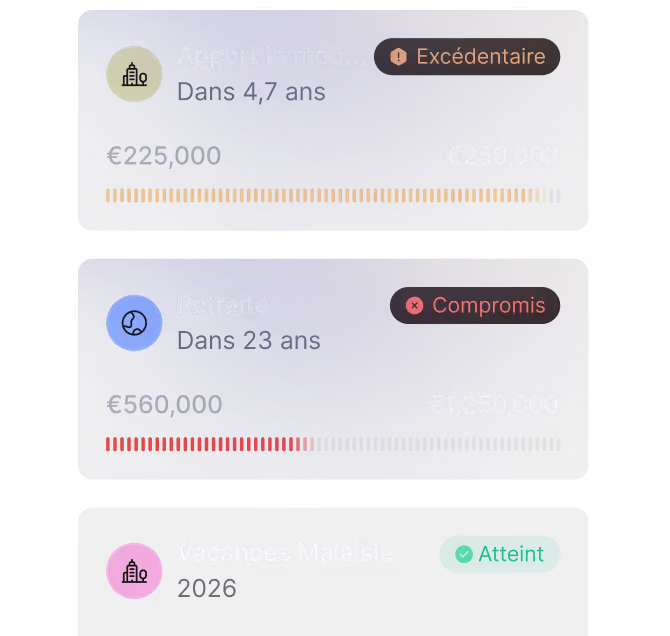
Worth knowing : As you can see, you now have plenty of choice for investing your €50,000. There is a multitude of options, which need to fit your personal situation and your own plans. One last piece of advice: before investing your money, make sure you have a reserve of available cash. This reserve is known as “emergency savings” (épargne de précaution). It is your guarantee of having enough to live comfortably for several months in case of a setback. Once this reserve is built up and kept in a liquid vehicle, you can invest your money with more confidence and peace of mind. Worth knowing: by signing up on our platform, you'll benefit from an automatic calculation of the amount suited to your profile! goals
Frequently asked questions
How can you invest €50,000?
There are several ways to grow €50,000. By placing it in financial vehicles (savings accounts, a PEA or securities account, life insurance, a PER), you can target interest, dividends or capital gains. Rental property or SCPI let you collect rent. Other options exist too: cryptocurrencies, unlisted companies, peer-to-peer lending.
What should you invest €50,000 in?
To invest €50,000, you can opt for financial investments (savings accounts, stock-market investments, life insurance, a PER) or real-estate investments (SCPI, rental property). Alternative investments also exist, such as cryptocurrencies, investing in unlisted companies or peer-to-peer lending.
Should you invest €50,000 all at once or gradually?
Both approaches have merit. Investing gradually (regular contributions) smooths out the purchase price and reduces the risk of poor market timing, especially on the stock market. Investing all at once maximises time spent in the market. The choice depends on your horizon, your risk tolerance and the volatility of the vehicle in question.
What tax treatment applies to a €50,000 investment?
It depends on the wrapper. The securities account is subject to the flat tax (PFU) of 31.4% on gains since 2026. The PEA exempts capital gains from income tax after five years (social security contributions of 18.6% still due). Life insurance benefits from an annual tax allowance after eight years. SCPI rental income is taxed as property income.
How much can €50,000 in savings earn?
Returns depend on the level of risk accepted and are never guaranteed. On secure options, the Livret A pays 1.5% (1.7% from 1 August 2026), and euro funds have averaged 2.6% in 2025, according to France Assureurs. On riskier options, a diversified equity portfolio has historically delivered around 6% to 8% a year over the long term, with no guarantee and a risk of capital loss.
Sources
France Assureurs, average euro fund return 2025 (2.6%)
Service-public.gouv.fr, change in the flat tax (PFU) rate to 31.4%
Livret A rate: 1.5% since February 2026, 1.7% from 1 August 2026
Regulatory disclaimers: Marketing communication. Investing carries a risk of partial or total capital loss. Past performance is not a reliable indicator of future performance. This article is provided for information and educational purposes only; it does not constitute personalised investment advice, a buy or sell recommendation, or tax advice. Before investing, read the Key Information Document (KID) and, where relevant, consult an authorised adviser. Finary SAS, an investment firm authorised by the ACPR (no. 19283), member of AMAFI. Insurance broker registered with ORIAS (no. 21001279), member of the CNCGP (association approved by the AMF). Crypto-Asset Service Provider (CASP) authorised by the AMF under the MiCA regime, references no. A2026-026 and no. N2026-008.