Lombard loan vs. mortgage in France: which one should you choose?

Updated on 5 August 2026
In France, a Lombard loan suits holders of a substantial financial portfolio who want quick liquidity without giving up their securities; a mortgage serves a broader audience financing a long-term property project. This comparison breaks down rates, LTV, term and taxation to help you choose.

- In 2026, Lombard loan rates range from 2.5% to 5%, compared with 3% to 4.5% for a standard mortgage.
- LTV ranges from 30% to 80% for a Lombard loan depending on the pledged asset, compared with 50% to 80% for a mortgage.
- A Lombard loan is repaid over 1 to 5 years, often interest-only, while a mortgage runs over 15 to 25 years, exceptionally 27.
- A Lombard loan generates no taxable income, while the interest on a mortgage for a rental property remains deductible from rental income.
- A Lombard loan carries the risk of a margin call if the pledged assets fall, while a mortgage depends mainly on the liquidity of the property financed.
How do a Lombard loan and a mortgage work?
A Lombard loan pledges financial assets as collateral, while a mortgage relies on a property: two collateral logics with very different mechanics and formalities.
What is a Lombard loan: how it works and pledging financial assets
A Lombard loan lets you raise cash without selling your shares or bonds.
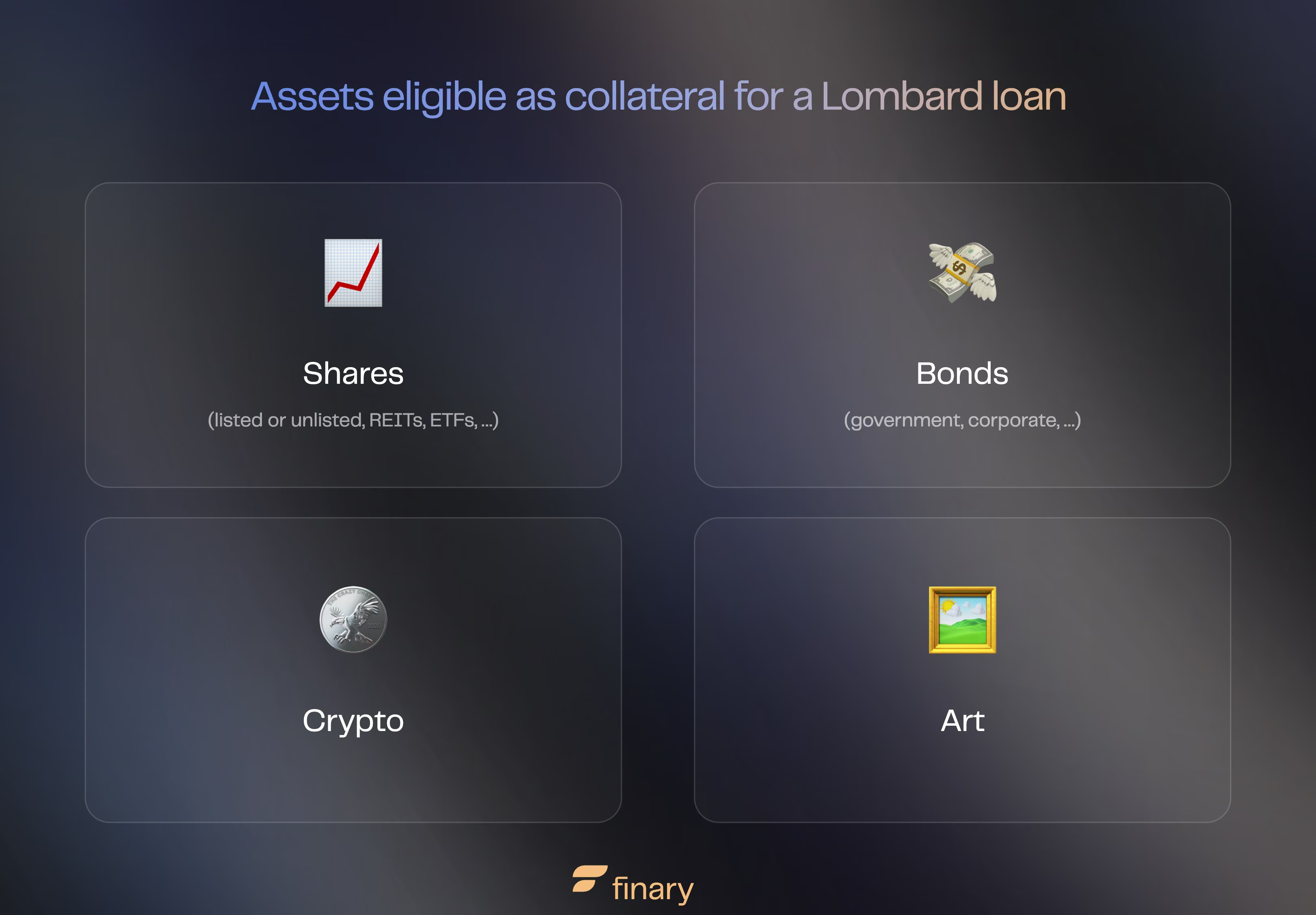
It relies on pledging: your financial assets (shares,bonds, funds,life insurance policies) serve as collateral for the loan. You keep full ownership of these assets and continue to receive dividends and interest, while benefiting from a cash advance.
Once reserved for a wealthy clientele, this type of loan has become more widely accessible. Some institutions, such as Swissquote (at the time of publication), even accept crypto-assets as collateral, illustrating how the sector is evolving.
A Lombard loan is often structured as aninterest-only (in fine)loan: you pay only the interest periodically, and repay the principal at maturity, generally within 1 to 5 years.
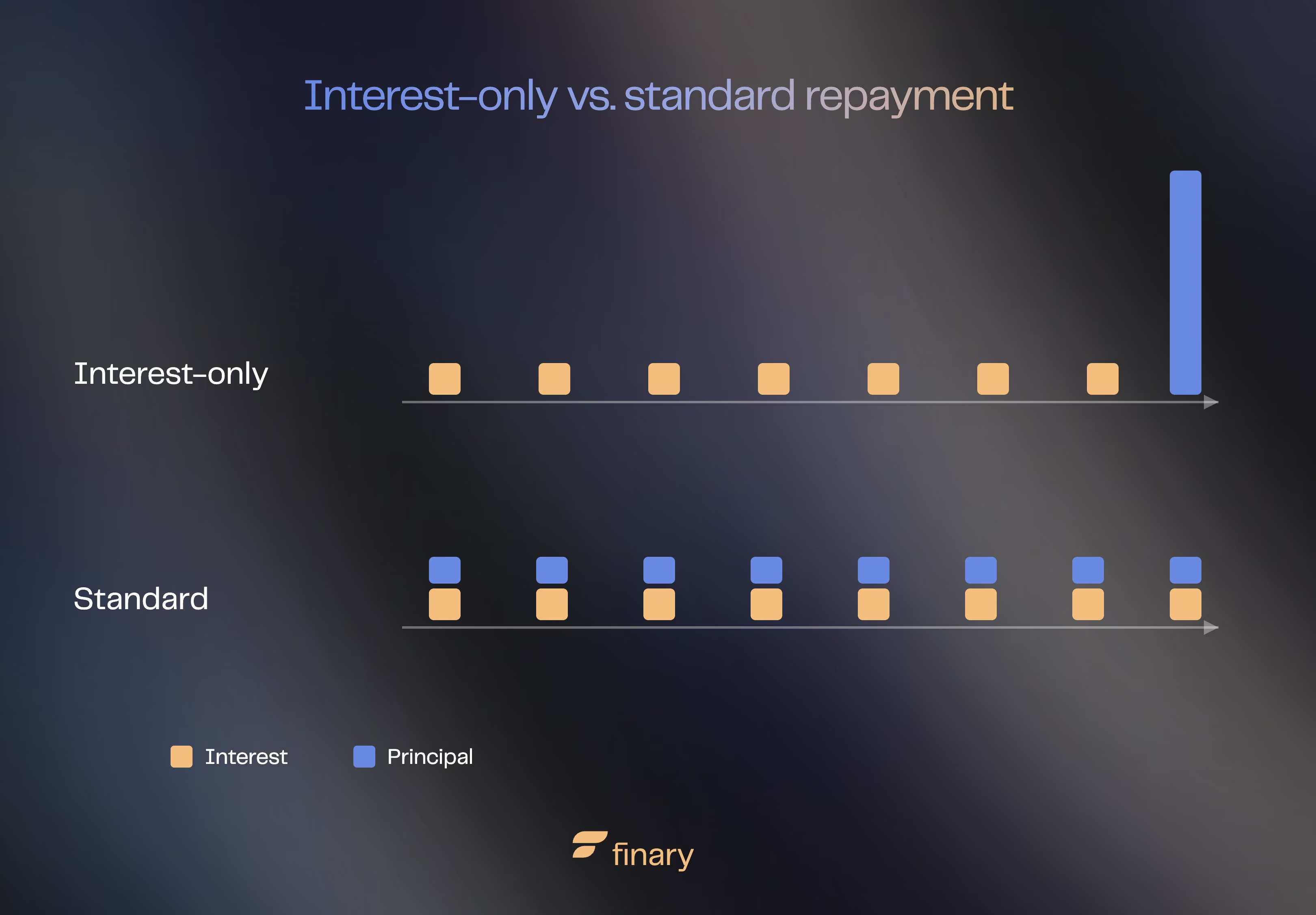
Its fast set-up, sometimes within 48 hours, is an advantage for anyone who wants funds quickly.
What is a mortgage: how it works and collateral on property
A mortgage relies on the value of your property assets. A property (primary residence, second home,rental investment) serves as collateral for the bank. If you default on repayment, the bank can seize and sell the property to recover the funds advanced.
This solid form of collateral involves stricter formalities: the mortgage deed must be drawn up by a notary and registered with the relevant authorities. The collateral is a tangible asset.
The amount you can borrow depends on the property's appraised value. According to theHaut Conseil de stabilité financière (HCSF), France's watchdog for financial stability, the term of a mortgage is capped at 25 years, extended to 27 years for transactions involving construction work or an off-plan purchase (VEFA), a binding rule for lenders since 1 January 2022.
This type of loan generally finances thepurchase of a propertyor allows you to raise significant liquidity backed by an existing asset.A mortgage is a solution backed by a genuine property guarantee, whose terms and risks should be assessed case by case.
Comparing collateral: financial assets for a Lombard loan versus property for a mortgage
The main difference between these two types of loan lies in the nature of the collateral.
A Lombard loan relies onfinancial assets: share portfolios, bonds, investment fund units, life insurance policies. These assets, generally liquid, can see their value fluctuate with the markets. For example, pledging a portfolio of technology shares carries a different risk profile from a government bond fund.
A mortgage relies onproperty: a flat, a house, commercial premises. These assets are tangible, less volatile in the short term, but also less liquid. Selling a property takes time and incurs costs.
This difference in liquidity and volatility directly affects the loan terms, in particular:
- the amount granted,
- the loan term,
- how quickly it can be obtained.
The nature of the collateral therefore determines the risk profile and the financing terms.
Key bank criteria: LTV, margins and pledging thresholds for a Lombard loan and a mortgage
When you apply for a loan, the bank assesses the risk and sets the amount it can grant. The loan-to-value ratio, or LTV (Loan-to-Value), expresses the percentage of the collateral's value the bank agrees to finance.
For a Lombard loan, this ratio varies depending on thepledged asset:
- up to 100% for a secure euro fund,
- between 30% and 70% for shares, depending on their volatility.
For reference, at the time of publication,BoursoBankadvertises the option to borrow up to 50% of the value of eligible assets, for amounts between €101,000 and €2,000,000 (source: issuer's website). For more information, see our article onbanks that offer a Lombard loan.
For a mortgage, LTV is generally between 50% and 80% of the property's appraised value. The bank applies a safety margin in case the market falls or a quick sale is needed.
For a mortgage, rates can be fixed or variable, with arrangement and notary fees.
Access thresholds also differ:
- a Lombard loan, although more accessible today, is often still reserved for a certain level of financial wealth,
- a mortgage is open to any solvent property owner.
These criteria determine the feasibility and cost of financing depending on the type of collateral offered.

Lombard loan or mortgage: how to compare rates, term and taxation
The choice comes down to six criteria: the rate, the term, the amount you can borrow (LTV), the initial costs, repayment flexibility and the tax treatment of each solution.
Comparison table: rate, term, costs and flexibility of a Lombard loan versus a mortgage
Comparing financing solutions can quickly become complex. This summary table highlights the main differences between a Lombard loan and a mortgage, beyond the headline figures.
| Feature | Lombard loan | Mortgage |
|---|---|---|
| Main collateral | Financial assets (shares, bonds, life insurance, etc.) | Property (primary residence, second home, rental) |
| Interest rate | Often based on Euribor + margin (e.g. 0.9% to 1.5%), sometimes higher. | Fixed or variable, generally lower for long terms. |
| Loan term | Short term (1 to 5 years, often renewable). | Long term (15 to 25 years, exceptionally 27 years under HCSF rules). |
| Amount you can borrow | % of the value of the pledged assets (LTV: 30-80%, sometimes 100% on euro funds). | % of the property's value (LTV: 50-80%, sometimes more depending on the project). |
| Initial costs | Low (no notary fees, minimal arrangement fees). | Higher (notary, collateral and arrangement fees). |
| Flexibility | High (interest-only repayment common, quick access to funds, reallocation possible under conditions). | Less flexible (standard amortising repayment, longer timeframes). |
| Borrower's insurance | Generally not required. | Often required. |
| Speed of approval | Very fast (sometimes 48 hours). | Slower (several weeks, sometimes months). |
This table offers a first overview.The key is to tailor each solution to your personal situation.
Tax impact in detail: wealth tax (IFI), rental income and capital gains in the Lombard loan vs. mortgage debate
Taxation is a factor worth examining. The choice between a Lombard loan and a mortgage carries different tax consequences.
With a Lombard loan,the cash you raise does not count as income. You therefore avoid any increase in income tax or in your reference taxable income.
By keeping your financial assets, you defer tax on capital gains, taxed under the flat tax regime (PFU) at31.4%since the LFSS (France's 2026 Social Security Financing Act), while still benefiting from their growth potential. As for the IFI (real-estate wealth tax), this loan has no direct impact, since it is backed by financial assets.
A mortgage offers other advantages. For a rental investment,loan interest is generally deductible fromrental income, which reduces the taxable base.
For IFI purposes, a property liability such as a mortgage counts as adeduction from the value of taxable property assets, easing the tax burden.
The key question is not which loan is more tax-efficient, but which tax structure best fits your wealth objectives, today and in the future.
Risk analysis: financial market volatility for a Lombard loan versus property market dynamics for a mortgage
Every type of financing carries risks that need to be anticipated to manage them better. A Lombard loan and a mortgage expose you to different risks.
A Lombard loan depends directly on the performance of the financial markets. The value of the pledged assets can vary sharply. If it falls below a certain threshold, the bank can demand additional collateral, a partial repayment, or sell the pledged assets, often on unfavourable terms. This is the main risk, and it stems from the volatility of the investments.
A mortgage relies on the relative stability of property. However, the property market can see price falls, stagnation or resale difficulties. Selling in unfavourable conditions can make it hard to recover the full value invested, especially after repaying the outstanding capital. The risk lies in liquidity, the property's long-term valuation and the ability to keep up with repayments.
For which profiles and projects: when to favour a Lombard loan or a mortgage
The choice of financing depends above all on your profile and your plans.
A Lombard loan is generally offered to those with substantial financial wealth who are familiar with the markets. It lets you raise cash without giving up your portfolio, to:
- seize an investment opportunity,
- finance a large-scale project,
- optimise your tax position.
For an entrepreneur, it offers a fast solution to a one-off need, without diluting capital or selling strategic assets. Its fast set-up is a decisive advantage.
A mortgage is aimed at a broader audience. It is particularly well suited to:
- buying property (primary residence, second home, rental investment),
- major renovation projects,
- debt consolidation, by combining several loans on potentially more favourable terms.
For an expatriate who owns property in France, this type of loan can finance projects in the country of residence or in France, even though the lending conditions are often stricter.
Hybrid strategies: combining a Lombard loan and a mortgage
The choice is not always either-or. Sometimes the most effective solution combines both mechanisms.
For example, if you want to buy a property without selling a growing share portfolio, a short-term Lombard loan can quickly provide the down payment.
The rest of the purchase is then financed by a standard mortgage, with lower rates and a longer term. The Lombard loan can then be repaid later, using other liquidity or a partial sale of securities at the right moment.
Putting your financing strategy into practice
Worked case studies: Lombard loan vs. mortgage for a property investor and a securities portfolio holder
Figures help you understand better, but they don't tell the whole story. Two concrete examples illustrate how these financing solutions actually work, beyond the headline rates.
Scenario 1: the property investor - buying a €300,000 rental flat
Marc has a €500,000 share portfolio and wants to invest in a rental property.
Option A: a standard mortgage
Marc borrows €300,000 over 20 years at a fixed rate of 3.8% (excluding insurance). His monthly payments come to around €1,787.
- Total interest cost (approximate): €128,880.
- Impact: his debt-to-income ratio rises, which can limit his future property plans under HCSF rules. Management stays simple thanks to a fixed monthly payment.
Option B: a Lombard loan
Marc pledges €300,000 of his portfolio to obtain an interest-only Lombard loan over 5 years at a rate of 4.5% (3-month Euribor + 1% margin). He pays only the interest, quarterly.
- Annual interest: €13,500 (i.e. €1,125/month).
- Principal to repay after 5 years: €300,000.
- Impact: his property debt-to-income ratio does not change directly. He keeps his portfolio, which can keep generating returns (for example 6% a year). If the portfolio returns 6%, the €300,000 pledged generates €18,000 gross, covering the interest and leaving a surplus.
- Risk: if the portfolio's value falls (for example to €250,000), the bank can issue a margin call, requiring additional collateral or a partial repayment. This strategy therefore depends on the performance of the assets and the ability to handle volatility.
Marc's choice depends on his confidence in his portfolio's performance, his risk tolerance and his future plans.
Scenario 2: a securities-portfolio holder - financing €150,000 of renovation work
Sophie has an €800,000 portfolio of shares and ETFs and wants to renovate her primary residence without selling her securities, to stay positioned for a rise or to avoid tax on capital gains.
Option A: a Lombard loan
Sophie pledges €300,000 of her portfolio (50% LTV) to obtain €150,000 through an interest-only Lombard loan over 4 years at 4.2%.
- Annual interest: €6,300.
- Impact: she preserves her investment strategy and keeps receiving dividends and potential returns. She does need to stay alert to margin calls, though.
Option B: a mortgage on her primary residence
If her home's value allows it, she can obtain a €150,000 mortgage over 10 years at 3.9%.
- Monthly payments: around €1,512.
- Total interest cost (approximate): €31,440.
- Impact: higher monthly payments, but a potentially lower total interest cost if the Lombard loan had to be renewed. Less flexibility if the property needs to be sold quickly.
Sophie has to choose between preserving her investment strategy or opting for the simplicity of an amortising repayment, with different consequences for her cash flow and wealth flexibility.
The key questions to ask before choosing
Choosing a financing method is like picking the right vehicle for a journey: you need to consider comfort, fuel consumption and the type of road, not just speed. Here are the key questions to guide your choice:
- What is the real purpose of these funds?Is it a one-off need, or an investment whose return needs to cover the cost of the loan? A Lombard loan often suits the first case, but requires a return analysis for the second.
- Is your time horizon fixed or flexible?A Lombard loan is generally short-term. If your project drags on, renewals can become costly or uncertain. A mortgage offers long-term visibility.
- What is your tolerance for market volatility?If a margin call during a period of market turbulence worries you, the stability of property collateral and a scheduled repayment may feel more reassuring.
- Are your financial assets suited to being pledged?The bank will assess the liquidity, diversification and quality of your portfolio. A diversified portfolio of ETFs and bonds will be valued more favourably than one concentrated in a few speculative stocks.
- What is the emotional value of your assets?Mortgaging your primary residence has a different psychological impact from pledging a share portfolio, even at an equal value.
- Do you have a clear strategy for repaying the Lombard loan's principal?Counting on the portfolio's performance is one thing; having a plan B (selling other assets, future income) is another.
- How does this decision fit into your medium- and long-term wealth strategy?A loan may look attractive in the short term but limit other opportunities or the transfer of your estate.
- Have you stress-tested your choice?What happens if rates rise, if the value of your assets falls by 30%, or if your income drops? How sound your decision is also comes down to how well it withstands the unexpected.
Answering these questions will help you align your financing solution with your deeper goals, beyond current market conditions.
Key takeaways for making the right choice
The choice between a Lombard loan and a mortgage depends above all on the nature of your wealth and your financial goals.
If you hold a substantial securities portfolio, a Lombard loan can offer speed and flexibility, while property owners may want to look at the mortgage option for its potentially higher amounts and longer terms. The choice should be weighed against your personal situation.
Non-contractual document for promotional purposes. Finary One is Finary's private wealth management offer, reserved for investors with at least €1,000,000 in investable assets. Investing carries risks, including the risk of partial or total capital loss. Finary SAS - 58 rue de Monceau 75380 Paris 8 - ORIAS no. 21001279, under the supervision of the AMF and the ACPR.
Frequently asked questions
Is a Lombard loan reserved for wealthy clients?
No. Historically reserved for private banking, the Lombard loan has become more widely accessible: players such as BoursoBank or Swissquote now offer it from just a few tens of thousands of euros pledged, with an online application process open to a wider audience than before.
What happens if the value of the assets pledged for a Lombard loan falls sharply?
The bank can trigger a margin call: it requires additional collateral, a partial repayment, or sells part of the pledged assets, sometimes on unfavourable market terms. This forced-liquidation risk is specific to a Lombard loan, unlike a mortgage.
Can a Lombard loan and a mortgage be combined for the same property purchase?
Yes: a short-term Lombard loan can finance the down payment without selling a securities portfolio, with the rest of the purchase then covered by a standard mortgage, at a lower rate and over a longer term.
Is a mortgage limited to financing a property purchase?
No. A mortgage can also raise significant liquidity by using a property you already own as collateral, for example to finance renovation work, consolidate debts or seize an investment opportunity, with no direct link to the purchase of the mortgaged property.
Can a Lombard loan be repaid before its term?
Yes, most interest-only Lombard loan contracts allow early repayment, in full or in part, notably through the sale of some of the pledged assets. The terms, any fees and notice periods vary by lender and should be checked in the contract.
What is the maximum term for a mortgage in France?
The Haut Conseil de stabilité financière (HCSF), France's financial-stability watchdog, caps mortgage terms at 25 years, extended to 27 years for transactions involving construction work or an off-plan purchase (VEFA), a binding rule for banks since 1 January 2022.
Sources
Observatoire Crédit Logement/CSA, average mortgage rates
economie.gouv.fr, decisions and recommendations of the Haut Conseil de stabilité financière (HCSF)
impots.gouv.fr, taxation of capital gains on securities and the flat-tax (PFU) rate
impots.gouv.fr, deducting loan interest from rental income
bofip.impots.gouv.fr, deducting liabilities from the real-estate wealth tax (IFI)
BoursoBank, official terms for a Lombard loan in private banking
Regulatory disclaimers:Marketing communication. Investing carries a risk of partial or total capital loss. Past performance is not a reliable indicator of future performance. This article is provided for information and educational purposes only; it does not constitute personalised investment advice, a buy or sell recommendation, or tax advice. Borrowing amplifies both losses and gains and may result in a loss greater than the capital invested (you remain liable for the loan). Complex product with a high level of risk.
Before investing, read the Key Information Document (KID) and, where relevant, consult an authorised adviser.
Finary SAS, an investment firm authorised by the ACPR (no. 19283), member of AMAFI. Insurance broker registered with ORIAS (no. 21001279), member of the CNCGP (association approved by the AMF). Crypto-Asset Service Provider (CASP) authorised by the AMF under the MiCA regime, references no. A2026-026 and no. N2026-008.