Private Equity Risk: Understanding It to Invest Better

Updated on 5 August 2026
Private equity exposes investors to a real risk of capital loss, illiquidity and limited transparency on asset valuations, but spreading commitments across several funds sharply reduces the risk of a total loss. This article details the main risks of private equity and the concrete strategies to manage them.

- Private equity brings together several strategies (venture capital, growth capital, buyout capital or LBO) with different risk profiles.
- The investment is locked up for 7 to 10 years on average, with a "J-curve" effect that makes early returns often negative.
- Valuing unlisted assets relies on methods internal to the manager, which creates a degree of opacity compared with listed markets.
- According to Cambridge Associates, the probability of a total loss of capital drops from 23.6% with a single fund to 0.7% with nine funds held simultaneously.
- Finary One supports wealth holders with at least €1,000,000 in investable assets in tracking and structuring their unlisted positions.
What is private equity, and what is its return/risk profile?
Private equity, or capital investment, means injecting capital into companies that are not listed on the stock market, with a return potential often higher than that of traditional assets, but a higher risk and a commitment of 5 to 10 years on average.
According to a Cambridge Associates study based on historical data (not guaranteed for the future), the risk of a permanent loss of capital falls sharply with the number of funds held in a private equity portfolio:
| Number of funds held | Probability of permanent loss of capital |
|---|---|
| 1 fund | 23.6% |
| 3 funds | 9% |
| 5 funds | 3.9% |
| 7 funds | 1.5% |
| 9 funds | 0.7% |
This diversification does not, however, eliminate the risk of underperformance on a single fund: an investor who concentrates their commitment on one poorly chosen fund can lose most of their capital. Private equity risk is therefore not a binary figure, but a spectrum that depends directly on the level of diversification and the quality of fund selection.
Definition, mechanics, and how it differs from venture capital
The term private equity, or capital investment, means injecting capital into companies that are not listed on the stock market. It finances promising companies, letting them grow, innovate or transform, away from the swings of the financial markets.
Investors, often through specialized funds, acquire stakes in these companies. Their goal is to support them over several years and realise a capital gain on resale.
Venture capital is a branch of private equity. It mainly targets the financing of innovative startups. Other strategies such as growth capital or buyout capital (LBO) target more established companies. Private equity therefore covers a broader spectrum than venture capital alone.

Non-contractual promotional document. Finary One is Finary's private wealth management offer, reserved for investors with at least €1,000,000 in investable assets. Investing carries risks, including partial or total capital loss. Finary SAS — 58 rue de Monceau 75380 Paris 8 — ORIAS no. 21001279, supervised by the AMF and the ACPR.
Private equity's return/risk profile: what to expect and how to assess it
Private equity offers a return potential often higher than traditional assets. However, that potential comes with a higher risk and a long-term commitment, generally 5 to 10 years, sometimes more.
To assess this return/risk profile, several factors need to be analysed:
- the fund strategy,
- the management team's expertise,
- the quality of the selected companies.
A key point is the low liquidity of these investments. It is difficult to sell units before maturity, which justifies a return premium. Over time, private equity has often delivered attractive returns, and sometimes more stable ones during periods of volatility on listed markets. But it demands patience and judgment.
Fees in private equity
Fees in private equity directly affect profitability. Two main categories exist:
- Management fees: annual fees calculated as a percentage of committed or invested capital. They pay for the day-to-day management of the fund.
- Carried interest: a share of profits paid to managers only once performance clears a set threshold, called the "hurdle rate". This mechanism aligns managers’ interests with investors’: the higher the performance, the higher their pay.
Significant overall fees, sometimes including distribution commissions or fees tied to the investment wrapper (such as life insurance), can reduce net returns. The fund must therefore generate a higher gross performance to meet investor objectives, which shapes how it is managed.
What are the main risks of private equity?
Private equity exposes investors to five main risks: capital loss, illiquidity, the difficulty of valuing unlisted assets, economic and market cycles, and regulatory, tax or currency risks.
1. The risk of capital loss
Investing in private equity involves a significant degree of uncertainty. Partial or total loss of capital is a real possibility. This risk is particularly high in venture capital, which targets young companies often still validating their business model.
For LBO funds or growth-capital funds, which invest in more mature and profitable companies, the loss rate generally falls between 5% and 15%.
It is tempting to compare private equity with the stock market. In some years, listed shares post similar performance. Over the long run, however, private equity has historically shown lower reported volatility (a smoothing effect from unlisted valuations). Past performance is not a reliable indicator of future performance.
For a detailed look at the pros and cons of each approach, see our full comparison of private equity and the stock market. You will find the key criteria for shaping your allocation strategy.
2. The risk of illiquidity
Illiquidity is a major feature of private equity. Funds typically commit capital for 7 to 10 years, sometimes more, as the AMF points out. Unlike listed shares, it is impossible to sell units quickly. The secondary market for these assets remains limited.
This lock-up of capital is not a flaw but an essential part of the model. It lets managers focus on the long term without the pressure of short-term results.
A fund’s life cycle follows a set pattern. The early years involve successive capital calls to fund investments and cover management fees. This phenomenon, known as the "J-curve", results in often negative returns at the start.
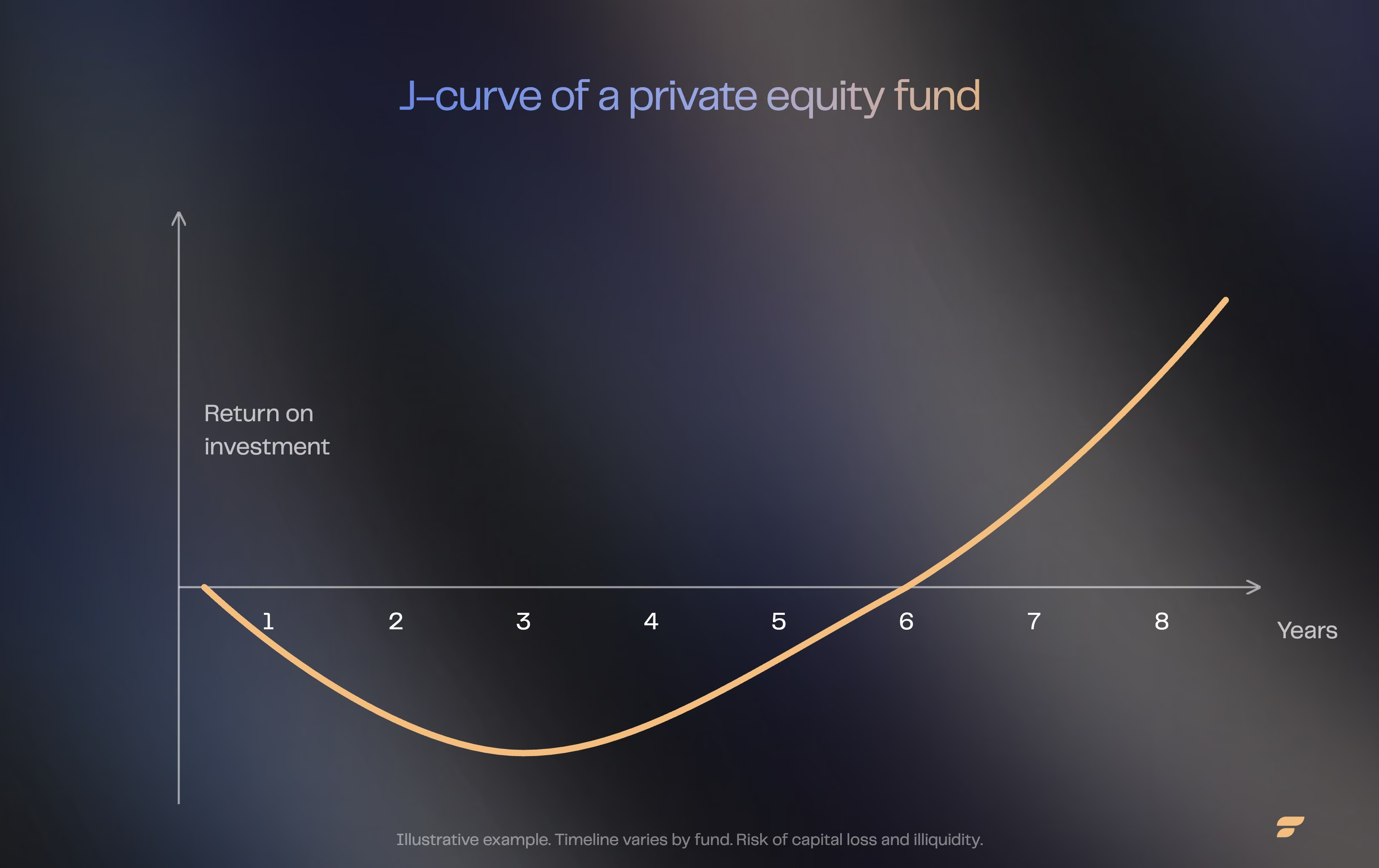
It is only once companies are sold that distributions start to generate gains. Patience and a long-term view are essential to succeed in private equity.
3. The risk of valuing unlisted assets, and the lack of transparency
Valuing an unlisted company, which is not subject to daily market pressure, remains a significant challenge. Managers use several internal methods, such as:
- listed comparables,
- past transactions,
- discounting future cash flows.
Despite their rigour, these methods carry an element of subjectivity. The value shown can vary depending on the assumptions used, which creates a possible gap with a theoretical market value.
This valuation approach contributes to a degree of opacity often criticised in the industry. Financial reporting is less frequent and information more limited. For investors, this can raise doubts. Choosing partners who prioritise transparency and access to data is therefore essential, in order to track your strategy and communicate confidently with your manager.
One of the main obstacles to investing in private equity is the lack of transparency and the irregular monitoring of investments, often limited to a few annual reports. Finary One offers a platform where investors get access to real-time tracking dashboards. This technological approach gives better visibility into how allocations evolve and makes it easier to talk with our advisors, making risk management more rigorous without adding complexity.
4. Market risk, economic cycles, and the importance of stress tests for anticipating the impact on private equity
Private equity, although often seen as decoupled from the financial markets, remains sensitive to the ups and downs of the real economy. An economic slowdown can slow growth at portfolio companies, reduce their ability to repay debt, or limit exit opportunities.
The sector depends more on the micro-economics of individual companies than on broad macroeconomic trends. Historically, vintages invested at the bottom of the cycle have sometimes benefited from more attractive entry valuations, though this is neither a rule nor a recommendation for market timing.
Changes in interest rates are another significant risk, especially for LBO deals, which rely on leverage. Rising rates increase financing costs and reduce profitability.
To anticipate these shocks, serious managers run stress tests. These simulations assess how resilient the portfolio is to different scenarios, ensuring prudent management in an uncertain environment.
5. Regulatory, tax and currency risks, and the growing influence of ESG criteria
The private equity environment is constantly evolving. Legislative or regulatory changes, whether on taxation, exit conditions or reporting requirements, can alter investment strategies.
For investments outside the eurozone, currency risk is an added factor. Currency swings can hurt performance if they move unfavourably.
What are known as Environmental, Social and Governance (ESG) criteria now play a central role. They represent both a risk factor and a source of opportunities.
According to the PwC Global Private Equity Responsible Investment Survey 2023, conducted among 209 management firms across 35 countries, mostly in Europe, 70% of them now rank ESG value creation among their priorities, compared with a risk-management logic ten years ago.
New regulations, such as the SFDR (Sustainable Finance Disclosure Regulation, the EU regulation on sustainability-related disclosures) or the EU taxonomy, impose stricter transparency and reporting requirements. They are pushing private equity players to step up their scrutiny of the impact of their investments.
Private equity risk and Finary One
Finary One offers support from a dedicated private wealth manager for wealth holders with at least €1,000,000 in investable assets. According to Cambridge Associates, diversifying across 9 funds reduces the risk of a permanent loss of capital to 0.7%, versus 23.6% for an investor exposed to a single fund. Past performance is not a reliable indicator of future performance, and manager selection remains decisive.
- Rigorous fund selection (track record, team, strategy and fee analysis) to limit the dispersion risk between top- and bottom-quartile funds.
- A dedicated private wealth manager who calibrates your private equity exposure based on your overall wealth, horizon and tolerance for illiquidity.
- A 360° view that folds your unlisted positions into your overall allocation, anticipates capital calls, and tracks consolidated net performance.
Learn more about Finary One → Reserved for investors with at least €1,000,000 in investable assets. Investing carries risks, including capital loss.
Concrete strategies to manage and reduce private equity risk
Diversifying your private equity portfolio to limit risk
Putting all your investments into a single sector or region sharply increases risk. In private equity, diversification is a solid foundation for stabilising your portfolio.
It rests on several complementary pillars:
- Vintages: investing across several years spreads out the risks tied to economic cycles. Avoid entering only during periods of euphoria.
- Geographies: diversifying across several countries or regions protects against local political and economic risks.
- Investment strategies: combining venture capital, growth capital and buyout capital balances risk and return profiles.
- Sectors: avoiding concentration in a single sector reduces exposure to sector-specific shocks.
Running rigorous due diligence to select funds
Due diligence means thoroughly vetting a fund before investing. This process goes well beyond looking at the numbers.
You should examine in particular:
- The management team's experience and track record, in particular their ability to navigate different economic cycles.
- The consistency of their investment philosophy and their method for creating value.
- Their successes and failures, and the lessons drawn from them.
Reviewing the fund's documents (prospectus, annual reports) is essential. Pay close attention to:
- The fee structure.
- The exit strategy.
- Any specific clauses that could affect your investment.
Also assess the target companies' financial statements, strategy and legal aspects.
Ask the manager precise questions. A transparent professional will answer clearly. This approach reduces the information asymmetry inherent to private equity.
Choosing the right investment vehicles and getting professional support
In France, access to private equity usually goes through specialized funds such as FCPR (Fonds Commun de Placement à Risques, a French venture-capital fund vehicle), FCPI, FIP or FPCI (Fonds Professionnel de Capital Investissement). The choice depends on your profile, your objectives, including tax objectives, and your investment capacity.
Beyond the vehicle itself, the quality of the management and the fund strategy must match your expectations.
Given this complexity, the support of a Conseiller en Investissements Financiers (CIF), France's regulated independent financial adviser status, can prove valuable. It will help you:
- Understand the range of funds available.
- Carry out thorough due diligence.
- Decode financial structures and fees.
- Build a diversified portfolio suited to your situation.
Professional support makes it easier to access selected opportunities and improves risk management. Technological tools, such as platforms that centralise data and communication, strengthen transparency and monitoring.
Defining your investor profile and investment horizon
Before investing in private equity, it is essential to assess your profile and objectives.
Capital invested is generally locked up for 7 to 10 years, sometimes more. If you expect to need liquidity in the medium term, this type of investment is not suitable.
Your risk tolerance needs to be high. Private equity can involve significant volatility and a risk of capital loss, even though diversification reduces that risk. You need to be able to withstand periods of uncertainty or unrealised losses psychologically.
Finally, your financial situation needs to be solid enough to lock up part of your wealth without unbalancing your overall portfolio.
It is generally recommended to allocate to private equity only the portion of your wealth compatible with a long lock-up and a risk of capital loss.
Non-contractual promotional document. Finary One is Finary's private wealth management offer, reserved for investors with at least €1,000,000 in investable assets. Investing carries risks, including partial or total capital loss. Finary SAS — 58 rue de Monceau 75380 Paris 8 — ORIAS no. 21001279, supervised by the AMF and the ACPR.
Understanding private equity risk from a wealth-management perspective
This private equity risk is not an insurmountable obstacle but a factor to be managed with method and expertise. A structured approach, combining suitable diversification, rigorous due diligence and professional support, makes it possible to approach this asset class in a disciplined way.
In a constantly changing economic environment, informed investors who manage these risks gain access to an asset class capable of generating potentially attractive returns, with no guarantee, while helping to finance the real economy.
Frequently asked questions
What is the main risk of private equity?
The main risk of private equity is the partial or total loss of invested capital, compounded by the illiquidity of units for several years. Diversifying across several funds sharply reduces this risk, without ever eliminating it entirely.
How long is capital locked up in private equity?
Capital is generally locked up for 7 to 10 years, sometimes more, the time it takes for the fund to invest, support portfolio companies and then sell them. The secondary market for selling units before maturity remains very limited.
How can you reduce the risk of loss in private equity?
Diversifying across several funds, vintages, geographies and investment strategies, combined with rigorous due diligence on the management team and fees, significantly reduces the risk of capital loss.
What is the J-curve in private equity?
The J-curve refers to the phenomenon whereby a private equity fund's returns are often negative in the early years, while capital calls and management fees are underway, before turning positive once the first exits occur.
What is the minimum wealth needed to invest in private equity with Finary One?
Finary One is designed for investors with at least €1,000,000 in investable assets, with a dedicated private wealth manager who calibrates private equity exposure according to overall wealth, investment horizon and tolerance for illiquidity.
Is private equity riskier than the stock market?
Private equity carries a risk of capital loss and illiquidity specific to unlisted assets, while listed shares offer more liquidity but more visible day-to-day market volatility. The two risk profiles are not directly comparable.
Sources
AMF, capital investment: FCPR, FCPI, FIP, risks for retail investors
PwC, Global Private Equity Responsible Investment Survey 2023
AMF, whitelist of Crypto-Asset Service Providers (CASP, "PSCA" in French), Finary SAS
Regulatory disclaimers: Marketing communication. Investing carries a risk of partial or total capital loss. Past performance is not a reliable indicator of future performance. This article is for information and educational purposes only; it does not constitute personalised investment advice, a buy or sell recommendation, or tax advice. This investment carries a liquidity risk (no guaranteed resale, long time horizon) and a risk of capital loss. Income and valuations are not guaranteed. Before investing, read the Key Information Document (KID) and, where relevant, consult an authorised adviser. Finary SAS, an investment firm authorised by the ACPR (no. 19283), member of AMAFI. Insurance broker registered with ORIAS (no. 21001279), member of the CNCGP (association approved by the AMF). Crypto-Asset Service Provider (CASP) authorised by the AMF under the MiCA regime, references no. A2026-026 and no. N2026-008.