Private Equity vs the Stock Market in France: Returns Compared Over 10 Years


Updated on 10 August 2026
Over the past ten years, French private equity has delivered a net return of 10.7% a year in France, against 9.5% for the CAC 40, at the cost of 7 to 10 years of illiquidity. This article compares their returns, risks and fees across several time horizons, and explains how to combine them based on your wealth.

- Private equity shows wide dispersion: the top quartile delivers a net IRR (internal rate of return) of 22.0% over 10 years, the bottom quartile -7.6%.
- Access remains restricted: Finary One opens up private equity to individuals with at least €1,000,000 in investable wealth, with dedicated support.
- Private equity charges 1.5-2% in management fees plus 20% carried interest, against 0.1-0.5% for an equity ETF.
- Entry tickets in private equity range from €1,000 to more than €100,000, against a few dozen euros to invest in the stock market.
- Past performance is not a reliable indicator of future performance: private equity carries a risk of capital loss and illiquidity.
Yet most retail investors still overlook this asset class, believing it remains the preserve of the ultra-wealthy and institutional funds.
This perception hides a quiet revolution: private equity is becoming more democratic and accessible to a wider range of investors.
Understanding the fundamentals
What is private equity?
The term private equity (PE) refers to investing in unlisted companies. This type of investment involves a long-term commitment and risk-taking to support the transformation of these companies.
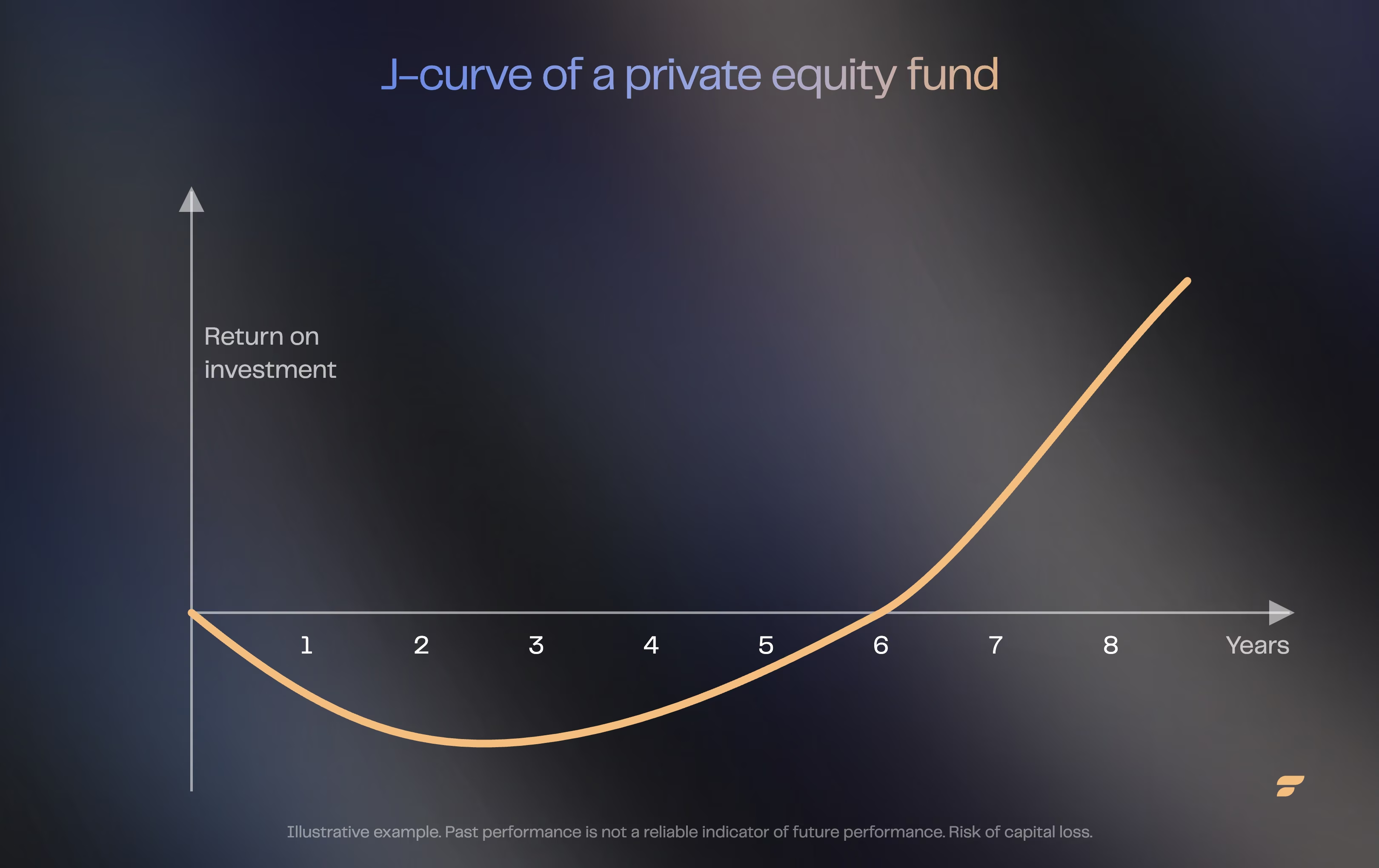
In PE, the "J-curve" illustrates how returns are often negative at first, before potentially turning positive over time, without any guarantee.
Investing in the stock market

The stock market is a public market, high liquidity, full transparency. However, this ease of access comes with high volatility.
Private equity vs the stock market: fundamental differences
| Criterion | Private equity | Stock market |
|---|---|---|
| Access | Restricted, high minimum | Open to everyone |
| Liquidity | Low, 7-10 years | High, instant |
| Historical return | 10.7%/yr net (France, end 2015 to end 2025) | 9.5%/yr (CAC 40, dividends reinvested, end 2015 to end 2025) |
| Volatility | Smoothed (quarterly valuation) | High, daily |
| Fees | 1.5-2% + carry | 0.1-0.5% (ETF) |
Past performance is not a reliable indicator of future performance. Private equity shows wide dispersion between funds.
Does private equity really outperform the stock market?
According to the France Invest x EY study, yes, but with wide dispersion between funds: over 10 years (end 2015 to end 2025), French private equity shows an average net IRR of 10.7% against 9.5% for the CAC 40, a gap that masks very uneven results depending on the manager.
Comparing returns
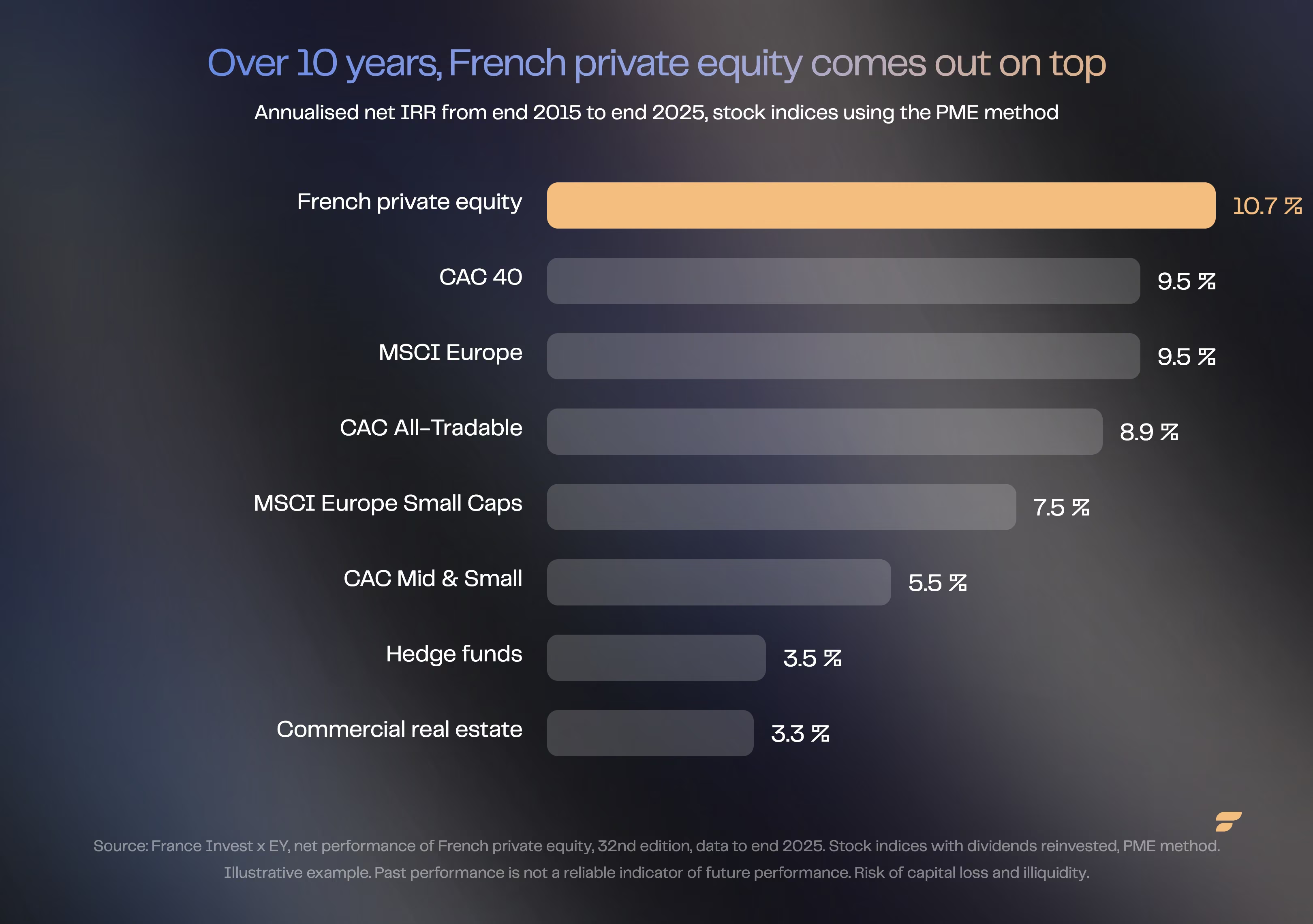
Over the past decade (end 2015 to end 2025), French PE delivered a net IRR of 10.7%. By comparison, the CAC 40, dividends reinvested, reached 9.5% over the same period.
If this 1.2-point annual gap held over 20 years, the final value of capital invested in private equity would be roughly 24% higher than at the CAC 40’s rate: this is an illustrative projection based on the 10-year gap observed, not an actual 20-year track record. Dispersion also remains very wide: over 10 years, the top quartile of French managers delivered a net IRR of 22.0%, against -7.6% for the bottom quartile. To compare the different private equity investment options, see our comparison of private equity platforms.
Risk, volatility and liquidity
PE carries a risk tied to illiquidity. In the stock market, the S&P 500 saw volatility of 16% over 10 years, against 10% for buyout funds. This "smoothed" volatility in PE masks the illiquidity risk and the difficulty of accessing the best funds.
Entry tickets, fees and taxation
In the stock market: a few dozen euros are enough. In PE: entry tickets into a fund typically range from €1,000 to more than €100,000, depending on the vehicle. This is distinct from the wealth-management threshold: Finary One serves investors with at least €1,000,000 in investable wealth to build an allocation that includes private equity, with dedicated support.
Fees are lower in the stock market (0.1-0.5% for an ETF) than in private equity, which typically adds 1.5 to 2% in annual management fees and 20% carried interest on performance, on top of which the fees of the wrapper used may apply (life insurance, PEA (a French tax-advantaged equity savings account)). Several vehicles exist to hold private equity, see our overview of private equity fund types. The applicable taxation depends on the wrapper and investment option chosen.

Private Equity vs the Stock Market and Finary One
Private equity outperformed the CAC 40 by 1.2 points a year over the period from end 2015 to end 2025 (France Invest x EY, 2025), but with 7 to 10 years of illiquidity. Choosing between PE and the stock market depends on your time horizon, your liquidity and your overall wealth. Finary One supports investors with €1,000,000 in investable assets.
- Personalised allocation between listed and unlisted assets based on your time horizon, your liquidity needs, your tax situation and your tolerance for dispersion between funds.
- A dedicated private wealth manager who structures the allocation within the right wrapper (Luxembourg life insurance, PEA, securities account, holding company) to adapt the tax framework to your situation.
- A 360° view that jointly manages your listed and unlisted positions, measures consolidated net performance and anticipates liquidity needs.
Learn more about Finary One → Reserved for investors with €1,000,000 in investable assets. Investing carries risks, including the risk of capital loss.
Should you prefer private equity or the stock market based on your profile?
This depends above all on your time horizon and your liquidity needs: private equity suits investors ready to lock up capital for several years to target higher performance, while the stock market suits those who want to keep full control of their portfolio and immediate liquidity.
PE or the stock market: choosing based on your profile
PE may suit investors ready to give up liquidity to target higher performance over 7 to 10 years. The stock market may suit investors who want to keep control of their portfolio, trade at any time and enjoy near-instant liquidity.
Building a diversified portfolio: combining PE and the stock market
As an illustration, some investors choose to allocate between 5 and 15% of their wealth to PE, depending on their time horizon and risk tolerance. Educational allocation example (not personalised, does not constitute investment advice):
- Equities (ETF, direct): 45%
- Private equity: 10%
- Real estate: 20%
- Bonds: 15%
- Cash: 10%
To be adapted based on your situation, your objectives and your time horizon.
The PE vs stock market trade-off: a question of wealth balance
The PE vs stock market debate is not a simple binary opposition but reveals two complementary approaches. While PE has historically shown higher returns (with wide dispersion between funds) and an apparent decorrelation linked to quarterly valuation, the stock market offers liquidity and immediate accessibility.
Frequently asked questions
Does private equity always outperform the stock market?
No. Over 10 years (end 2015 to end 2025), French private equity showed an average net IRR of 10.7% against 9.5% for the CAC 40, but dispersion is wide: the bottom quartile of funds shows a negative IRR of -7.6%, against 22.0% for the top quartile.
What is the minimum entry ticket to invest in private equity?
Private equity funds generally accept tickets from €1,000 to more than €100,000, depending on the vehicle. Finary One supports investors with at least €1,000,000 in investable wealth in building an allocation that includes unlisted assets.
Is private equity riskier than the stock market?
Private equity carries a different risk, not necessarily a higher one: capital illiquidity for 7 to 10 years and wide dispersion between funds, rather than the daily volatility of stock markets. Both carry a risk of capital loss.
What are private equity fees compared with an ETF?
A private equity fund generally charges 1.5 to 2% in annual management fees plus 20% carried interest on performance, against 0.1 to 0.5% for an equity ETF. These fees reduce the net performance received by the investor.
What share of your wealth should you allocate to private equity?
As an illustration, some investors allocate between 5 and 15% of their wealth to private equity depending on their time horizon and risk tolerance. This allocation is not personalised advice and should be adapted to each situation.
Sources
France Invest x EY, Net Performance of French Private Equity, 32nd edition, data to end 2025
AMF, whitelist of Crypto-Asset Service Providers (CASP, "PSCA" in French), Finary SAS
Regulatory disclaimers: Marketing communication. Investing carries a risk of partial or total capital loss. Past performance is not a reliable indicator of future performance. This article is for informational and educational purposes only; it does not constitute personalised investment advice, a recommendation to buy or sell, or tax advice. This investment carries a liquidity risk (no guaranteed resale, long time horizon) and a risk of capital loss; income and valuations are not guaranteed. Before investing, read the Key Information Document (KID) and, where relevant, consult an authorised adviser. Finary SAS, an investment firm authorised by the ACPR (no. 19283), member of AMAFI. Insurance broker registered with ORIAS (no. 21001279), member of the CNCGP (association approved by the AMF). Crypto-Asset Service Provider (CASP) authorised by the AMF under the MiCA regime, references no. A2026-026 and no. N2026-008.