What Is Private Equity? A Complete Guide for Beginners

Updated on 22 July 2026
Private equity, or capital investment, refers to investing in companies that are not listed on the stock market, combined with active support for their development over several years. This guide explains how it works, its different forms, its benefits, its risks, and how individual investors in France can access it.

- Private equity finances unlisted companies over a 5- to 10-year horizon, with active support for management teams, unlike a passive stock market investment.
- Four main strategies coexist: venture capital, growth capital, LBO (buyout), and turnaround capital, depending on the maturity of the target company.
- Individual investors access it through regulated funds (FCPR, FCPI, FIP) or through platforms and club deals, with entry tickets starting from €1,000 to €10,000.
- Capital stays locked up for several years and carries a risk of partial or total loss, in exchange for return potential and a degree of decorrelation from listed markets.
- Since 21 February 2026, the IR-PME tax break no longer applies to “classic” FCPI and FIP funds: only the FCPI-JEI, the FIP Corse, and the FIP Outre-mer remain eligible, at 30%.
What Is Private Equity?
Private Equity Definition: What Exactly Are We Talking About?
Private equity involves investing directly in the capital of companies not listed on the stock market, in exchange for active support of their development over several years.
When Blackstone acquired Hilton Hotels for $26 billion in 2007, then sold it eleven years later for a $14 billion profit, few people realised they had just witnessed one of the greatest private equity successes in history. Yet this industry, which moves trillions of dollars, remains largely unknown to the general public.
Private equity refers to investing in companies that are not listed on the stock market. These companies, often promising or undergoing transformation, operate away from public financial markets.
The investor does more than provide funds. They get actively involved, advise, and take part in the company's development. This approach combines capital, expertise, and a long-term vision.
It brings together specialised funds, experienced entrepreneurs, families looking to pass on their know-how, and individuals seeking to diversify their wealth.
Private equity is defined by a direct, personalised relationship between investors and companies.
Unlike stock markets, there is no real-time pricing or news-driven volatility. The investment plays out over time, with the aim of transforming, supporting, and unlocking hidden value.
Why Is Private Equity Also Called Capital Investment?
The French term “capital-investissement” (capital investment) reflects a philosophy of commitment. It is not just about putting money in, but also about supporting a company's human, industrial, and technological development. Unlike a public shareholder, a private equity investor becomes a strategic partner.
In France, the term evokes a strong link with family-owned SMEs, innovative start-ups, and growing regional businesses. This sector relies on key concepts such as succession, growth, turnaround, and innovation.
Many French entrepreneurial success stories, in tech and in industry, have benefited from the support of private equity funds. This form of financing has helped thousands of companies transform, expand internationally, and weather crises. It acts as a discreet but powerful lever, with a concrete impact on employment, innovation, and competitiveness.
Want to explore another side of private equity? Find out in detail how to invest in startups.
How Does Private Equity Work? The Investment Cycle Explained
Private equity works in four stages: raising capital from investors, rigorously selecting unlisted companies, actively managing them for several years, and then exiting to realise the return.
The 4 Key Stages: Fundraising, Selection, Management, and Exit
The process starts in a confidential meeting room, far from the financial markets. Institutional investors, family offices, and sometimes seasoned individual investors commit to providing capital to a fund. This stage, known as fundraising, represents a long-term commitment, often ten years or more, where trust matters more than immediate liquidity.
Not to be confused: the fundraising of a private equity fund (carried out with investors who will fund the vehicle) is different from the fundraising of a startup, where a growth-seeking company raises capital directly from investors. Here, we are talking about the earlier stage, where the fund pools resources that will later be deployed across various unlisted companies.
Once the capital is raised, the fund looks for unlisted companies. The selection process is rigorous. Each deal undergoes an in-depth review covering growth, profitability, management strength, and innovation potential. The investment team meets the company's leaders, reviews the accounts, and studies the market. Judgement complements this analysis, since a poor decision can hurt the fund's performance.
Portfolio management is an often underrated but essential phase. The fund does more than watch from the sidelines: it sits on the board, challenges strategy, and mobilises its network.
Finally, the exit closes the cycle. After several years, the fund arranges the sale of its stake, whether through an IPO, a sale to an industrial buyer, or a sale to another fund. This moment determines the return, based on the difference between the purchase price and the sale price. Investors then recover their capital, plus – or minus – any capital gain realised.
Focus on the J-Curve: Understanding Value Creation
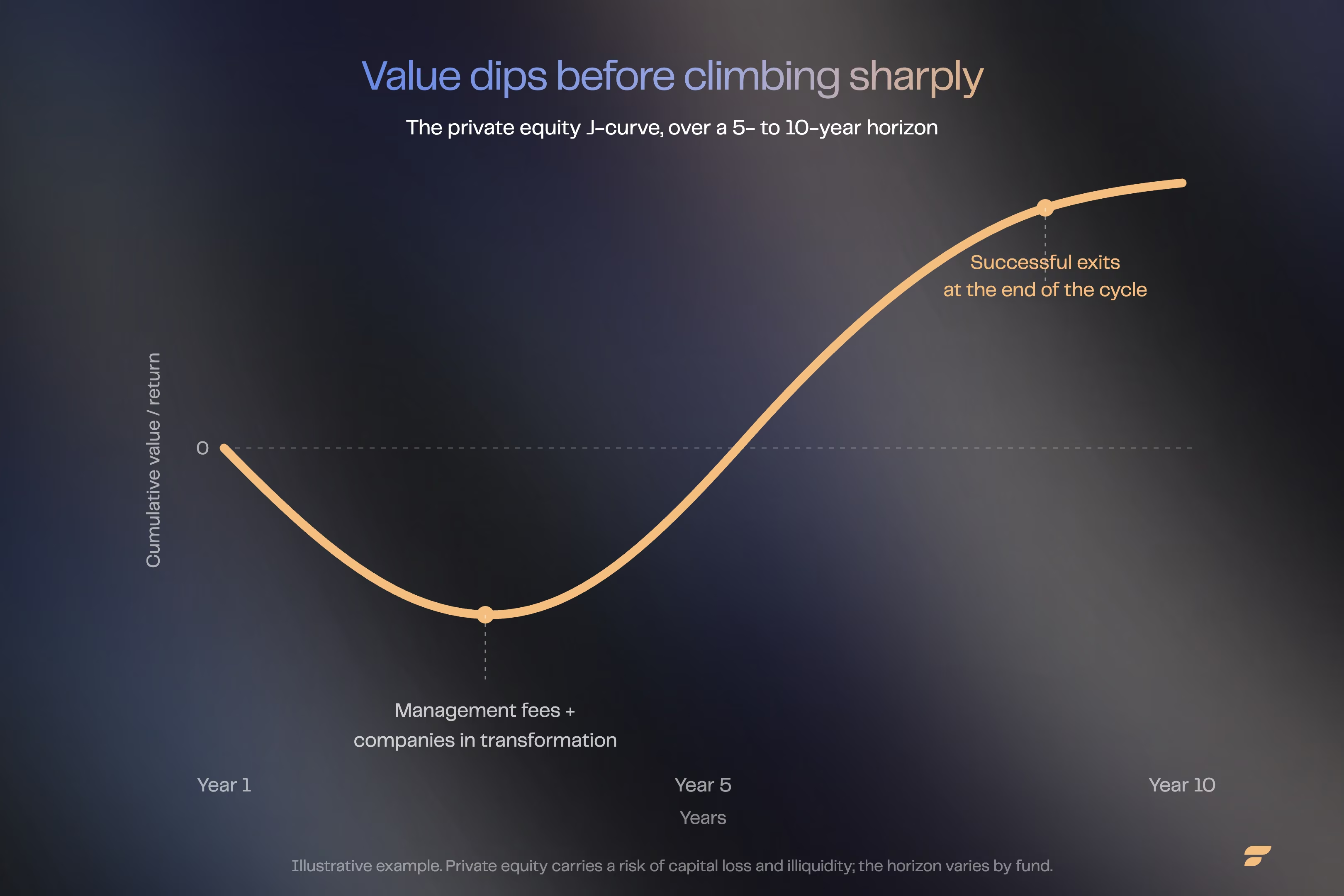
Private equity is like a marathon. In the early years, returns are often weak. This phenomenon, known as the J-curve, is explained by management fees and investments in companies undergoing transformation, which weigh on performance. Capital appears to shrink at first.
Over time, the picture improves. As portfolio companies gain in value, the curve turns upward. Successful exits, usually towards the end of the cycle, drive performance sharply higher. This dynamic underlines the importance of a long investment horizon: leaving too early risks missing the upswing.
A Concrete Example of a Private Equity Investment
Illustrative example (fictional): a fund identifies a family-owned industrial SME that is profitable but lacking momentum. Specialised in aerospace components, the company has never attempted to export. The fund invests in its capital, injects equity, and encourages management to hire an export director. It finances the modernisation of the production line and negotiates international partnerships.
Three years later, revenue has doubled and the SME signs a contract with a major industry player. The fund then sells its stake to a German industrial group, drawn in by the growth and new momentum. Investors realise a significant capital gain, the result of strategic support and controlled risk-taking.
This scenario, a common one, illustrates the logic of private equity: spotting potential, investing time and expertise, then orchestrating an exit at the right moment. Every stage is crucial, and value creation rests on a structured, hands-on approach.

The Different Forms of Private Equity: A Complete Overview
Venture Capital: Investing in Innovative Start-ups
Venture capital combines boldness and patience. An investor backs a still-nascent idea, carried by a team with no revenue yet. The risk is high, but so is the growth potential.
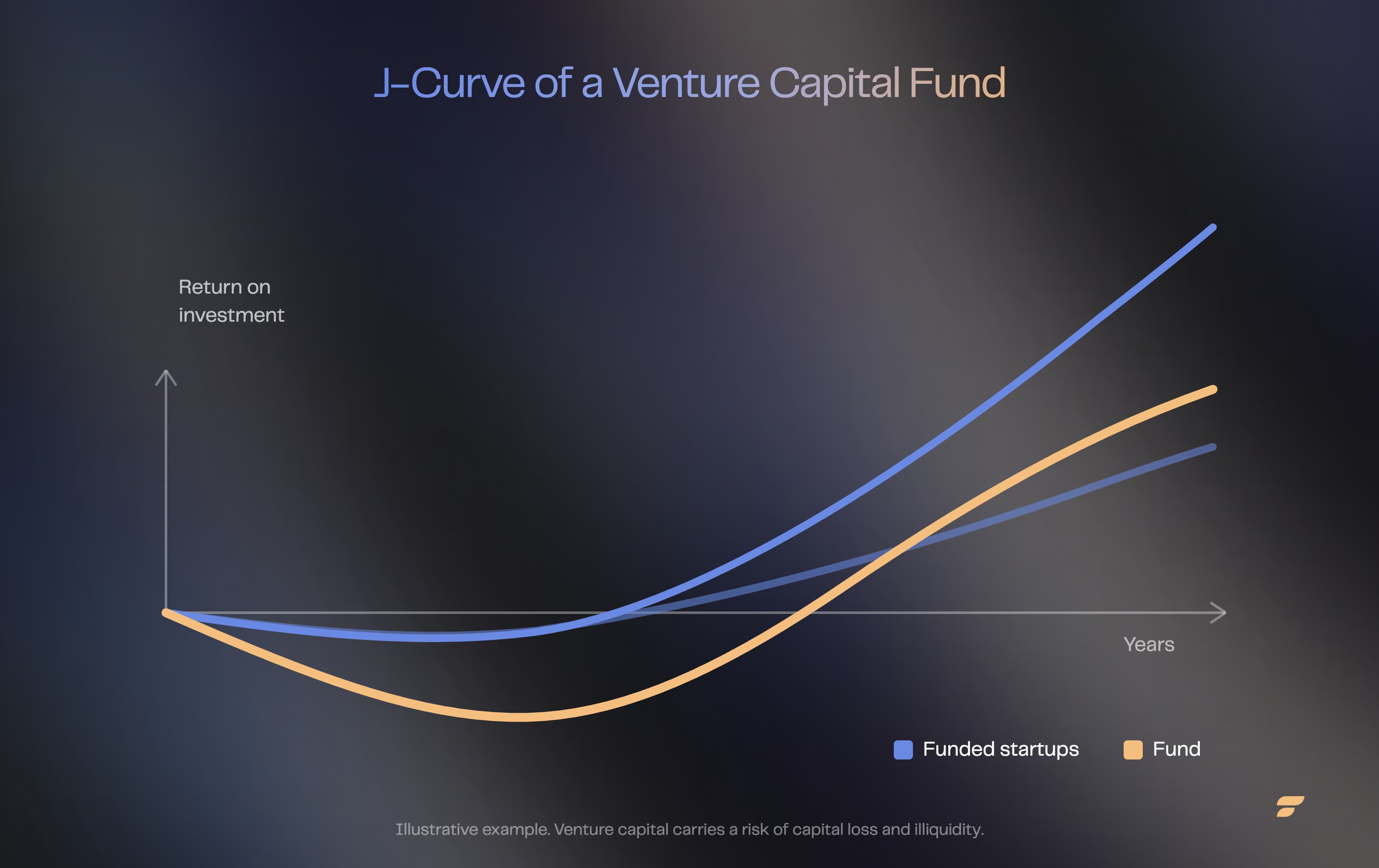
Venture capital funds invest in start-ups that have barely left the incubator, in exchange for significant equity stakes. They provide more than just funding: they offer guidance, mentorship, and access to a network. Investors become true partners, driving the company's evolution.
Venture capital stands out for its long time horizon. Results are measured over several years. Failures are common, but a single success can offset many setbacks. This "home run" logic can sometimes transform an entire portfolio. Experienced investors know that innovation takes time, tailored support, and specific safeguards.
Growth Capital: Supporting the Growth of SMEs
Growth capital accelerates expansion while keeping control in the founders' hands. The companies involved have already proven their model: they generate revenue, sometimes profit, and want to move to the next level.
The investor acts as a co-pilot, ready to finance a new factory, international expansion, or the launch of a new product line. Unlike venture capital, growth capital targets already-viable companies.
Funds bring financial resources, but also operational expertise, notably to:
- structure governance,
- optimise processes,
- recruit key talent.
This partnership combines ambition and discipline to support rapid growth.
Buyout Capital and LBOs: Optimising Mature Companies
Buyout capital, often illustrated by the LBO (Leveraged Buy-Out), is a precise type of transaction. The goal is to take over a mature, profitable company using financial leverage.
Investors buy the company, sometimes alongside the existing management team, financing part of the deal with debt. This optimises the return on equity.
An LBO is not just a financial transaction. It is also a transfer: a founder steps aside, a new team takes over, and the company reinvents itself.
Buyout funds create value by restructuring, modernising, or internationalising the company. Timing plays a key role: the exit is planned from the moment of entry, with specific targets.
Other Strategies: Turnaround Capital
Private equity also includes other types of funds and strategies that are less well known but essential. Turnaround capital targets companies in difficulty. The investor acts as a turnaround specialist, bringing capital and expertise to restructure the business, renegotiate debt, or replace management.
The goal is to put the company back on a growth path.
Other approaches are emerging, such as:
- private debt, where the investor lends directly,
- hybrid strategies combining equity and debt.
These solutions offer flexibility, tailored to specific needs. Private equity adapts to the diversity of companies and their life cycles.
Why Invest in Private Equity? Benefits and Risks
Investing in private equity can offer return potential above listed markets and diversify a portfolio, in exchange for significant illiquidity and a risk of capital loss.
The Advantages: Higher Returns and Portfolio Diversification

Private equity can offer return potential, in exchange for a high risk of capital loss and significant illiquidity. It allows investors to put money directly into the real economy, where companies grow outside the stock markets.
By supporting transformation, innovation, family business succession, or the revival of regional SMEs, this type of investment fosters sustainable growth.
According to the 2024 net performance study by France Invest (31st edition, July 2025), French private equity posted a net IRR of 12.4% per year over ten years, compared with 8.9% for the CAC 40 and 8.3% for the CAC All Tradable over the same period. Past performance is not a reliable indicator of future performance, and the risk of capital loss is real.
The diversification angle represents another important benefit. Private equity cycles move independently of listed markets. When volatility hits the CAC 40 or the Nasdaq, valuations of unlisted companies follow their own rhythm, sometimes moving against the tide.
For investors, this helps smooth out portfolio fluctuations and adds a layer of resilience. This decorrelation from the stock market protects wealth from stock market turbulence.
Lastly, private equity offers active participation in value creation. Funds do more than just buy and sell. They support, restructure, advise, and bring their expertise to companies. The investor thus becomes an indirect driver of growth, which sets this type of investment apart from simple passive management.
The Risks: Illiquidity and a Long Investment Horizon
Illiquidity is the main constraint of private equity. Investing in this sector means locking up capital for 5, 7, or even 10 years. It is not possible to sell out at will.
This constraint, often seen as a drawback, is the price to pay for access to opportunities reserved for patient investors. It encourages a long-term outlook, removed from the day-to-day swings of the markets.
The risk of capital loss remains real. Not every unlisted company succeeds. Some stagnate, others fail. Out of ten investments, one or two often generate most of the gains, while others fall short.
This asymmetry, known as the "power law", calls for rigorous diversification and careful selection of funds or projects. Caution and discipline in choosing investments are essential.
Focus on Taxation in France: IR-PME and Other Benefits
Private equity taxation in France offers benefits that are often overlooked, but the rules have changed significantly recently. The French government encourages direct investment in unlisted SMEs through the income tax reduction known as (IR-PME, known as the “loi Madelin”): 18% of the amount invested, up to €50,000 for a single person or €100,000 for a couple, per year.
Since 21 February 2026, “classic” FCPI and FIP funds no longer benefit from this tax break: only the FCPI invested in Young Innovative Companies (JEI), the FIP Corse, and the FIP Outre-mer still qualify for a 30% reduction, up to €75,000 for a single person or €150,000 for a couple for the FCPI-JEI, and up to €10,000 for the regional FIP funds. This tax support, now more narrowly targeted, can improve net returns and partly offset the illiquidity for the vehicles that remain eligible.
Another benefit concerns the exemption from capital-gains tax, subject to holding-period and reinvestment conditions. Under strict eligibility conditions, certain vehicles may also qualify for a partial or full exemption from the IFI (France's real-estate wealth tax). Tax treatment depends on each investor's individual situation; personalised tax advice is recommended.
Non-contractual document for promotional purposes. Finary One is Finary's private wealth management offer, reserved for investors with at least €1,000,000 in investable assets. Investing carries risks, including the risk of partial or total capital loss. Finary SAS — 58 rue de Monceau 75380 Paris 8 — Investment firm authorised by the ACPR no. 19283, ORIAS no. 21001279, member of AMAFI.
How Can Individual Investors in France Access Private Equity?
An individual investor can access private equity through regulated funds (FCPR, FCPI, FIP, ELTIF), online platforms, club deals, or a dedicated service like Finary One starting at €1,000,000 in investable assets.
The Investment Vehicles: FCPR, FCPI, and ELTIF
Private equity is no longer reserved for a select few. Individual investors can now invest in private equity through specific vehicles such as the FCPR, the FCPI, or the ELTIF. These structures open up a market long reserved for professionals.
The FCPR (Fonds Commun de Placement à Risques, a French risk-investment fund) allows investors to put money into unlisted companies, with a significant share of the portfolio dedicated to that segment. The FCPI (Fonds Commun de Placement dans l'Innovation, an innovation-focused fund) targets innovative companies, investing mainly in unlisted, innovative SMEs. The FIP (Fonds d'Investissement de Proximité, a regional investment fund) favours regional SMEs, for those who want to give a local dimension to their savings.
The ELTIF (European Long-Term Investment Fund) is a European fund designed to harmonise access to private equity across the continent. It offers slightly improved liquidity and rules designed to protect non-professional investors. However, the lock-up period remains long, often between 8 and 10 years.
| Vehicle | Main target | Typical entry ticket | Lock-up period | Key advantage |
|---|---|---|---|---|
| FCPR | Unlisted SMEs | €5,000 – €10,000 | 6-10 years | Diversification, tax benefits |
| FCPI | Innovative SMEs | €5,000 – €10,000 | 6-10 years | Innovation tax break |
| FIP | Regional SMEs | €5,000 – €10,000 | 6-10 years | Local focus, tax benefits |
| ELTIF | European SMEs, infrastructure | €10,000+ | 8-10 years | European framework, liquidity |
Commitment length is a key factor. Investing in private equity means locking up capital for several years. This type of investment does not suit those looking for immediate liquidity or active day-to-day management.
Platforms and Club Deals: Greater Accessibility
Digital technology has transformed access to private equity. Online investment platforms and club deals have opened this market to a new generation of investors.
Today, specialised platforms offer pooled access to funds or direct deals. The entry ticket often ranges from €1,000 to €10,000, depending on the structure. Club deals bring together a small group of investors around a specific deal. They offer personalised support and greater transparency in deal selection.
This model appeals because it lets investors pick their own deals and build a tailor-made allocation. It gives access to opportunities once reserved for large investors.
However, it calls for increased vigilance:
- Rigorous deal selection
- Understanding the risks
- In-depth review of the legal documentation
An often overlooked aspect is the human dimension. The best club deals rely on networks of experts, entrepreneurs, and experienced investors. Access to this social capital and to quality "deal flow" often makes the difference between a successful investment and a risky venture.
Private Equity and Finary One
Finary One provides a dedicated private wealth manager for portfolios starting at €1,000,000 in investable assets. A 5% to 15% allocation to private equity, with a wide dispersion between top-quartile and bottom-quartile funds according to available historical data: manager selection is a key factor. Past performance is not a reliable indicator of future performance.
- Selection of top-quartile funds (LBO, growth capital, secondaries, evergreen) with a personalised review of fees and track record.
- A dedicated private wealth manager who sizes your private equity allocation in line with your overall wealth, tax situation, and investment horizon.
- A 360° view that integrates your unlisted holdings into your overall allocation, measures consolidated net performance, and anticipates capital calls.
Learn more about Finary One → Reserved for investors with €1,000,000 or more in investable assets. Investing carries risks, including the risk of capital loss.
Private Equity: An Investment Lever Worth Understanding
Private equity turns savings into a driver of economic growth, and can offer experienced investors return prospects in exchange for a risk of capital loss and marked illiquidity.
Despite its illiquidity constraints and long-term horizon, this asset class deserves a place in a diversified wealth strategy, provided investors understand its mechanics and adapt their allocation to their financial goals.
Frequently Asked Questions
What Is the Minimum Entry Ticket to Invest in Private Equity?
Online platforms and club deals offer entry tickets from €1,000 to €10,000 depending on the structure. Retail-oriented FCPR, FCPI, and FIP funds are generally accessible from €5,000, while a dedicated service like Finary One is aimed at portfolios starting at €1,000,000 in investable assets.
How Long Does Capital Stay Locked Up in Private Equity?
The investment horizon generally runs from 5 to 10 years, sometimes longer for FCPR funds and ELTIFs. This period corresponds to the time needed to transform an unlisted company and organise its sale under good conditions.
Is Private Equity Accessible to Non-professional Investors?
Yes, through regulated vehicles such as the FCPR, FCPI, FIP, or ELTIF, as well as online platforms and club deals. These structures have democratised access to an asset class long reserved for institutional investors and family offices.
What Is the Difference Between Venture Capital and an LBO?
Venture capital funds early-stage companies with no significant revenue, carrying a high risk of failure offset by strong growth potential. An LBO (Leveraged Buy-Out) acquires mature, profitable companies using financial leverage to optimise the return on equity.
What Are the Main Risks of Private Equity?
Illiquidity is the main risk: capital stays locked up for several years with no possibility of immediate resale. On top of that comes a risk of partial or total capital loss, as some unlisted companies may stagnate or fail despite the fund's support.
Does Private Equity Still Come With a Tax Benefit in 2026?
Partially. Since 21 February 2026, only the FCPI invested in Young Innovative Companies (JEI), the FIP Corse, and the FIP Outre-mer still qualify for a 30% tax reduction. “Classic” FCPI and FIP funds no longer benefit from this advantage.
Sources
Service-public.fr, IR-PME tax reduction for subscribing to a company's capital
AFG (French Asset Management Association), practical guide to ELTIF 2.0
Wealth Club, Blackstone / Hilton Hotels case study
Regulatory disclaimers: Marketing communication. Investing carries a risk of partial or total capital loss. Past performance is not a reliable indicator of future performance. This article is provided for information and educational purposes only; it does not constitute personalised investment advice, a buy or sell recommendation, or tax advice. This investment carries a liquidity risk (no guaranteed resale, long horizon) and a risk of capital loss. Income and valuations are not guaranteed. Before investing, read the Key Information Document (KID) and, where relevant, consult an authorised adviser. Finary SAS, an investment firm authorised by the ACPR (no. 19283), member of AMAFI. Insurance broker registered with ORIAS (no. 21001279), member of the CNCGP (association approved by the AMF). Crypto-Asset Service Provider (CASP) authorised by the AMF under the MiCA regime, references no. A2026-026 and no. N2026-008.