


How to invest €500,000 in France in 2026?

Updated on 28 July 2026
To invest €500,000 in France, diversify the amount across tax-advantaged accounts (PEA, a French tax-advantaged equity savings account; life insurance; a securities account) and real estate (buy-to-let, SCPI, a French non-listed real-estate investment fund comparable to a REIT), depending on your goals, investment horizon and risk profile.
This guide details the investment options suited to a €500,000 capital and how to balance performance with security.

- No single tax-advantaged account is enough on its own: the PEA is capped at €150,000, and combining it with the PEA-PME reaches €225,000 at most.
- The securities account has no cap, but its gains are subject to the flat tax (PFU) of 31.4% since 1 January 2026.
- Life insurance combines flexibility, lighter taxation after eight years, and smoother wealth transfer of up to €152,500 per beneficiary.
- Real estate, whether direct or through SCPI, lets you use credit leverage, but its value can also fall.
- Beyond €500,000 in investable assets, dedicated wealth-planning support helps structure a tailored allocation.
Why does diversifying your investment options matter when investing €500,000?
You probably already know it: diversification is the golden rule of investing. In practice, diversifying means spreading your money across different investment options, each with its own risk and return profile. Placing €500,000 gives you the room to diversify widely, whether in real estate, stocks or other financial products.
Every investment's value moves up and down over time, with its own highs and lows. No two investments move the same way. When one stock's value falls, for example, another's may rise, driven by external events that cannot be predicted or controlled (this is the core idea behind modern portfolio theory). So in a diversified portfolio, a loss on one investment is generally offset by gains on other assets.
Diversifying your investments therefore dilutes the risk of losses, letting you combine security with performance.
To be effective, diversification should happen on several levels:
- type of investment: equities, bonds (government bonds/OAT, corporate debt), derivatives, real estate...
- investment horizon: short, medium or long term
- geographic area: for example, holding shares in both French and foreign companies
- sector: environment, commodities, banking, new technologies, real estate ETF and more.
How do you define your goals before investing €500,000?
Investing €500,000 calls for patience and judgment. It is therefore strongly recommended to use an account aggregator to track your wealth precisely. Before committing such an amount, it is also important to define your investor profile and objectives. To build a full picture, start by reviewing the following:
- Professional situation: is it stable, or likely to change in the coming years? Do you anticipate a career move (and a potential rise in income)?
- Plans: this could mean buying your primary or secondary residence, a long trip, funding your children's education, a retirement project, and so on.
- Objectives: getting the most profitable investment possible, preparing for retirement, reducing your taxes...
- Investor profile: do you favour risk or security? What return do you expect from your investment? Are you comfortable with financial products? The level of risk you accept corresponds to the amount you could potentially lose. With a long-term horizon, you might consider riskier assets, since volatility effects partly smooth out over time (without eliminating the risk of short-term ups and downs);
- Investment horizon: short term (under 3 years), medium term (3 to 8 years) or long term (8 years or more).
- Emergency fund: the amount you need to keep on hand, based on your income and personal situation.
Once you have reviewed these different points, you should have a clearer idea of your objectives as an investor. Broadly speaking, several types of goals can be distinguished:
- building an emergency fund
- building capital over the medium and long term for various projects
- reducing your taxes
Building an emergency fund
This is money you can access immediately, to fund certain projects (renovations, travel, buying a car, and so on) or cover unexpected expenses. An emergency fund therefore needs to be liquid, meaning quickly accessible. In that sense, savings accounts, a current account, or a euro fund within life insurance (offering immediate withdrawal) are all good options for holding your emergency fund.
Cutting your tax bill with a €500,000 investment
€500,000 is a substantial down payment for a property purchase. Combined with bank leverage, it could give you access to as much as €1,500,000 for a large-scale real estate project. Several tax schemes tied to real estate can also unlock tax reductions or deductions.
For example, you could buy a building in need of renovation eligible for the Malraux scheme (a tax reduction proportional to the amount of work) or several apartments to renovate in order to generate property deficits (deductible from your overall taxable income, up to €10,700 a year for 6 years). The Girardin industriel scheme can also be worth considering: the reduction can reach up to €18,000 in a single year.
Building capital over the medium or long term
This is money you place in one or more investment options with a view to a life project, near or distant. For example: investing in the stock market, buying a property, or passing wealth on to your children. You lock this money away with the aim of growing it over the years.
With that in mind, it is worth looking at the types of investment that work well for putting €500,000 to work.

Which investments should you choose to invest €500,000?
The larger the amount, the wider the range of investment options. A €500,000 capital genuinely gives you an abundance of choice. Remember: diversification is key! Such an amount also opens the door to real estate investments, a popular way to diversify your wealth (real estate remains subject to the risk of capital loss).
So you can place your €500,000 across several types of investment options:
- tax-advantaged accounts
- property-backed investments: direct real estate and 'paper' real estate (SCPI).
Tax-advantaged accounts for placing €500,000
A tax-advantaged account is a savings product that lets you benefit from tax advantages on the interest and returns it generates. There are three main families of tax-advantaged accounts:
- the equity savings plan (PEA) and its small-business counterpart, the PEA PME
- the standard securities account
- life insurance
That said, most tax-advantaged accounts are subject to a cap beyond which no further tax benefit applies, or no further contributions are allowed. Placing €500,000 therefore requires drawing on several tax-advantaged accounts at once to maximise your tax benefits.
The equity savings plan (PEA) for investing €500,000
The PEA is a regulated savings product capped at €150,000 that lets you build a portfolio of European equities while benefiting from a full exemption on capital gains and investment income from the 5th year onward. It can hold shares, investment funds (UCITS) or ETFs (Exchange Traded Funds) eligible for the PEA. It is a medium- to long-term investment: any withdrawal before five years closes the PEA.
So you will not be able to place the full €500,000 in a PEA. That said, if you want to invest in the stock market and acquire shares in small and medium-sized businesses, you can combine the PEA and PEA PME for a combined cap of €225,000.
The securities account, the standard investment portfolio
A securities account lets you hold securities such as shares, bonds or fund units, as well as more speculative derivative products.
Its advantage: it comes with no threshold and no cap. On the other hand, it does not offer favourable taxation: according to service-public.gouv.fr, the flat tax (PFU) of 31.4% applies (12.8% income tax and 18.6% social contributions since 1 January 2026). This option suits investors who want to manage a wide range of financial products themselves, with frequent short-term trading (buying and selling financial assets).
Life insurance, a diversified investment and wealth-transfer tool
Life insurance is a key account for placing part of your €500,000. It has no cap on contributions and gives access to both the euro fund (capital protected by the insurer) and unit-linked funds (equities, ETFs, SCPI, private equity), which carry a risk of capital loss. Its taxation eases after eight years of holding, with an annual allowance of €4,600 for a single person (€9,200 for a couple) on gains withdrawn. It is also a powerful wealth-transfer tool: capital passed on death benefits from a €152,500 allowance per beneficiary, for premiums paid before age 70.
within reach
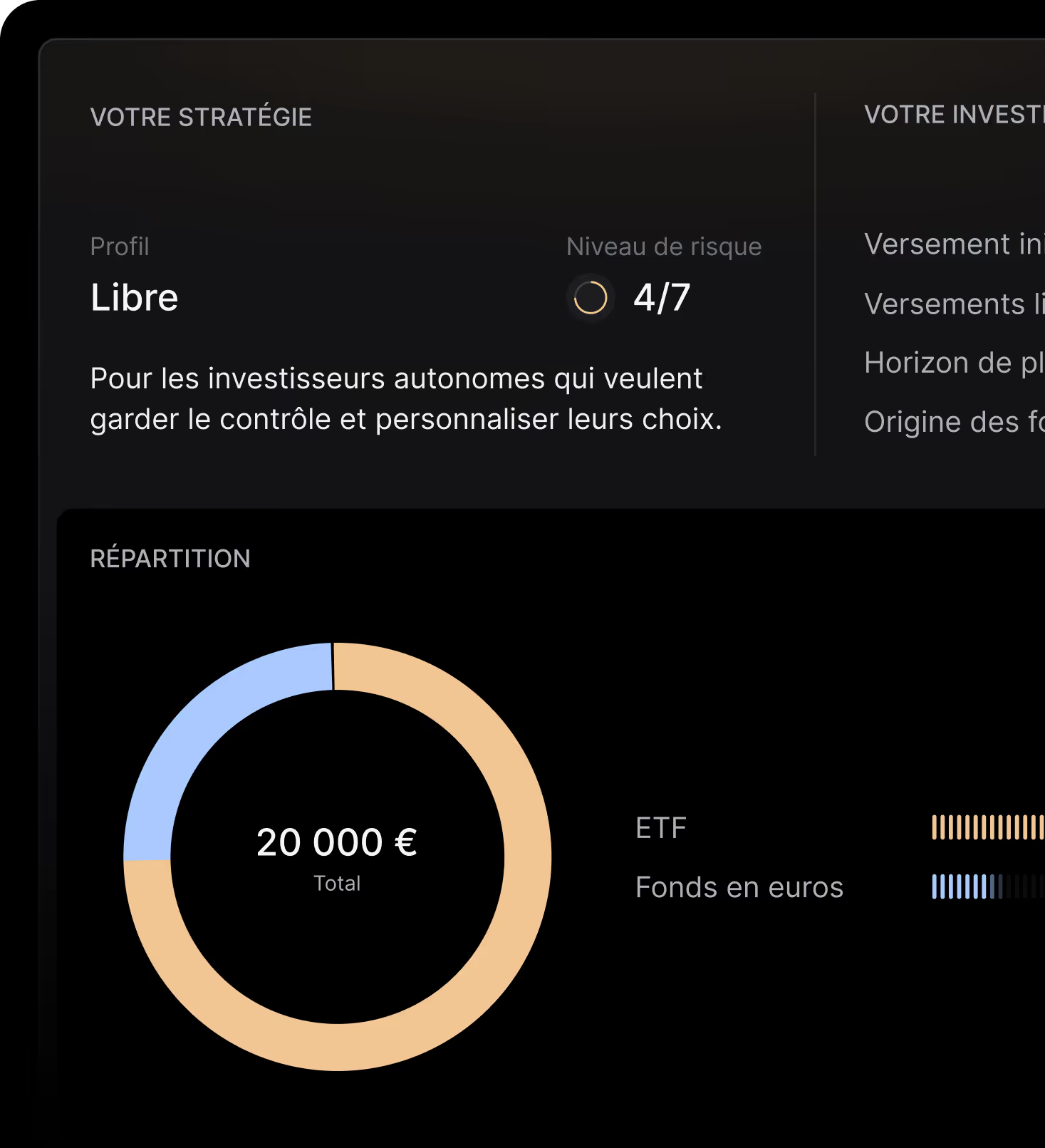
Non-contractual document for promotional purposes. Investment in unit-linked vehicles carries a risk of capital loss, since their value is subject to fluctuation, both upwards and downwards, depending in particular on developments in the financial markets. The insurer commits to the number of unit-linked units, not their value, which it does not guarantee. This life insurance policy is an individual life insurance policy, denominated in euros and/or unit-linked vehicles, underwritten by Generali Vie, a company governed by the French Insurance Code. Finary SAS — 58 rue de Monceau 75380 Paris 8 — Investment Firm authorised by the ACPR under no. 19283, ORIAS no. 21001279, member of AMAFI.
Placing your €500,000 in property-backed investments
It's no secret: investing in property is an excellent way to generate immediate or future passive income. With €500,000, buy-to-let investing is well within reach. But you could also choose to invest in an SCPI (Société civile de placement immobilier). SCPIs are companies that invest directly in real estate assets: retail units, clinics, offices, and so on. When you invest in an SCPI, you receive shares that entitle you to rental income in proportion to your stake. Returns can be significant, but the value of SCPI shares, like that of physical property, can rise or fall depending on market conditions.
The notable advantage of real estate investing lies in the ability to use leverage (a bank loan) to boost your returns. Because real estate is considered a moderate-risk asset, it is one of the few investments that can be financed in whole or in part with a bank loan.
This feature opens up a genuine range of possibilities for your €500,000. You can invest more and amplify your returns (as well as your potential losses) while benefiting from the tax reductions specific to certain real estate investments.
For your €500,000, real estate therefore lets you pursue a dual objective:
- building capital over the medium/long term that can generate an income stream;
- reducing the tax on your other sources of income.
Investing €1,000,000 with Finary One
Finary One is designed precisely for wealth starting at €1,000,000 in investable assets. The approach: build a diversified, tailor-made allocation combining private equity, Luxembourg life insurance, real estate and cash, within a full 360° view of your wealth.
- A wealth allocation built by a dedicated wealth manager, following a full audit of your existing assets and objectives (income, wealth transfer, long-term performance).
- Access to asset classes usually out of reach for an individual investor (tier-1 private equity funds, Luxembourg life insurance FAS/FID (Fonds d'Assurance Spécialisé / Fonds Interne Dédié, i.e. specialised/dedicated internal insurance funds), and Lombard lending backed by your portfolio).
- A single platform that consolidates your entire wealth in real time and makes it easier to rebalance your allocation with your dedicated wealth manager.
Learn more about Finary One → Reserved for investors with €1,000,000 or more in investable assets. Investing carries risks, including the risk of capital loss.
Frequently asked questions
How much can a €500,000 investment return?
Impossible to say with precision: each investment option has a different return potential. As a general rule, the higher the risk, the higher the potential return. As a rough guide, returns vary by investment option, risk profile and market conditions, and no return is guaranteed.
How can you invest €500,000 in the stock market?
To invest €500,000 in the stock market, you can go through a PEA (capped at €150,000) or life insurance with unit-linked funds. You can also use a securities account or online brokers such as DeGiro, staying mindful of transaction fees.
How can you invest €500,000 for the short term?
For the short term, a life insurance euro fund and savings accounts limit the risk of loss. Unless you are willing to take on risk, equity investments are not recommended on a horizon of under three years.
How much does €500,000 invested return per month?
This mainly depends on the risk accepted. Historically, a diversified equity investment has delivered around 7 to 8% average annual return over the long term (before fees and tax), or roughly €3,300 per month for €500,000, with no guarantee and a risk of capital loss.
Sources
Service-public.gouv.fr: taxation of savings and investment income (PFU 31.4% in 2026)
Service-public.gouv.fr: equity savings plan (PEA), €150,000 cap
Impots.gouv.fr: life insurance taxation (allowances after 8 years and wealth transfer)
Impots.gouv.fr: property deficit deductible from overall income (€10,700 cap)
Economie.gouv.fr: Girardin tax reduction
Regulatory disclaimers: Marketing communication. Investing carries a risk of partial or total capital loss. Past performance is not a reliable indicator of future performance. This article is provided for information and educational purposes only; it does not constitute personalised investment advice, a buy or sell recommendation, or tax advice. Before investing, read the Key Information Document (KID) and, where relevant, consult an authorised adviser. Finary SAS, an investment firm authorised by the ACPR (no. 19283), member of AMAFI. Insurance broker registered with ORIAS (no. 21001279), member of the CNCGP (association approved by the AMF). Crypto-Asset Service Provider (CASP) authorised by the AMF under the MiCA regime, references no. A2026-026 and no. N2026-008.