


Target Maturity Bond Fund

Updated on 8 July 2026.
Thomas sold his small business last year. In his account, a figure he had never seen before: seven figures, net, the fruit of twenty years of work. And one sentence from his banker keeps replaying in his head: “With this fund, you know your return in advance.”
You might be in the same position. A business sale, corporate cash to invest, a defensive pocket to build, and this product presented to you as the perfect compromise between a euro fund that no longer pays much and stocks that feel too risky.
A target maturity bond fund (also called a fixed-maturity fund or dated bond fund) does show a target return known from the moment you subscribe: the manager buys a basket of bonds and holds them until a fixed date, 2028, 2030. But “fixed in advance” has never meant “guaranteed”. The real question, the one almost nobody digs into before signing, is what happens if an issuer in the basket defaults.
In our video “Investing €1 Million”, Thomas, who has just sold his business, puts around €1 million of his Protection pocket into a target maturity bond fund: the coupons feed his cash flow while the rest of his wealth works elsewhere. That is exactly the mechanism we break down here.
 Investing in a target maturity bond fund carries a risk of capital loss, particularly in the event of an issuer default or an exit before maturity. Past performance and target returns are not a reliable indicator of future performance.
 - A target maturity bond fund (or fixed-maturity fund, dated bond fund) buys a basket of bonds and holds them until a fixed maturity date, often 2028 to 2030.
- The portfolio's actuarial yield (the yield to maturity, YTM) is known at subscription: it is a return target, not a guaranteed return.
- The main risk is the default risk of one or more issuers: a default cuts into the return, and potentially into part of the capital.
- Liquidity is limited: the product is designed to be held until maturity. An early exit happens at the market net asset value, which can be below par if rates have risen.
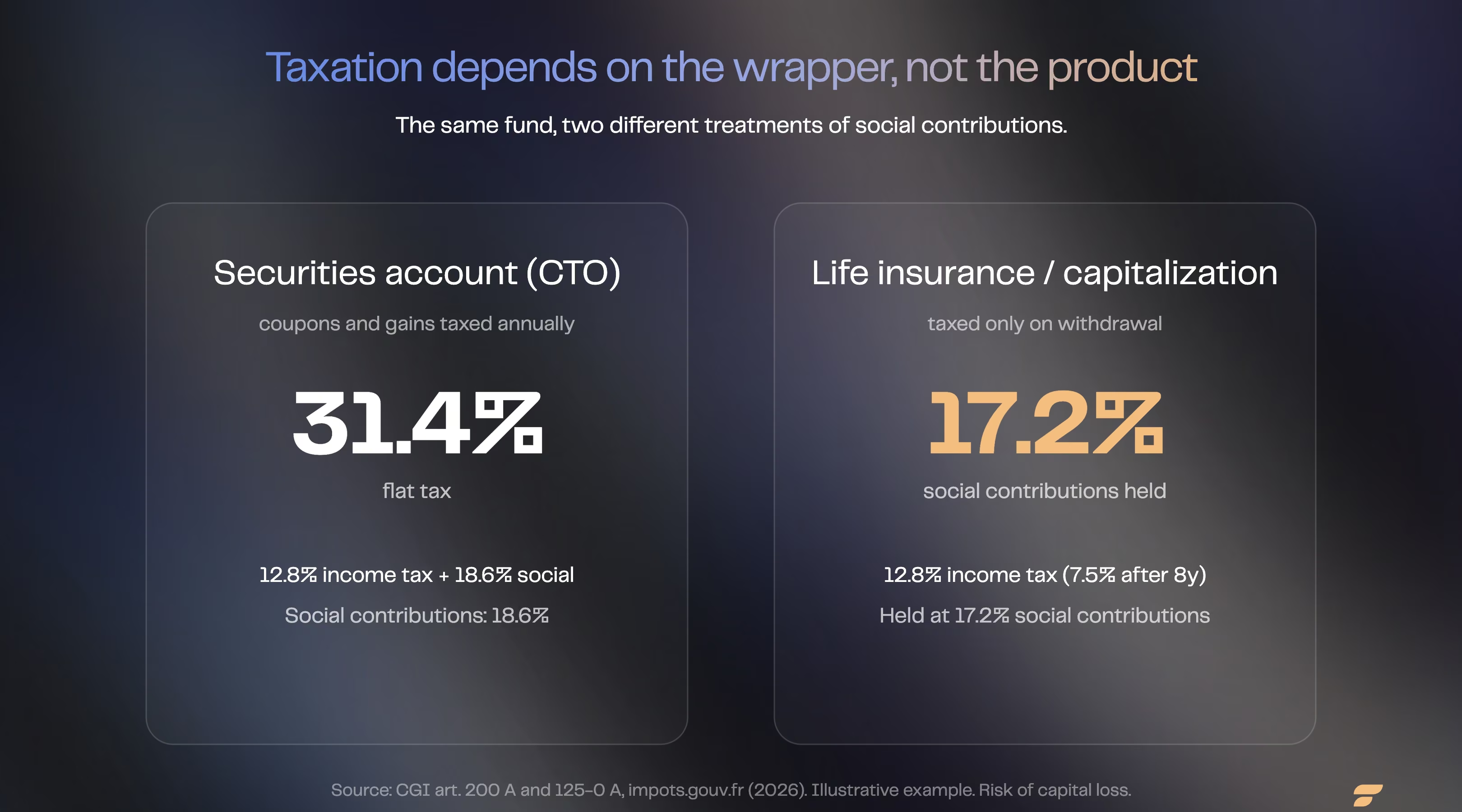
- Taxation depends on the wrapper it is held in, not on the product itself: in a securities account, coupons and capital gains are subject to the 31.4% flat tax; in life insurance or a capitalization contract, tax only applies on withdrawal, with social security contributions held at 17.2%.
What is a target maturity bond fund (or fixed-maturity fund)?
A target maturity bond fund is a fund that buys a basket of bonds and holds them until a fixed maturity, instead of trading them continuously. It is also called a fixed-maturity fund or a dated bond fund.
A useful reminder in one sentence: a bond is a loan. You lend to a company or a government, which pays you interest, the coupon, and repays you on a set date. A target maturity fund applies that logic to around a hundred issuers at once.
Legally, a bond remains a debt claim, not a promise of return. The French Monetary and Financial Code defines it this way: “Bonds are negotiable securities which, within a single issue, confer the same claim rights for the same nominal value” (art. L. 213-5). A claim right depends on the issuer's ability to repay, which is never guaranteed in advance.
The mechanics unfold in three stages. The manager builds the portfolio during a marketing window, often limited to a few months. The fund then “carries” these bonds, collecting the coupons year after year. At the announced maturity, the bonds come due, get repaid, and the fund becomes liquid: everyone gets their share back.
This structure is what sets a dated bond fund apart from a conventional bond fund. A conventional fund runs indefinitely, its value moves with interest rates, and you never know when you are “exiting” at a good price. A target maturity fund, by contrast, has a finish line. And it is that finish line that makes the return predictable.
Investment grade or high yield? The basket often mixes highly rated corporate bonds (investment grade) with riskier but better-paid bonds (high yield). The higher the high-yield share, the higher the target return climbs, but the higher the default risk climbs too. The rate on offer is never free: it is the price of the risk taken. For comparison, investing directly in bonds exposes you to a single issuer; a dated fund spreads that risk across dozens of lines.

Why do people talk about a return “fixed in advance”?
People talk about a return fixed in advance because the portfolio's actuarial yield, its yield to maturity (YTM), can be calculated from the moment you subscribe. But that figure is a target, not a promise.
Here is the manager's reasoning. Each bond in the basket has a known purchase price, coupon and repayment date. Aggregating this data gives the portfolio's theoretical return if everything goes as planned: no issuer defaults, and the fund is held to the end. That is the figure, often expressed as a range, that the salesperson quotes you.
The word that changes everything is “if”. The actuarial yield assumes zero defaults. And that is precisely what nobody can guarantee. According to the AMF, a product whose performance is presented as almost inevitable is a warning sign: no bond coupon can be presented as already secured.
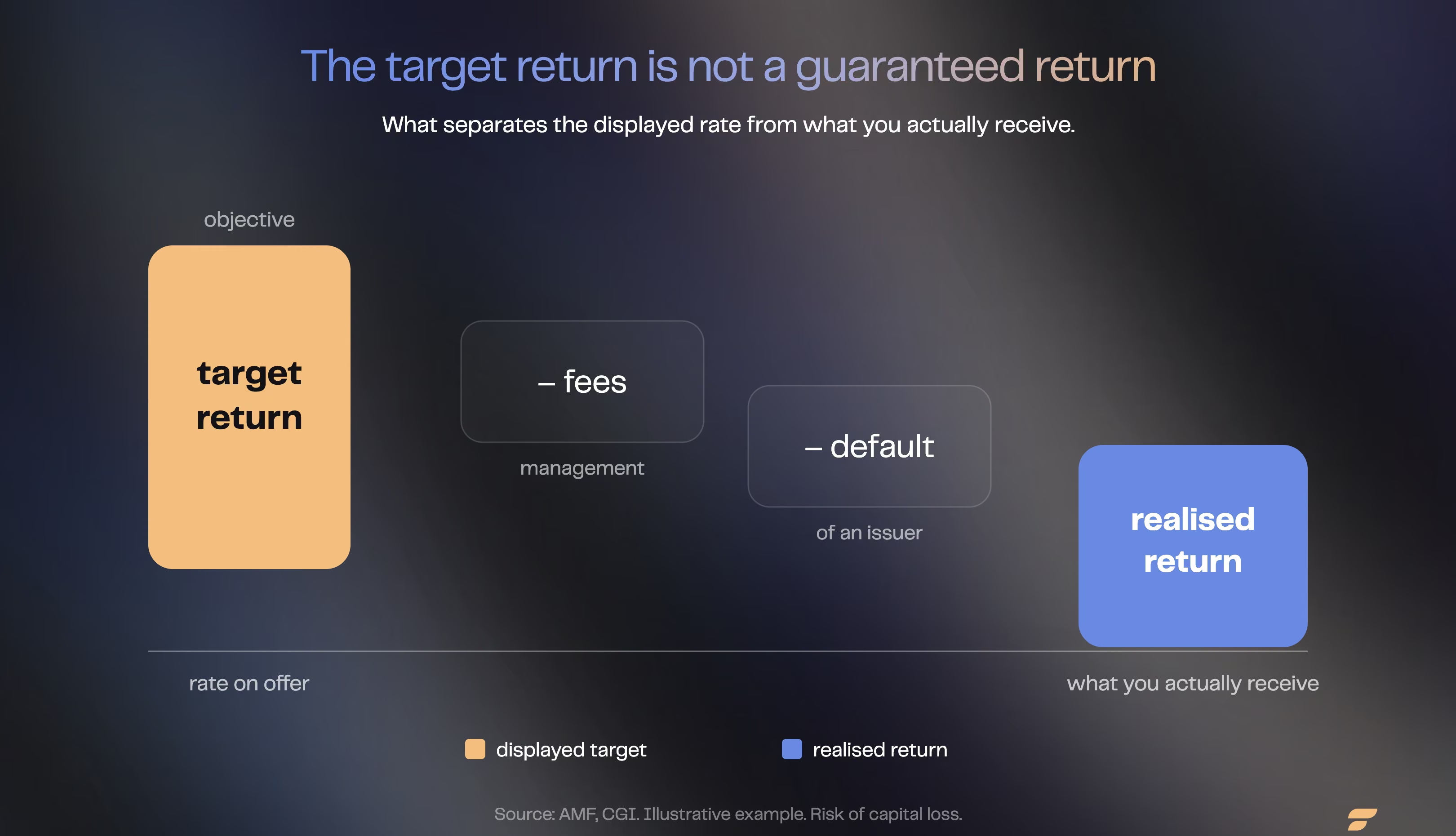
The difference between a target and a guarantee is paid for when a default happens. If an issuer in the basket fails to repay, the fund takes a loss on that line. The realised return then falls below the target return. On a highly diversified portfolio, one isolated default eats up a few tenths of a point. On a basket concentrated in high yield, a wave of defaults can turn a positive target return into a disappointing performance, or even a loss. The same issuer-risk logic applies to structured products: a debt security is only worth as much as the strength of whoever issues it.
Two other frictions eat into the gap between the rate on the label and what you actually receive.
- Management fees. The target return is sometimes quoted gross. The fund's annual fees, often around 1%, are deducted from it. On a fund targeting 4%, one point of fees takes away a quarter of the return.
- Interest rate risk before maturity. As long as you hold to the end, it does not concern you. But if you need to exit early, you sell at the market value of the moment. If rates have risen since you entered, that value can be lower than your initial stake.
What are the risks of a target maturity bond fund?
The main risks are an issuer default, illiquidity until maturity, interest rate risk on early exit, and the erosion of returns by fees. No target maturity fund escapes these four points.
Let's go through them one by one, without sugarcoating.
- Default risk, or credit risk. This is risk number one. Each bond in the basket is a bet on the issuer's ability to repay. A default cuts into the return; a series of defaults can eat into the capital. That is the price paid for a return above a euro fund.
- Illiquidity. The fund is designed to be held until maturity. Your horizon is the stated date, 2028 or 2030. Tying up a sum for several years is not neutral: that money is not available if something unexpected comes up.
- Interest rate risk before maturity. If you sell your units before the term, you receive the market net asset value. A rise in rates since your subscription mechanically pushes that value down. Exiting early can therefore be costly.
- The marketing window. These funds can only be subscribed to during a limited period, while the manager builds the basket. Once that window closes, access happens on the secondary market, on different terms.
A target maturity bond fund is therefore not a euro fund. A euro fund offers a capital guarantee, but a lower return. A target maturity fund aims for a higher return, in exchange for a real risk of capital loss. These are two different building blocks within the same defensive pocket, not substitutes. To place this product among other controlled-risk options, see our overview of limited-risk investments.
How is a target maturity bond fund taxed?
The taxation of a target maturity bond fund depends on the wrapper you hold it in, not on the product itself. The same fund is not taxed the same way depending on whether it sits in a securities account or in life insurance.
That is the principle to remember before any choice. Three main wrappers, three different logics.
In a securities account (CTO). Coupons, which count as investment income, and capital gains on disposal are subject to the 31.4% flat tax, made up of 12.8% income tax (CGI art. 200 A) and 18.6% social security contributions (the general rate for securities since 2026, source impots.gouv.fr). You can opt for the progressive income tax scale if it is more favourable, but that election then applies to all of your investment income for the year.
In life insurance or a capitalization contract. Here, one point changes everything: as long as you do not withdraw, the gains are not taxed. Tax only applies at the time of withdrawal. The flat-rate levy is 12.8%, reduced to 7.5% after eight years for the portion corresponding to net premiums of €150,000 or less (CGI art. 125-0 A), with an annual tax allowance of €4,600 for a single person, €9,200 for a couple. A point that is often misunderstood: social security contributions stay at 17.2% on life insurance and capitalization contracts, an exception maintained even though the general rate for securities rose to 18.6%. For how the wrapper works in full, see our guide to life insurance.
A capitalization contract held by a holding company subject to corporate tax. A useful specificity for anyone with corporate cash to put to work: a capitalization contract can be held by a company subject to corporate income tax. It is one possible wrapper for holding a bond pocket inside a corporate structure, whereas life insurance is reserved for individuals.
Two clarifications that help you avoid classic mistakes.
- The PEA is out of the picture. Bond funds are not eligible for the PEA (a French tax-advantaged equity savings account), which is reserved for European Union shares.
- The IFI does not apply. A bond fund is a debt security: held directly, it falls outside the scope of the IFI (France's real estate wealth tax). Within a life insurance unit-linked fund, only the property portion would fall within that scope, and it is zero for bond holdings.
The table below summarises the difference between wrappers.
Wrapper. Taxable event. Tax treatment of gains. Securities account (CTO). Annual coupons + capital gain on disposal. Flat tax of 31.4% (12.8% income tax + 18.6% social contributions), option for the progressive scale possible. Life insurance. Only on withdrawal. PFU of 12.8%, reduced to 7.5% after 8 years (premiums ≤ €150,000), plus social contributions of 17.2%, tax allowance of €4,600 / €9,200 after 8 years. Capitalization contract (individual). Only on withdrawal. Same regime as life insurance for income tax, plus social contributions of 17.2%. Capitalization contract (holding company subject to corporate tax). Annual flat-rate taxation under corporate tax. Depends on the company's corporate tax regime.
Illustrative example. Your actual tax treatment depends on your personal situation. Source: CGI art. 200 A, CGI art. 125-0 A, impots.gouv.fr (social security contributions, 2026).
Target maturity funds, euro funds, direct bonds, structured products: how to choose?
A target maturity fund sits between a euro fund and direct bonds: a higher targeted return than a euro fund, more diversification than a single bond, but a risk of capital loss that a euro fund does not carry. Each building block answers a different need.
- The euro fund guarantees the capital and pays a moderate return. It is the maximum-safety building block, at the cost of a lower return.
- A direct bond ties you to a single issuer: a known return, but all the credit risk rests on one name. A dated bond fund spreads that risk across dozens of lines.
- A structured product is another defensive pocket, but its logic is different: the return depends on a formula linked to an underlying asset, with conditional protection barriers. Not to be confused with the actuarial yield of a bond basket.
For substantial wealth, these building blocks are not mutually exclusive: they combine within an allocation suited to large wealth, alongside other pockets such as infrastructure funds. Within that mix, a target maturity fund plays the role of the predictable-return, defined-horizon pocket, exactly what Thomas is looking for in our video to feed his cash flow without touching the rest.
The real question is not “which product is best” but “which product for which role”. An attractive target return says nothing about the place this fund should occupy in your wealth, nor about the credit risk you are actually accepting.
The trap of a return fixed in advance is that it lulls vigilance to sleep. You remember the headline figure, 4%, 5%, and forget everything hiding behind it: the point of fees that takes away a quarter, the issuer default you will only spot in an annual report, the early exit at the wrong moment because you needed cash. None of these costs make any noise when you sign. They all get paid later, when it is too late to fix. The return is arithmetic. Knowing where to place this fund, with what credit risk and in which wrapper, is a craft.
How Finary One fits a target maturity bond fund into your wealth
Finary One starts from your overall situation, never from a single product. A target maturity bond fund only makes sense once placed within a complete allocation: how much of a defensive pocket, in which wrapper, for what horizon.
In practice, a Finary One private wealth manager carries out a wealth diagnostic, free of charge and with no obligation, across three areas:
- Protection: the life insurance beneficiary clause, the marital property regime, protecting the business owner after a sale.
- Structuring: how professional and personal wealth interact, using a holding company or a capitalization contract for corporate cash.
- Investment wrappers: the choice between a securities account, French or Luxembourg life insurance, and a capitalization contract, to place each pocket in the right spot.
The private wealth manager replaces neither your notary nor your tax lawyer: they steer the discussion between them and you, and give you a clear read on your priorities. This is an extension of the philosophy Mounir Laggoune develops in his book Investir pour être libre: an investment is only as good as the coherence of the whole. You can discover the approach on the Finary One page.
Investment advice, meanwhile, is about the long haul: a target maturity fund reaches maturity, and you then need to reinvest, rebalance, and fit it in with everything else. It is support across twenty to thirty years of decisions, not a one-off choice.
Frequently asked questions
Is a target maturity bond fund guaranteed?
No. The displayed return is an actuarial target known at subscription, not a guarantee. It assumes that no issuer in the basket defaults. A default cuts into the return, and potentially into part of the capital. Investing carries a risk of capital loss.
What is the difference between a fixed-maturity fund and a conventional bond fund?
A fixed-maturity fund (or target maturity fund) buys a basket of bonds and holds them until a fixed date, which makes its return predictable. A conventional bond fund runs with no set maturity, and its value fluctuates continuously with interest rates.
How is the return of a dated bond fund calculated?
It corresponds to the actuarial yield (yield to maturity, YTM) of the bond basket, calculated from the purchase price, coupons and repayment dates of each line, assuming the fund is held to maturity with no default. Management fees are then deducted from it.
Can a target maturity bond fund be held in a PEA?
No. Bond funds are not eligible for the PEA, which is reserved for European Union shares. They are held in a securities account, in life insurance or in a capitalization contract.
What is the tax treatment of coupons from a target maturity fund?
In a securities account, coupons are subject to the 31.4% flat tax (12.8% income tax + 18.6% social contributions). In life insurance or a capitalization contract, nothing is taxed until there is a withdrawal, after which a 12.8% levy applies (7.5% after 8 years under conditions) along with social security contributions of 17.2%.
What happens if I sell before maturity?
You sell your units at the market net asset value of the moment. If rates have risen since your subscription, that value can be lower than your initial stake: the product is designed to be held until maturity.
Is a target maturity bond fund subject to the IFI?
No. A bond fund is a debt security, outside the scope of the IFI (France's real estate wealth tax). Within a life insurance unit-linked fund, only a potential real estate portion would fall within scope, which is zero for bond holdings.
Sources
- Code monétaire et financier, art. L. 213-5 (definition of bonds)
- CGI art. 200 A (flat tax, 12.8% income tax): legifrance.gouv.fr
- CGI art. 125-0 A (life insurance taxation, 7.5% and €4,600 / €9,200 tax allowance): legifrance.gouv.fr
- impots.gouv.fr, securities and social security contributions 2026 (31.4% = 12.8% + 18.6%): impots.gouv.fr
- AMF, investor information centre (information on financial products, issuer risk, non-guaranteed returns): amf-france.org
Regulatory disclaimers:
Marketing communication. Investing carries a risk of partial or total capital loss. Past performance is not a reliable indicator of future performance. This article is informational and educational; it does not constitute personalised investment advice, a recommendation to buy or sell, or tax advice.
This investment carries a liquidity risk (resale not guaranteed, long horizon) and a risk of capital loss. Income and valuations are not guaranteed.
Before investing, read the Key Information Document (KID) and, where applicable, consult an authorised adviser.
Finary SAS, an investment firm authorised by the ACPR under no. 19283, member of AMAFI. Insurance broker registered with ORIAS under no. 21001279, member of the CNCGP (association approved by the AMF). Crypto-Asset Service Provider (CASP) authorised by the AMF under the MiCA regime, under references no. A2026-026 and no. N2026-008.